
Visto un uccello? Identificalo all'istante con l'app Birdby
Apri l'appInformazioni
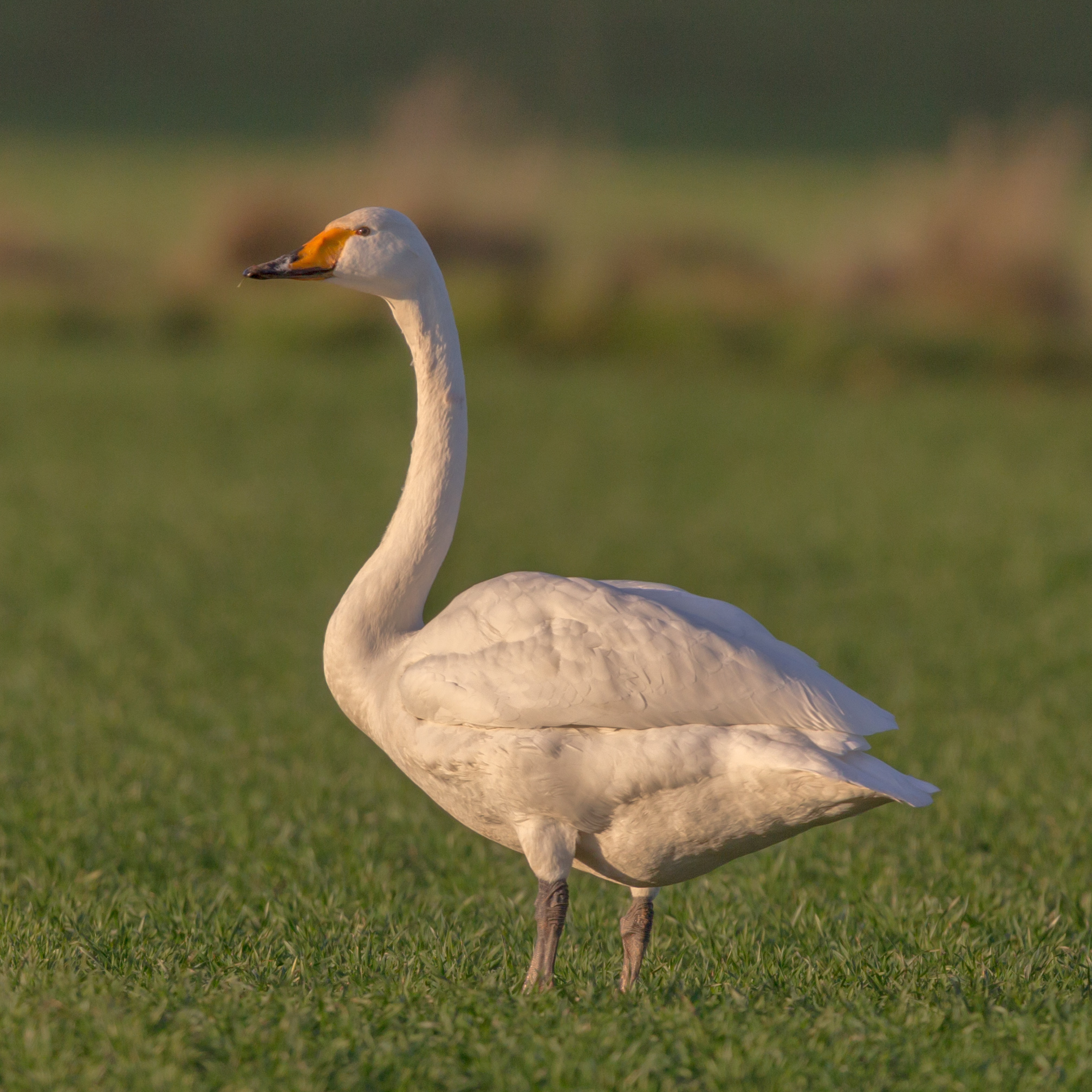
The Whooper Swan is a large, elegant waterfowl species, renowned for its striking yellow and black bill and loud, bugling calls. It is a migratory bird, breeding in the Arctic and subarctic regions of Eurasia and wintering further south. It is one of the heaviest flying birds and a prominent symbol of wild wetlands.
Dimensioni e longevità
- Lunghezza
- 140-165 cm (55-65 in)
- Apertura alare
- 205-275 cm (81-108 in)
- Peso
- 7.4-14 kg (16-31 lb), males typically larger than females
- Longevità
- Up to 10-15 years in the wild, with records of over 20 years
- Dieta
- Herbivore
Caratteristiche fisiche
- Piumaggio
- Adults are entirely pure white. Juveniles have greyish-brown plumage, particularly on the head and neck, which gradually whitens over their first year.
- Forma del becco
- Large, wedge-shaped bill. Adults have a distinctive pattern of yellow and black: the basal half is bright yellow, extending to a point on the culmen, while the distal half and tip are black. Juveniles have a pinkish-grey bill with a black tip, gradually developing the adult coloration.
- Colore degli occhi
- Dark brown
- Colore delle zampe
- Black
- Caratteristiche distintive
- The most distinctive feature is the large yellow and black bill pattern. Unlike the Mute Swan, it holds its neck straight and lacks a knob at the base of the bill. Its calls are also very distinctive.
- Aspetto giovanile
- Juveniles are greyish-brown, especially on the head and neck, with a pinkish-grey bill that has a black tip. Their plumage gradually whitens, and the bill develops adult coloration over their first year.
- Cambiamenti stagionali
- No significant seasonal plumage changes in adults; they remain white year-round. Juveniles transition from grey-brown to white over their first year.
- Dimorfismo sessuale
- Males (cobs) are generally larger and heavier than females (pens), but plumage is identical.
Come identificare
- 1
Bill Pattern
Look for the distinctive large yellow patch on the basal half of the bill, which extends to a point on the culmen, contrasting sharply with the black tip. This is the most reliable field mark for adults.
- 2
Neck Posture
Observe how the swan holds its neck. Whooper Swans typically hold their neck straight and erect, unlike the S-curve of the Mute Swan.
- 3
Vocalizations
Listen for the loud, bugling, trumpet-like 'whoop-whoop' calls, especially in flight or when disturbed. This is a key differentiator from the silent Mute Swan.
- 4
Size
Note its large size, though it can be confused with other large swans. Use bill pattern and calls for definitive identification.
- 5
Juvenile Plumage
Young Whooper Swans are greyish-brown with a pinkish-grey bill and black tip, gradually whitening and developing the adult bill pattern over their first year.
Habitat e areale
- Biomi
- Tundra, taiga, temperate wetlands, freshwater lakes, rivers, marshes, coastal lagoons, estuaries, agricultural fields (during winter).
- Areale geografico
- Breeds across the Arctic and subarctic regions of Eurasia, from Iceland and Scandinavia eastward through Russia to the Pacific. Winters in temperate Europe, the Black Sea and Caspian Sea regions, Central Asia, China, Korea, and Japan.
- Fascia altitudinale
- Primarily lowlands, from sea level up to a few hundred meters, especially in breeding and wintering grounds.
- Ambienti preferiti
- Shallow, nutrient-rich freshwater bodies with abundant aquatic vegetation for feeding. During winter, they also utilize coastal areas and flooded agricultural land.
Comportamento
- Periodo di attività
- Diurnal, active during daylight hours for feeding and other activities.
- Abitudini alimentari
- Primarily herbivorous, feeding on aquatic vegetation such as submerged plants, roots, tubers, and seeds. They dabble and up-end in shallow water to reach food. In winter, they may graze on agricultural crops like winter wheat and potatoes.
- Comportamento sociale
- Highly social, especially outside the breeding season, forming large flocks on wintering grounds. During breeding, they are territorial and typically found in isolated pairs or small family groups.
- Tipo di volo
- Powerful, direct flight with slow, deliberate wingbeats. They fly with their necks outstretched. Often fly in V-formations or in long, undulating lines during migration. Their wings produce a characteristic 'whooping' sound in flight.
- Migrazione
- Long-distance migratory bird. Breeds in the Arctic and subarctic during summer and migrates south to temperate regions for winter. Migration occurs in large flocks, often at high altitudes.
- Territorialità
- Strongly territorial during the breeding season, defending their nesting sites and surrounding feeding areas from other swans and waterfowl. Less territorial on wintering grounds, where they gather in large, often mixed-species, flocks.
Canto e richiami
- Canto
- The Whooper Swan's 'song' is not a melodic song in the typical sense but rather a series of loud, resonant, bugling calls. These calls are often described as 'whoop-whoop-whoop' or 'hoo-hoo-hoo', carrying long distances.
- Richiamo
- The primary call is a loud, far-carrying, bugling 'whoop' or 'honk', often given in a series. These calls are used for communication within flocks, during flight, and as alarm calls. They are distinctively resonant and trumpet-like.
- Quando vocalizza
- Vocalizes frequently, especially during flight, when communicating with flock members, and as an alarm. More vocal than the Mute Swan.
Riproduzione
- Stagione riproduttiva
- May to July, depending on latitude and ice melt.
- Abitudini di nidificazione
- Nests are large mounds of vegetation (grasses, moss, sedges, reeds) built on small islands, hummocks, or dense vegetation near water. Both parents contribute to nest building.
- Dimensione della covata
- Usually 4-7 eggs, but can range from 3 to 9.
- Descrizione dell'uovo
- Typically 4-7 eggs, dull white or creamy, sometimes stained brown. Large, oval-shaped.
- Periodo di incubazione
- 35-42 days, primarily by the female, while the male guards the nest.
- Periodo di involo
- 60-70 days. Cygnets are precocial and can swim and feed shortly after hatching, but remain with parents for several months, often through their first winter.
- Cure parentali
- Both parents care for the young (cygnets). They are highly protective and will aggressively defend their offspring. Cygnets stay with their parents for their first winter migration.
Dove trovarlo
Wetlands and Lakes
Look for them on large, shallow freshwater lakes, reservoirs, and slow-moving rivers, especially those with extensive aquatic vegetation.
Coastal Areas
During winter, they can be found in coastal lagoons, estuaries, and sheltered bays.
Agricultural Fields
In winter, they often feed in flooded fields, stubble fields, and pastures, sometimes in large flocks.
Arctic and Subarctic Tundra
During the breeding season, they inhabit remote tundra pools and slow-flowing rivers in northern regions.
Consigli sul campo
- Listen for Calls. Their loud, bugling calls are often heard before the birds are seen, especially during migration or when large flocks are present.
- Scan Water Bodies. Use binoculars or a scope to scan large expanses of water for their distinctive white plumage and bill pattern.
- Observe Feeding Behavior. Watch for them dabbling or up-ending in shallow water, indicating feeding activity.
- Check Wintering Grounds. Visit known wintering sites, such as nature reserves and protected wetlands, where large numbers often congregate.
- Look for Family Groups. During late summer and autumn, look for family groups with greyish-brown cygnets accompanying the white adults.
Specie simili
Mute Swan
Cygnus olor
The Mute Swan has an orange bill with a prominent black knob at the base (larger in males), and typically holds its neck in an S-curve with the bill pointed downwards. It is largely silent, only hissing when disturbed. Whooper Swans have a yellow and black bill, hold their neck straight, and are very vocal with bugling calls.
Tundra Swan (Bewick's Swan)
Cygnus columbianus bewickii
The Tundra Swan (Bewick's Swan in Eurasia) is smaller than the Whooper Swan. Its bill also has a yellow and black pattern, but the yellow patch is typically smaller and more rounded, not extending to a point on the culmen as in the Whooper Swan. The black area on the bill is more extensive in Bewick's. Calls are similar but generally higher-pitched and less resonant than the Whooper Swan's.
Fatti rapidi
- Wingspan:
- Up to 2.75 meters (9 feet)
- Weight:
- One of the heaviest flying birds, up to 14 kg (31 lbs)
- Bill Color:
- Distinctive yellow and black pattern
- Vocalization:
- Loud, bugling 'whoop' calls
- Migration:
- Long-distance migrant, often in V-formations
Curiosità
- The Whooper Swan is the national bird of Finland.
- Its scientific name, 'Cygnus cygnus', is a tautonym, meaning the genus and species names are the same, reflecting its iconic status as 'the swan'.
- Whooper Swans form strong pair bonds that often last for life.
- They are known to fly at considerable altitudes during migration, sometimes reaching several thousand meters.
- The 'whooping' sound of their wings in flight is a characteristic feature, giving them their common name.
Classificazione scientifica
- Regno
- Animalia
- Phylum
- Chordata
- Classe
- Aves
- Ordine
- Anseriformes
- Famiglia
- Anatidae
- Genere
- Cygnus
- Specie
- Cygnus cygnus
Esplora Whooper Swan
Identifica uccelli ovunque
Gratis su iOS, Android e Web. Identificazione per foto e suono, database completo e la tua lista personale.