
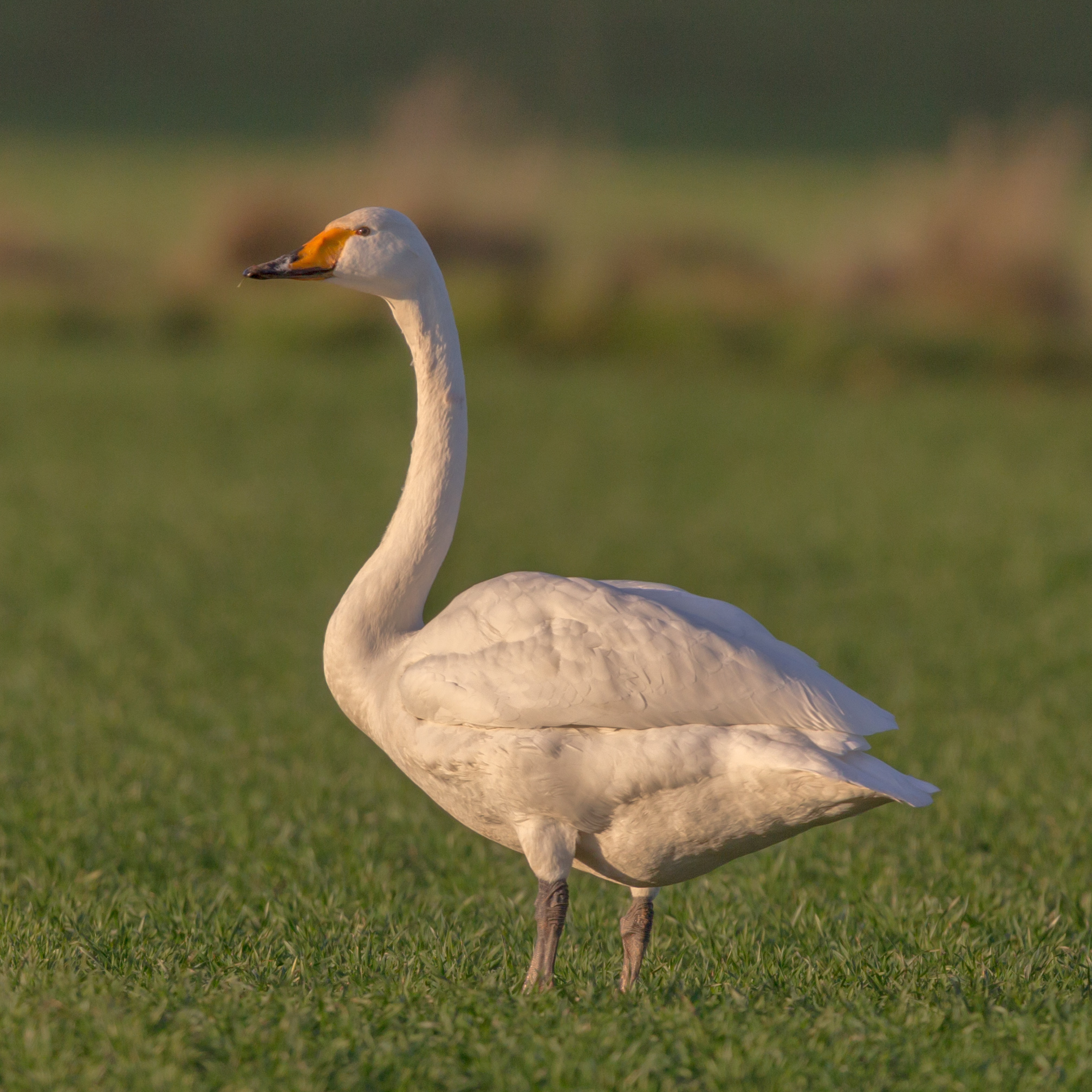
Come identificare Whooper Swan
Cygnus cygnus
Visto un uccello? Identificalo all'istante con l'app Birdby
Apri l'appPer identificare correttamente Whooper Swan (Cygnus cygnus), controlla ciascuna di queste caratteristiche. Gli uccelli possono essere complicati da riconoscere, perché comportamento, habitat e canto spesso confermano ciò che una sola foto non può.
Dimensioni a colpo d'occhio
- Lunghezza
- 140-165 cm (55-65 in)
- Apertura alare
- 205-275 cm (81-108 in)
- Peso
- 7.4-14 kg (16-31 lb), males typically larger than females
Caratteristiche fisiche da controllare
- 1
Piumaggio
Colorazione e disegno generale del piumaggio.
Adults are entirely pure white. Juveniles have greyish-brown plumage, particularly on the head and neck, which gradually whitens over their first year.
- 2
Forma del becco
Forma e colore del becco, un segno di campo chiave.
Large, wedge-shaped bill. Adults have a distinctive pattern of yellow and black: the basal half is bright yellow, extending to a point on the culmen, while the distal half and tip are black. Juveniles have a pinkish-grey bill with a black tip, gradually developing the adult coloration.
- 3
Colore degli occhi
Colore dell'iride e segni distintivi sugli occhi.
Dark brown
- 4
Colore delle zampe
Colore di zampe e piedi.
Black
- 5
Caratteristiche distintive
Tratti distintivi che separano questa specie.
The most distinctive feature is the large yellow and black bill pattern. Unlike the Mute Swan, it holds its neck straight and lacks a knob at the base of the bill. Its calls are also very distinctive.
- 6
Aspetto giovanile
Come i giovani si differenziano dagli adulti.
Juveniles are greyish-brown, especially on the head and neck, with a pinkish-grey bill that has a black tip. Their plumage gradually whitens, and the bill develops adult coloration over their first year.
- 7
Cambiamenti stagionali
Variazione del piumaggio tra stagione riproduttiva e non.
No significant seasonal plumage changes in adults; they remain white year-round. Juveniles transition from grey-brown to white over their first year.
- 8
Dimorfismo sessuale
Differenze tra maschi e femmine.
Males (cobs) are generally larger and heavier than females (pens), but plumage is identical.
Segni di campo chiave
- Bill Pattern. Look for the distinctive large yellow patch on the basal half of the bill, which extends to a point on the culmen, contrasting sharply with the black tip. This is the most reliable field mark for adults.
- Neck Posture. Observe how the swan holds its neck. Whooper Swans typically hold their neck straight and erect, unlike the S-curve of the Mute Swan.
- Vocalizations. Listen for the loud, bugling, trumpet-like 'whoop-whoop' calls, especially in flight or when disturbed. This is a key differentiator from the silent Mute Swan.
- Size. Note its large size, though it can be confused with other large swans. Use bill pattern and calls for definitive identification.
- Juvenile Plumage. Young Whooper Swans are greyish-brown with a pinkish-grey bill and black tip, gradually whitening and developing the adult bill pattern over their first year.
Esplora Whooper Swan
Identifica uccelli ovunque
Gratis su iOS, Android e Web. Identificazione per foto e suono, database completo e la tua lista personale.