
Visto un uccello? Identificalo all'istante con l'app Birdby
Apri l'appInformazioni
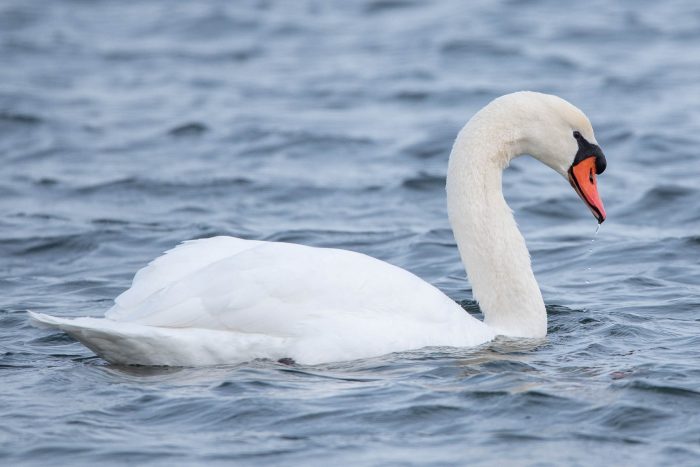
The Mute Swan (Cygnus olor) is a large species of swan, a member of the waterfowl family Anatidae. It is native to much of Eurasia, and an introduced species in North America, Australasia, and southern Africa. It is easily recognizable by its all-white plumage, long S-curved neck, and a prominent orange bill with a black knob at the base, which is larger in males.
Dimensioni e longevità
- Lunghezza
- 125-170 cm (49-67 in)
- Apertura alare
- 200-240 cm (79-94 in)
- Peso
- 8.3-12.2 kg (18-27 lb) for males, 6.8-11.2 kg (15-25 lb) for females, with exceptional individuals reaching up to 23 kg (51 lb)
- Longevità
- Up to 20 years in the wild, typically 10-12 years
- Dieta
- Herbivore, primarily aquatic vegetation, supplemented by small invertebrates and grains
Caratteristiche fisiche
- Piumaggio
- Adults are entirely pure white. Juveniles (cygnets) are typically grey-brown, gradually turning white over their first year, though a rare 'Polish' morph is white from hatching.
- Forma del becco
- Large, wedge-shaped bill, bright orange with a black tip and a prominent black knob (cere) at the base. The knob is noticeably larger and more pronounced in males (cobs) than in females (pens), especially during the breeding season.
- Colore degli occhi
- Dark brown
- Colore delle zampe
- Blackish-grey
- Caratteristiche distintive
- The most distinctive features are the S-shaped curve of the neck, the orange bill with a black knob, and the characteristic 'snorting' or 'hissing' sound it makes when disturbed, rather than a true vocal call. When swimming, it often holds its neck in a graceful S-curve with the bill pointed downwards.
- Aspetto giovanile
- Cygnets are typically covered in grey-brown down, with a dull greyish-pink bill that gradually darkens to black and then develops the adult orange and black coloration. They attain adult white plumage by their second year.
- Cambiamenti stagionali
- No significant seasonal plumage changes in adults. The size of the black knob on the male's bill can be more pronounced during the breeding season.
- Dimorfismo sessuale
- Males (cobs) are generally larger and heavier than females (pens) and have a significantly larger black knob on their bill, especially during the breeding season. Otherwise, plumage is identical.
Come identificare
- 1
Neck Posture
Look for the distinctive S-shaped curve of the neck, often with the head held low and the bill pointed downwards, especially when swimming. Other swan species typically hold their necks straighter.
- 2
Bill Color and Knob
Identify the bright orange bill with a black tip and a prominent black knob (cere) at the base. The size of this knob is a good indicator of sex (larger in males).
- 3
Plumage
Adults are entirely pure white. Juveniles are grey-brown.
- 4
Vocalization
Listen for the characteristic 'hissing' or 'snorting' sounds when disturbed, and the loud, rhythmic 'singing' or 'thrumming' sound produced by their wings in flight. The absence of loud, bugling calls distinguishes it from other swan species.
- 5
Behavior
Observe its territorial displays, such as arching its wings over its back (busking display) and hissing, especially during the breeding season.
Habitat e areale
- Biomi
- Freshwater wetlands, lakes, ponds, slow-moving rivers, estuaries, and coastal lagoons.
- Areale geografico
- Native to temperate Europe and Asia, from the UK and Scandinavia eastwards across Russia to China. Introduced populations exist in North America (primarily the Great Lakes region and Atlantic coast), Australia, New Zealand, and South Africa.
- Fascia altitudinale
- Typically found at low elevations, from sea level up to a few hundred meters, associated with water bodies.
- Ambienti preferiti
- Shallow, nutrient-rich waters with abundant aquatic vegetation. They prefer areas with emergent vegetation for nesting and shelter, often near human habitation in parks and urban waterways.
Comportamento
- Periodo di attività
- Diurnal, active during daylight hours.
- Abitudini alimentari
- Primarily grazes on submerged aquatic vegetation, reaching it by dabbling or up-ending. They also feed on emergent plants, grasses on banks, and occasionally small invertebrates, tadpoles, and insects. In urban areas, they readily accept bread and other human handouts, though this is not ideal for their health.
- Comportamento sociale
- Typically seen in pairs or small family groups. Outside the breeding season, they may form larger flocks, especially in wintering areas or where food is abundant. They can be highly territorial and aggressive, particularly during nesting, defending their territory against other swans, waterfowl, and even humans.
- Tipo di volo
- Powerful, direct flight with slow, deep wing beats that produce a distinctive, loud 'singing' or 'thrumming' sound, audible from a considerable distance. They require a long run-up on water to become airborne.
- Migrazione
- Many populations are largely resident, especially in milder climates or where food is consistently available. Northern and eastern European/Asian populations are migratory, moving south and west for the winter. Introduced populations are generally resident.
- Territorialità
- Highly territorial during the breeding season. Pairs will aggressively defend their nesting site and surrounding feeding areas from intruders, often displaying with raised wings and hissing.
Canto e richiami
- Canto
- The Mute Swan is largely silent, hence its name. It does not have a true song.
- Richiamo
- The most common vocalizations are a series of snorts, grunts, and hisses, particularly when agitated or defending territory. The wings produce a distinctive, resonant 'singing' or 'thrumming' sound in flight, which is a key identification feature.
- Quando vocalizza
- Vocalizations (hisses, snorts) are primarily heard when the bird is disturbed, threatened, or during territorial disputes. The wing sound is constant during flight.
Riproduzione
- Stagione riproduttiva
- Typically March to June, varying with geographic location.
- Abitudini di nidificazione
- Nests are large mounds of reeds, rushes, grasses, and other vegetation, built on or near water, often on small islands or dense emergent vegetation. Both sexes participate in nest building, with the female doing most of the incubation.
- Dimensione della covata
- Typically 5-8 eggs, but can range from 3 to 10.
- Descrizione dell'uovo
- Large, oval, smooth, and dull, initially pale greenish-blue or buff, fading to dirty white. Average size is about 112 x 74 mm.
- Periodo di incubazione
- 35-41 days, primarily by the female.
- Periodo di involo
- Cygnets are precocial and can swim and feed shortly after hatching. They fledge (become capable of sustained flight) at 120-150 days (4-5 months), remaining with their parents for several months, often through their first winter.
- Cure parentali
- Both parents care for the cygnets, protecting them fiercely. Cygnets often ride on their parents' backs, especially when young or crossing open water.
Dove trovarlo
Urban Parks and Lakes
Commonly found in city parks, ornamental lakes, and ponds where they are often accustomed to human presence.
Slow-moving Rivers and Canals
Look for them in calm sections of rivers, canals, and backwaters with ample aquatic vegetation.
Estuaries and Coastal Lagoons
In some regions, they can be found in brackish water environments, especially during winter.
Wetland Reserves
Protected wetland areas and nature reserves with suitable freshwater habitats are excellent places to observe them in a more natural setting.
Consigli sul campo
- Look for the S-curve. The S-shaped neck is the most reliable field mark for a Mute Swan, especially when swimming.
- Observe the bill. The orange bill with a black knob is unique among swans in its native range. Note the size of the knob to potentially distinguish sex.
- Listen for wing sounds. Even if you can't see them clearly, the loud, rhythmic 'singing' sound of their wings in flight is unmistakable.
- Be cautious during breeding season. Mute Swans can be very aggressive when nesting or with cygnets. Maintain a respectful distance.
- Check for cygnets. During late spring and summer, look for grey-brown cygnets accompanying the white adults.
Specie simili
Whooper Swan
Cygnus cygnus
The Whooper Swan has a straight neck, a yellow and black bill (more yellow than black), and lacks the prominent black knob at the base of the bill. It is also highly vocal, with a loud, bugling call.
Tundra Swan (Bewick's Swan)
Cygnus columbianus
The Tundra Swan (including Bewick's Swan) is smaller than the Mute Swan, has a straight neck, and a bill that is predominantly black with a variable patch of yellow at the base (less yellow than Whooper Swan). It also lacks the black knob and is vocal, with a higher-pitched, yelping call.
Trumpeter Swan
Cygnus buccinator
The Trumpeter Swan is similar in size but has a completely black bill (no orange or knob) and a straight neck. It is also very vocal, with a deep, resonant 'trumpet-like' call.
Fatti rapidi
- Common Name:
- Mute Swan
- Scientific Name:
- Cygnus olor
- Family:
- Anatidae
- Conservation Status:
- Least Concern
- Diet:
- Herbivore (aquatic vegetation)
- Distinguishing Feature:
- S-curved neck, orange bill with black knob
- Flight Sound:
- Loud, thrumming or 'singing' wings
Curiosità
- Despite its name, the Mute Swan is not entirely mute; it produces a variety of hisses, snorts, and grunts, and its wings make a distinctive 'singing' sound in flight.
- Mute Swans are one of the heaviest flying birds, with some males weighing over 20 kg (44 lbs).
- In the UK, all unmarked Mute Swans in open waters are traditionally considered property of the Crown, a custom dating back to the 12th century.
- Cygnets often ride on their parents' backs, especially when crossing open water or when tired, a charming sight for observers.
- The 'busking' display, where a swan arches its wings over its back, is a territorial display used to intimidate rivals or perceived threats.
Classificazione scientifica
- Regno
- Animalia
- Phylum
- Chordata
- Classe
- Aves
- Ordine
- Anseriformes
- Famiglia
- Anatidae
- Genere
- Cygnus
- Specie
- Cygnus olor
Esplora Mute Swan
Identifica uccelli ovunque
Gratis su iOS, Android e Web. Identificazione per foto e suono, database completo e la tua lista personale.