
Visto un uccello? Identificalo all'istante con l'app Birdby
Apri l'appInformazioni
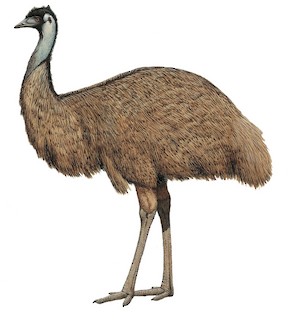
The Emu is the second-largest living bird by height, endemic to Australia. It is a flightless bird, characterized by its long neck and legs, and shaggy brown plumage. Emus are highly nomadic, often traveling long distances to find food and water, and play a significant ecological role as seed dispersers.
Dimensioni e longevità
- Lunghezza
- 150-190 cm (59-75 in)
- Apertura alare
- Approximately 80-100 cm (31-39 in) (vestigial wings)
- Peso
- 18-60 kg (40-132 lb)
- Longevità
- 10-20 years in the wild, up to 30 years in captivity
- Dieta
- Omnivore (primarily herbivorous)
Caratteristiche fisiche
- Piumaggio
- Adult Emus have shaggy, coarse, brown to grey-brown plumage, which provides excellent camouflage in their varied habitats. The feathers are double-shafted, giving them a hair-like appearance. The head and neck are sparsely feathered, revealing bluish-black skin.
- Forma del becco
- Short, broad, and flattened beak, dark grey to black in color, adapted for grazing and plucking vegetation.
- Colore degli occhi
- Brown eyes, often appearing dark.
- Colore delle zampe
- Strong, thick, and scaly legs, grey to black in color, with three forward-pointing toes.
- Caratteristiche distintive
- Large size, flightless, long neck and legs, shaggy brown plumage, bluish-black skin on the head and neck, vestigial wings.
- Aspetto giovanile
- Chicks are striped with black and white or dark brown longitudinal bands, which provide camouflage. As they grow, these stripes fade, and they gradually develop the adult's shaggy brown plumage. Subadults may retain some faint striping.
- Cambiamenti stagionali
- No significant seasonal plumage changes. The density of feathers may vary slightly with temperature, but the overall coloration remains consistent.
- Dimorfismo sessuale
- Females are typically slightly larger and heavier than males, especially during the breeding season. During courtship, females may display a more prominent, darker blue patch on their head and neck. Vocalizations also differ, with females producing a deeper booming call.
Come identificare
- 1
Size and Shape
Look for a very large, flightless bird with a long neck and legs, and a distinctive shaggy, somewhat disheveled appearance due to its double-shafted feathers.
- 2
Plumage
The overall color is a dull brown to grey-brown. The head and neck are sparsely feathered, revealing bluish-black skin, which can be a key identifier, especially in good light.
- 3
Legs and Feet
Observe the thick, powerful, grey-black legs with three forward-pointing toes. Emus are built for running.
- 4
Behavior
Watch for their characteristic running gait, often with a swaying motion of the body. They are usually seen foraging on the ground, pecking at vegetation.
- 5
Vocalizations
Listen for the deep, resonant booming call, particularly from females, and the grunting sounds from males during the breeding season.
Habitat e areale
- Biomi
- Grasslands, woodlands, savannas, mallee scrub, and semi-arid regions.
- Areale geografico
- Mainland Australia, widespread across most of the continent, avoiding densely populated areas and dense rainforests.
- Fascia altitudinale
- Sea level to approximately 1500 meters (5000 feet).
- Ambienti preferiti
- Open plains, eucalyptus woodlands, and areas with a mix of grasses, shrubs, and trees, often near water sources.
Comportamento
- Periodo di attività
- Diurnal, most active during the day, particularly in the early morning and late afternoon.
- Abitudini alimentari
- Primarily herbivorous, feeding on a wide variety of native and introduced plants, including seeds, fruits, flowers, young shoots, and roots. They also consume insects (e.g., caterpillars, grasshoppers) and small vertebrates when available. They swallow small stones (gastroliths) to aid digestion.
- Comportamento sociale
- Generally solitary or found in pairs, though they can form temporary flocks of varying sizes (sometimes hundreds) in response to food availability or during migration. They are not highly territorial outside of the breeding season.
- Tipo di volo
- Flightless. Emus are cursorial birds, meaning they are adapted for running. They can run at speeds up to 50 km/h (31 mph) with a long, powerful stride.
- Migrazione
- Nomadic, not migratory in the traditional sense. They undertake opportunistic movements in response to rainfall and food availability, often traveling long distances across their range.
- Territorialità
- Males establish and defend a nesting territory during the breeding season. Outside of breeding, they are not strongly territorial.
Canto e richiami
- Canto
- Emus do not have a song. Their vocalizations are primarily calls.
- Richiamo
- The most distinctive call is a deep, resonant booming sound, produced by inflating a cervical air sac. Females typically produce a deeper, louder boom than males. Males also emit a grunting sound, especially during courtship and when brooding. Chicks make whistling calls.
- Quando vocalizza
- Vocalizations are most frequent during the breeding season, with females booming to attract mates and males grunting during nesting duties. Booming can also be heard at other times, particularly at dawn and dusk.
Riproduzione
- Stagione riproduttiva
- Typically May to August (winter in Australia), but can vary depending on rainfall and food availability.
- Abitudini di nidificazione
- The male builds a simple, shallow nest on the ground, usually in a sheltered spot among tussocks of grass, shrubs, or under a low tree. The nest is made of grass, leaves, bark, and sticks.
- Dimensione della covata
- 5-15 eggs, with an average of 9-10. Multiple females may lay eggs in the same nest.
- Descrizione dell'uovo
- Large, dark green to almost black, thick-shelled eggs. They are oval-shaped and have a granular texture.
- Periodo di incubazione
- Approximately 56 days (8 weeks). The male solely incubates the eggs, rarely leaving the nest to feed or drink.
- Periodo di involo
- Chicks are precocial and leave the nest shortly after hatching. They remain with the male for 5-18 months, learning foraging skills and protection.
- Cure parentali
- The male Emu is solely responsible for incubation and raising the chicks. He becomes highly protective and aggressive towards intruders during this period.
Dove trovarlo
National Parks and Reserves
Many national parks and wildlife reserves across mainland Australia offer excellent opportunities to see Emus, such as the Flinders Ranges National Park (South Australia), Mungo National Park (New South Wales), and various parks in Western Australia and Queensland.
Agricultural and Pastoral Lands
Emus are often found in open agricultural areas and pastoral lands, particularly where there are patches of native vegetation and access to water. Always observe from a distance and respect private property.
Semi-arid and Arid Zones
These birds thrive in the vast, open landscapes of Australia's interior, where they can be seen foraging and moving across the plains.
Consigli sul campo
- Time of Day. Emus are most active during the cooler parts of the day, early morning and late afternoon, when they are typically foraging.
- Look for Movement. Their large size makes them relatively easy to spot, but their brown plumage can blend into the landscape. Look for movement in open areas or along tree lines.
- Water Sources. In drier regions, Emus will congregate near waterholes or dams, especially during hot periods.
- Listen for Calls. Their distinctive booming call can carry over long distances, helping to locate them even when they are out of sight.
- Roadside Sightings. Emus are frequently seen along roadsides in rural and remote areas. Drive cautiously and be aware of their presence, as they can be unpredictable.
Specie simili
Southern Cassowary
Casuarius casuarius
Cassowaries are found in rainforests of northeastern Australia and New Guinea, not the open habitats of Emus. They are smaller, have a distinctive bony casque on their head, bright blue and red wattles on their neck, and black, stiff plumage. Their legs have a dagger-like claw on the inner toe.
Ostrich
Struthio camelus
Ostriches are native to Africa and are significantly larger than Emus. They have long, bare necks, black and white plumage (males), and only two toes on each foot. Their eggs are also much larger and white.
Fatti rapidi
- Native to:
- Australia
- Flight Status:
- Flightless
- Diet Type:
- Omnivore (primarily herbivore)
- Incubation by:
- Male only
- Top Speed:
- 50 km/h (31 mph)
Curiosità
- The Emu is depicted on the Australian coat of arms, alongside the Red Kangaroo.
- Emu oil, derived from their fat, has been traditionally used by Indigenous Australians for its anti-inflammatory properties and is now used in cosmetics and health products.
- Emus have a nictitating membrane (a transparent third eyelid) that they can use to clear dust from their eyes, especially useful in arid environments.
- Despite being flightless, Emus have vestigial wings, each with a small claw at the tip.
- The male Emu undergoes a significant physiological change during incubation, losing a substantial amount of weight as he rarely leaves the nest to feed.
Classificazione scientifica
- Regno
- Animalia
- Phylum
- Chordata
- Classe
- Aves
- Ordine
- Casuariiformes
- Famiglia
- Dromaiidae
- Genere
- Dromaius
- Specie
- Dromaius novaehollandiae
Esplora Emu
Identifica uccelli ovunque
Gratis su iOS, Android e Web. Identificazione per foto e suono, database completo e la tua lista personale.