
Come identificare Emu
Dromaius novaehollandiae
Visto un uccello? Identificalo all'istante con l'app Birdby
Apri l'appPer identificare correttamente Emu (Dromaius novaehollandiae), controlla ciascuna di queste caratteristiche. Gli uccelli possono essere complicati da riconoscere, perché comportamento, habitat e canto spesso confermano ciò che una sola foto non può.
Dimensioni a colpo d'occhio
- Lunghezza
- 150-190 cm (59-75 in)
- Apertura alare
- Approximately 80-100 cm (31-39 in) (vestigial wings)
- Peso
- 18-60 kg (40-132 lb)
Caratteristiche fisiche da controllare
- 1
Piumaggio
Colorazione e disegno generale del piumaggio.
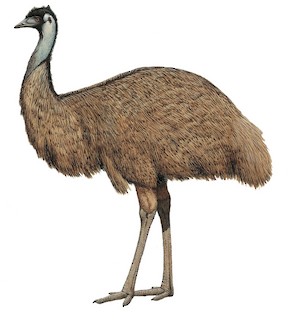
Adult Emus have shaggy, coarse, brown to grey-brown plumage, which provides excellent camouflage in their varied habitats. The feathers are double-shafted, giving them a hair-like appearance. The head and neck are sparsely feathered, revealing bluish-black skin.
- 2
Forma del becco
Forma e colore del becco, un segno di campo chiave.
Short, broad, and flattened beak, dark grey to black in color, adapted for grazing and plucking vegetation.
- 3
Colore degli occhi
Colore dell'iride e segni distintivi sugli occhi.
Brown eyes, often appearing dark.
- 4
Colore delle zampe
Colore di zampe e piedi.
Strong, thick, and scaly legs, grey to black in color, with three forward-pointing toes.
- 5
Caratteristiche distintive
Tratti distintivi che separano questa specie.
Large size, flightless, long neck and legs, shaggy brown plumage, bluish-black skin on the head and neck, vestigial wings.
- 6
Aspetto giovanile
Come i giovani si differenziano dagli adulti.
Chicks are striped with black and white or dark brown longitudinal bands, which provide camouflage. As they grow, these stripes fade, and they gradually develop the adult's shaggy brown plumage. Subadults may retain some faint striping.
- 7
Cambiamenti stagionali
Variazione del piumaggio tra stagione riproduttiva e non.
No significant seasonal plumage changes. The density of feathers may vary slightly with temperature, but the overall coloration remains consistent.
- 8
Dimorfismo sessuale
Differenze tra maschi e femmine.
Females are typically slightly larger and heavier than males, especially during the breeding season. During courtship, females may display a more prominent, darker blue patch on their head and neck. Vocalizations also differ, with females producing a deeper booming call.
Segni di campo chiave
- Size and Shape. Look for a very large, flightless bird with a long neck and legs, and a distinctive shaggy, somewhat disheveled appearance due to its double-shafted feathers.
- Plumage. The overall color is a dull brown to grey-brown. The head and neck are sparsely feathered, revealing bluish-black skin, which can be a key identifier, especially in good light.
- Legs and Feet. Observe the thick, powerful, grey-black legs with three forward-pointing toes. Emus are built for running.
- Behavior. Watch for their characteristic running gait, often with a swaying motion of the body. They are usually seen foraging on the ground, pecking at vegetation.
- Vocalizations. Listen for the deep, resonant booming call, particularly from females, and the grunting sounds from males during the breeding season.
Esplora Emu
Identifica uccelli ovunque
Gratis su iOS, Android e Web. Identificazione per foto e suono, database completo e la tua lista personale.