
Visto un uccello? Identificalo all'istante con l'app Birdby
Apri l'appInformazioni
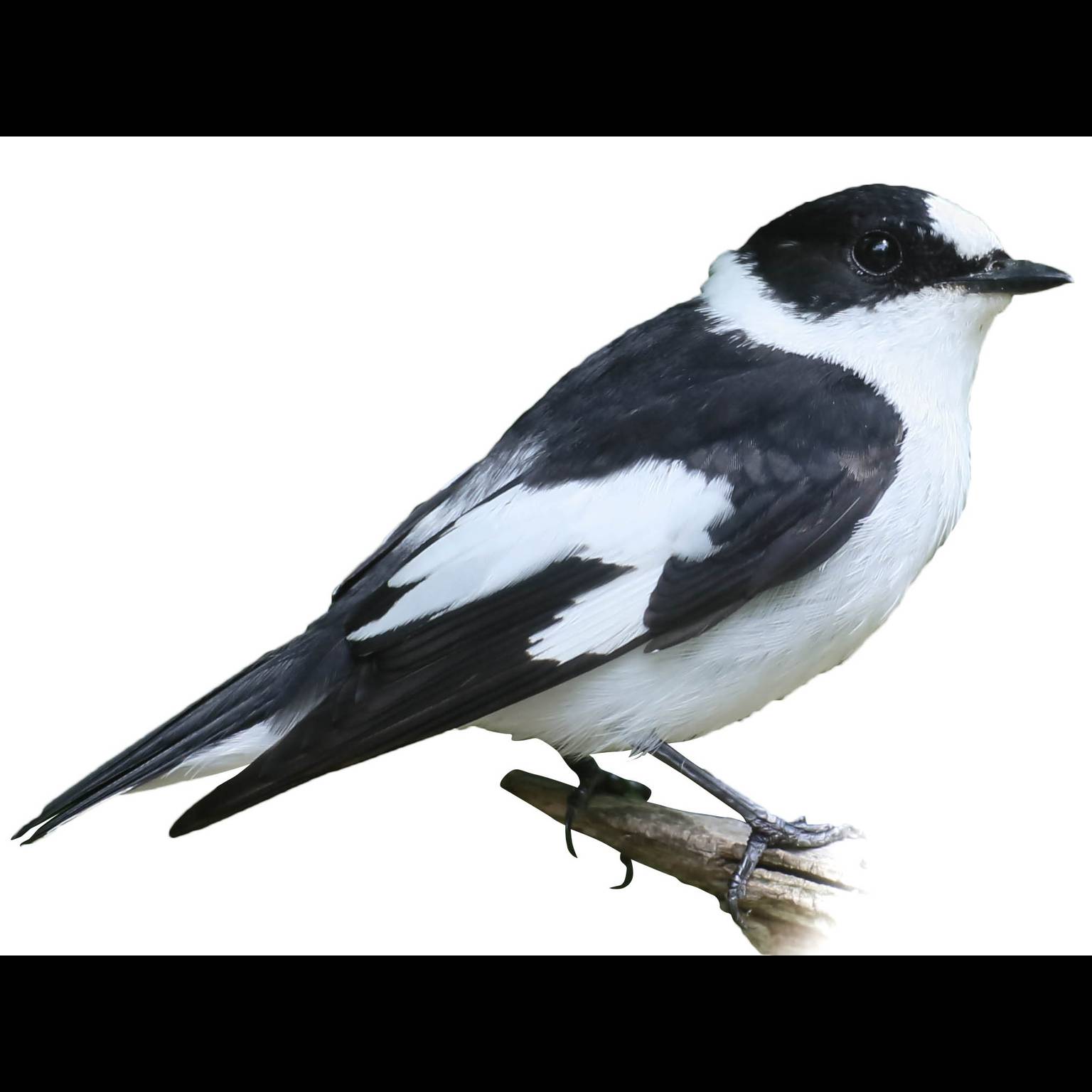
The Collared Flycatcher is a small, migratory passerine bird belonging to the Old World flycatcher family. It is known for its striking black and white plumage in males, particularly the prominent white collar, and its insectivorous diet. It breeds in deciduous and mixed forests across central and eastern Europe and migrates to sub-Saharan Africa for the non-breeding season.
Dimensioni e longevità
- Lunghezza
- 12-13.5 cm
- Apertura alare
- 22-24 cm
- Peso
- 10-15 g
- Longevità
- 2-5 years (up to 8 years recorded)
- Dieta
- Insectivore
Caratteristiche fisiche
- Piumaggio
- Adult breeding male: Glossy black upperparts, pure white underparts, large white wing patch, and a distinctive broad white collar extending from the nape around the sides of the neck. Adult breeding female: Dull brown-grey upperparts, whitish underparts, smaller and duller white wing patch, and often a faint pale collar or none at all. Non-breeding males resemble females but retain some blackish feathers and a larger white wing patch.
- Forma del becco
- Small, pointed, and slightly flattened at the base, adapted for catching insects in flight. Black in color.
- Colore degli occhi
- Dark brown
- Colore delle zampe
- Blackish-grey
- Caratteristiche distintive
- The most distinctive feature of the breeding male is the prominent white collar. Both sexes have a noticeable white patch on the wing. They often perch upright and sally out to catch insects.
- Aspetto giovanile
- Juveniles are mottled brown above with pale spots, and buffy-white below with dusky streaking. They lack the distinct white collar and wing patch of adults, appearing more like a duller, streaked version of the female.
- Cambiamenti stagionali
- Breeding males have striking black and white plumage. After breeding, males undergo a post-nuptial molt and become duller, resembling females but often retaining some blackish tones and a larger white wing patch. Females show less dramatic seasonal changes, remaining largely dull brown-grey.
- Dimorfismo sessuale
- Pronounced sexual dimorphism in breeding plumage. Males are strikingly black and white with a clear white collar, while females are duller brown-grey and white, lacking the prominent collar and having less extensive white on the wings.
Come identificare
- 1
Male Breeding Plumage
Look for the striking black upperparts and pure white underparts. The key feature is the broad, complete white collar extending around the nape and sides of the neck. Also note the large white patch on the wing.
- 2
Female/Non-breeding Male Plumage
These are duller, with brown-grey upperparts and whitish underparts. Look for a noticeable, though smaller, white wing patch. Females may show a faint pale collar or none at all. Non-breeding males retain some blackish tones and a larger white wing patch than females.
- 3
Song
Listen for the distinctive, slow, and melodious 'tsi-tsi-tsee-tsee-tsee-tsee-tsee-tsee' song, which is less varied and more repetitive than the Pied Flycatcher's. It often has a 'hiccup' quality.
- 4
Behavior
Observe its foraging behavior: perching upright on a branch, then making short, agile sallies to catch insects in mid-air before returning to a perch.
Habitat e areale
- Biomi
- Temperate broadleaf and mixed forests, woodlands, parks, orchards.
- Areale geografico
- Breeds in central and eastern Europe, from France and Germany eastward to Russia and Ukraine, and south to the Balkans. Winters in sub-Saharan Africa, primarily in the miombo woodlands of southeastern Africa.
- Fascia altitudinale
- Typically found from sea level up to 1,000 meters, occasionally higher in mountainous regions.
- Ambienti preferiti
- Prefers mature deciduous or mixed forests with an open understory, especially those with old trees providing suitable nesting holes. Also found in large parks, avenues, and orchards with mature trees.
Comportamento
- Periodo di attività
- Diurnal
- Abitudini alimentari
- Primarily insectivorous, catching insects in flight (hawking) from a perch or gleaning them from foliage. Diet includes flies, beetles, moths, caterpillars, and spiders. Occasionally consumes berries in autumn.
- Comportamento sociale
- Solitary or in pairs during the breeding season. Can form loose flocks during migration and in wintering grounds.
- Tipo di volo
- Agile and direct flight, often characterized by short, rapid sallies from a perch to catch flying insects, followed by a return to the same or a nearby perch.
- Migrazione
- Long-distance migratory species. Breeds in Europe and migrates south to winter in sub-Saharan Africa, typically arriving in breeding grounds in April-May and departing in August-September.
- Territorialità
- Males are territorial during the breeding season, defending their nesting sites and foraging areas. They often compete with Pied Flycatchers for nest holes.
Canto e richiami
- Canto
- A clear, melodious, and rather slow song, often described as 'tsi-tsi-tsee-tsee-tsee-tsee-tsee-tsee'. It is less varied and more repetitive than the song of the Pied Flycatcher, with a distinctive 'hiccup' or 'hiccup-like' quality.
- Richiamo
- Common calls include a sharp 'tsip' or 'zit', and a soft 'huit' or 'whee'. An alarm call is a rapid 'tack-tack-tack'.
- Quando vocalizza
- Most vocal during the breeding season, particularly at dawn and dusk, and throughout the day when attracting a mate or defending territory.
Riproduzione
- Stagione riproduttiva
- May to July
- Abitudini di nidificazione
- Nests in tree cavities, often old woodpecker holes, or in artificial nest boxes. The nest is a cup-shaped structure made of grass, moss, bark strips, and rootlets, lined with finer materials like hair and feathers. Females typically build the nest.
- Dimensione della covata
- 4-7 eggs, typically 5-6
- Descrizione dell'uovo
- 4-7 eggs, pale blue or greenish-blue, unspotted. Approximately 18 x 13 mm.
- Periodo di incubazione
- 13-15 days, primarily by the female.
- Periodo di involo
- 14-16 days after hatching. Both parents feed the young.
- Cure parentali
- Both parents participate in feeding the nestlings, though the female does most of the incubation. After fledging, the young are fed by parents for a short period before becoming independent.
Dove trovarlo
Mature Deciduous Forests
Especially those with oak, hornbeam, and beech trees, and an open understory. Look for old trees with natural cavities or abandoned woodpecker holes.
Mixed Woodlands
Areas where deciduous trees are interspersed with conifers, particularly in central and eastern Europe.
Large Parks and Gardens
Urban or suburban green spaces with mature trees can attract breeding pairs.
Orchards and Avenues
Areas with old fruit trees or lines of mature trees can provide suitable nesting and foraging habitat.
Consigli sul campo
- Listen for the song. The male's song is a key indicator of its presence, especially during the breeding season (May-July). Learn to distinguish it from the similar Pied Flycatcher song.
- Look for movement. Collared Flycatchers are active insectivores. Watch for their characteristic 'sallying' behavior from a perch to catch flying insects.
- Check tree cavities and nest boxes. During the breeding season, they are often found near their nesting sites. If you see nest boxes in suitable habitat, keep an eye on them.
- Visit during migration. During spring (April-May) and autumn (August-September) migration, they can be seen in a wider variety of habitats, including coastal areas and gardens, as they pass through.
Specie simili
Pied Flycatcher
Ficedula hypoleuca
Breeding male Collared Flycatcher has a complete white collar and a larger white wing patch, whereas the Pied Flycatcher male has a white forehead patch and typically lacks a full collar (though some individuals may show a partial one). The white on the flanks of the Collared Flycatcher extends further up. Females are very similar, but Collared Flycatcher females often show a paler, more uniform brown-grey upperpart and sometimes a faint pale collar, and a slightly larger white wing patch. The song of the Collared Flycatcher is slower and more monotonous than the Pied Flycatcher's.
Semi-collared Flycatcher
Ficedula semitorquata
Breeding male Semi-collared Flycatcher has a less extensive white collar, often broken at the nape, and a smaller white wing patch. The white on the flanks is also less extensive. Females are extremely difficult to distinguish from Collared Flycatcher females in the field, often requiring careful observation of subtle plumage details and vocalizations. Their breeding ranges largely do not overlap, which can aid identification.
Fatti rapidi
- Status:
- Migratory
- Diet:
- Insects
- Habitat:
- Deciduous and mixed forests
- Nesting:
- Tree cavities/nest boxes
- Conservation:
- Least Concern
Curiosità
- Collared Flycatchers are known to hybridize with Pied Flycatchers (Ficedula hypoleuca) in areas where their breeding ranges overlap, particularly in central Europe. These hybrids often show intermediate plumage characteristics.
- Males are polygynous, meaning a single male may mate with multiple females, often establishing secondary nests some distance from the primary nest.
- They are highly dependent on the availability of suitable tree cavities for nesting, making them good candidates for conservation efforts involving nest box provision.
- The species name 'albicollis' comes from Latin, meaning 'white-necked', referring to the distinctive white collar of the male.
Classificazione scientifica
- Regno
- Animalia
- Phylum
- Chordata
- Classe
- Aves
- Ordine
- Passeriformes
- Famiglia
- Muscicapidae
- Genere
- Ficedula
- Specie
- Ficedula albicollis
Esplora Collared Flycatcher
Identifica uccelli ovunque
Gratis su iOS, Android e Web. Identificazione per foto e suono, database completo e la tua lista personale.