
Visto un uccello? Identificalo all'istante con l'app Birdby
Apri l'appInformazioni
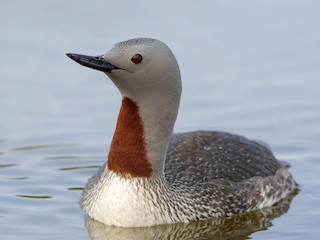
The Red-throated Loon, also known as the Red-throated Diver, is the smallest and most widespread species of loon or diver. It is a migratory aquatic bird found in the northern hemisphere, breeding primarily in Arctic and subarctic regions and wintering along coastal waters further south. Known for its distinctive red throat patch in breeding plumage and its unique 'take-off' behavior directly from water, it is an agile swimmer and diver.
Dimensioni e longevità
- Lunghezza
- 53-69 cm (21-27 in)
- Apertura alare
- 106-120 cm (42-47 in)
- Peso
- 1-2.7 kg (2.2-6.0 lbs)
- Longevità
- Up to 20 years in the wild
- Dieta
- Piscivore (primarily fish)
Caratteristiche fisiche
- Piumaggio
- Breeding adults have a grey head and neck, a distinctive brick-red throat patch, and fine black and white streaking on the back of the neck. The back is dark grey-brown, and the underparts are white. Non-breeding adults and juveniles are duller, lacking the red throat patch, with a pale grey-brown head and neck, a dark crown, and a white throat and foreneck. The back is dark grey-brown with fine white speckling, and the underparts are white.
- Forma del becco
- Slender, straight, and dagger-like, typically dark grey to black in breeding plumage, often paler at the base of the lower mandible in non-breeding plumage.
- Colore degli occhi
- Dark red in adults, brownish in juveniles.
- Colore delle zampe
- Dark grey to black, positioned far back on the body.
- Caratteristiche distintive
- Smallest loon species. In flight, it holds its head and neck slightly below the body axis, giving it a distinctive 'hunchbacked' appearance. Its unique ability to take off directly from water, unlike other loons that require a long 'runway', is a key field mark. The red throat patch in breeding plumage is diagnostic.
- Aspetto giovanile
- Similar to non-breeding adults but often with a more mottled or scaly appearance on the back due to pale feather edgings. The bill is typically paler, often greyish.
- Cambiamenti stagionali
- Breeding plumage (spring/summer) features the prominent red throat patch, grey head and neck, and dark back. Non-breeding plumage (autumn/winter) is duller, lacking the red throat, with a pale grey-brown head and neck, dark crown, and white underparts. The back is dark with fine white speckling.
- Dimorfismo sessuale
- Males and females are generally similar in plumage and size, though males may average slightly larger.
Come identificare
- 1
Size and Shape
Smallest loon species, with a relatively slender neck and a small, often slightly upturned bill. In flight, look for the 'hunchbacked' profile with head and neck held slightly below the body.
- 2
Breeding Plumage (Adult)
Look for the distinctive brick-red throat patch, grey head and neck, and dark grey-brown back. The bill is slender and dark.
- 3
Non-breeding Plumage (Adult & Juvenile)
Absence of red throat patch. Pale grey-brown head and neck with a darker crown. White throat and foreneck. Dark grey-brown back with fine white speckling. Bill often appears paler at the base of the lower mandible.
- 4
Flight Behavior
Observe its unique ability to take off directly from water, unlike other loons that require a long running start. Its flight is strong and direct.
- 5
Vocalizations
Listen for its mournful, wailing cries or cat-like mewing calls, especially in breeding areas. Alarm calls are sharp 'kark' notes.
- 6
Bill Angle
Often holds its slender bill slightly upturned, particularly when swimming, which can be a useful field mark.
Habitat e areale
- Biomi
- Tundra, taiga, coastal marine environments, freshwater lakes, and ponds.
- Areale geografico
- Circumpolar Arctic and subarctic regions of North America, Europe, and Asia. Winters along temperate coasts of the North Atlantic and North Pacific, and inland on large lakes.
- Fascia altitudinale
- Primarily low-lying coastal and freshwater habitats, from sea level up to a few hundred meters in breeding areas.
- Ambienti preferiti
- Breeds on small, shallow freshwater ponds and lakes in tundra and taiga, often close to the coast. Winters on sheltered coastal waters, estuaries, and large inland lakes, preferring areas with abundant small fish.
Comportamento
- Periodo di attività
- Diurnal, active during daylight hours for foraging and other activities.
- Abitudini alimentari
- Primarily piscivorous, diving to catch small fish such as herring, capelin, sand eels, and sticklebacks. Also consumes crustaceans, mollusks, and aquatic insects, especially when fish are scarce. Dives typically last 30-60 seconds.
- Comportamento sociale
- Generally solitary or found in pairs during the breeding season. During migration and winter, they can be seen in loose flocks, sometimes numbering in the hundreds, especially in rich feeding areas.
- Tipo di volo
- Strong, direct flight with rapid wingbeats. In flight, the head and neck are held slightly lower than the body, giving a characteristic 'hunchbacked' profile. Unique among loons for its ability to take off directly from water without a long running start.
- Migrazione
- Long-distance migrant. Breeds in Arctic and subarctic regions and migrates south to winter along temperate coastal waters. Migration occurs in spring (March-May) and autumn (September-November).
- Territorialità
- Highly territorial during the breeding season, defending their nesting pond from other loons and sometimes other waterbirds. Displays include head-dipping, bill-pointing, and aggressive chases.
Canto e richiami
- Canto
- The breeding call is a series of mournful, wailing cries, often described as a 'wailing lament' or 'cat-like mewing'. It can also produce a goose-like 'a-OO-ah' call.
- Richiamo
- Common calls include a short, sharp 'kark' or 'kak-kak-kak' in alarm or during flight. A distinctive 'creaking gate' call is also heard, particularly during courtship or territorial disputes. A low, guttural 'arrr' is used when disturbed.
- Quando vocalizza
- Most vocal during the breeding season, especially at dawn and dusk, and when disturbed. Less vocal during migration and in winter.
Riproduzione
- Stagione riproduttiva
- May to August, depending on latitude and ice melt.
- Abitudini di nidificazione
- Nests are typically a shallow scrape or depression lined with vegetation, built on a small island, hummock, or directly on the ground at the edge of a small freshwater pond or lake. Often placed very close to the water's edge, allowing the bird to slip directly into the water if disturbed.
- Dimensione della covata
- 1-3 eggs, typically 2.
- Descrizione dell'uovo
- Usually 1-3 (most commonly 2) olive-brown to dark brown eggs, often spotted or blotched with darker brown or black. Eggs measure approximately 70 x 45 mm.
- Periodo di incubazione
- 24-29 days, shared by both parents.
- Periodo di involo
- Chicks are precocial and can swim and dive shortly after hatching. They fledge and become independent at 38-48 days old.
- Cure parentali
- Both parents share incubation duties and care for the young. Chicks are often carried on the parents' backs for warmth and protection from predators.
Dove trovarlo
Arctic and Subarctic Tundra/Taiga
During the breeding season, look for them on small, shallow freshwater ponds and lakes, often near the coast, across northern North America, Europe, and Asia.
Coastal Waters
In winter, they are found on sheltered coastal bays, estuaries, and inlets, particularly where small fish are abundant. Look along the Atlantic and Pacific coasts of North America and Eurasia.
Large Inland Lakes
Occasionally found on large inland lakes during migration or winter, though less common than coastal habitats.
Consigli sul campo
- Scan sheltered coastal waters. During winter, use binoculars or a scope to scan sheltered bays and estuaries for diving birds. Look for their low profile on the water and frequent dives.
- Listen for calls in breeding areas. In Arctic and subarctic breeding grounds, listen for their distinctive wailing calls, especially during early morning or late evening.
- Observe flight patterns. If you see a loon taking off directly from the water, it's almost certainly a Red-throated Loon. Note its 'hunchbacked' flight profile.
- Look for bill shape and angle. The slender, often slightly upturned bill is a good distinguishing feature, especially in non-breeding plumage when other marks are less obvious.
Specie simili
Black-throated Loon
Gavia arctica
Larger size, thicker neck, and a more upright posture on the water. In breeding plumage, the Black-throated Loon has a black throat patch (not red), grey head, and distinct white flank patches. In non-breeding plumage, it has a straighter bill, a more defined dark cap, and a sharper demarcation between dark upperparts and white underparts, often with a 'chin strap' effect.
Great Northern Loon
Gavia immer
Significantly larger and heavier with a much thicker bill. Breeding plumage is characterized by a black head and neck, white 'necklace' and checkered back. Non-breeding plumage is much darker on the back and crown, with a more robust bill and a distinct 'chin strap' marking.
Pacific Loon
Gavia pacifica
Similar in size to Black-throated Loon. Breeding plumage has a purple-glossed black throat patch, grey head, and distinct white flank patches. Non-breeding plumage is very similar to Black-throated Loon, but often shows a slightly thinner bill and a less defined 'chin strap'.
Fatti rapidi
- Smallest Loon:
- The Red-throated Loon is the smallest of the five loon species.
- Unique Take-off:
- It is the only loon species that can take off directly from water without a long running start.
- Red Throat Patch:
- Diagnostic breeding plumage feature, giving it its common name.
- Circumpolar Distribution:
- Breeds across the Arctic and subarctic regions of the Northern Hemisphere.
- Piscivorous Diet:
- Feeds primarily on small fish, caught by diving underwater.
Curiosità
- Unlike other loons, the Red-throated Loon can take off from very small bodies of water, including puddles, due to its lighter weight and unique wing structure.
- Its legs are positioned so far back on its body that it is almost impossible for it to walk on land, making it extremely vulnerable when out of water. It only comes ashore to nest.
- The Red-throated Loon's mournful calls are often associated with the wild, remote landscapes of the Arctic and have been used in film and television to evoke a sense of wilderness.
- Chicks are often carried on the backs of their parents, providing warmth and protection from predators like Arctic Foxes and gulls.
- The scientific name 'Gavia stellata' means 'starry diver', possibly referring to the fine white speckling on its back in non-breeding plumage or the 'star-like' appearance of its eyes.
Classificazione scientifica
- Regno
- Animalia
- Phylum
- Chordata
- Classe
- Aves
- Ordine
- Gaviiformes
- Famiglia
- Gaviidae
- Genere
- Gavia
- Specie
- Gavia stellata
Esplora Red-throated Loon
Identifica uccelli ovunque
Gratis su iOS, Android e Web. Identificazione per foto e suono, database completo e la tua lista personale.