
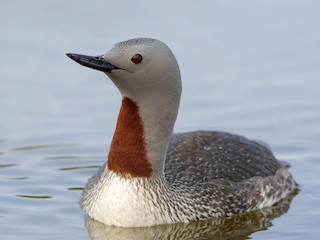
Come identificare Red-throated Loon
Gavia stellata
Visto un uccello? Identificalo all'istante con l'app Birdby
Apri l'appPer identificare correttamente Red-throated Loon (Gavia stellata), controlla ciascuna di queste caratteristiche. Gli uccelli possono essere complicati da riconoscere, perché comportamento, habitat e canto spesso confermano ciò che una sola foto non può.
Dimensioni a colpo d'occhio
- Lunghezza
- 53-69 cm (21-27 in)
- Apertura alare
- 106-120 cm (42-47 in)
- Peso
- 1-2.7 kg (2.2-6.0 lbs)
Caratteristiche fisiche da controllare
- 1
Piumaggio
Colorazione e disegno generale del piumaggio.
Breeding adults have a grey head and neck, a distinctive brick-red throat patch, and fine black and white streaking on the back of the neck. The back is dark grey-brown, and the underparts are white. Non-breeding adults and juveniles are duller, lacking the red throat patch, with a pale grey-brown head and neck, a dark crown, and a white throat and foreneck. The back is dark grey-brown with fine white speckling, and the underparts are white.
- 2
Forma del becco
Forma e colore del becco, un segno di campo chiave.
Slender, straight, and dagger-like, typically dark grey to black in breeding plumage, often paler at the base of the lower mandible in non-breeding plumage.
- 3
Colore degli occhi
Colore dell'iride e segni distintivi sugli occhi.
Dark red in adults, brownish in juveniles.
- 4
Colore delle zampe
Colore di zampe e piedi.
Dark grey to black, positioned far back on the body.
- 5
Caratteristiche distintive
Tratti distintivi che separano questa specie.
Smallest loon species. In flight, it holds its head and neck slightly below the body axis, giving it a distinctive 'hunchbacked' appearance. Its unique ability to take off directly from water, unlike other loons that require a long 'runway', is a key field mark. The red throat patch in breeding plumage is diagnostic.
- 6
Aspetto giovanile
Come i giovani si differenziano dagli adulti.
Similar to non-breeding adults but often with a more mottled or scaly appearance on the back due to pale feather edgings. The bill is typically paler, often greyish.
- 7
Cambiamenti stagionali
Variazione del piumaggio tra stagione riproduttiva e non.
Breeding plumage (spring/summer) features the prominent red throat patch, grey head and neck, and dark back. Non-breeding plumage (autumn/winter) is duller, lacking the red throat, with a pale grey-brown head and neck, dark crown, and white underparts. The back is dark with fine white speckling.
- 8
Dimorfismo sessuale
Differenze tra maschi e femmine.
Males and females are generally similar in plumage and size, though males may average slightly larger.
Segni di campo chiave
- Size and Shape. Smallest loon species, with a relatively slender neck and a small, often slightly upturned bill. In flight, look for the 'hunchbacked' profile with head and neck held slightly below the body.
- Breeding Plumage (Adult). Look for the distinctive brick-red throat patch, grey head and neck, and dark grey-brown back. The bill is slender and dark.
- Non-breeding Plumage (Adult & Juvenile). Absence of red throat patch. Pale grey-brown head and neck with a darker crown. White throat and foreneck. Dark grey-brown back with fine white speckling. Bill often appears paler at the base of the lower mandible.
- Flight Behavior. Observe its unique ability to take off directly from water, unlike other loons that require a long running start. Its flight is strong and direct.
- Vocalizations. Listen for its mournful, wailing cries or cat-like mewing calls, especially in breeding areas. Alarm calls are sharp 'kark' notes.
- Bill Angle. Often holds its slender bill slightly upturned, particularly when swimming, which can be a useful field mark.
Esplora Red-throated Loon
Identifica uccelli ovunque
Gratis su iOS, Android e Web. Identificazione per foto e suono, database completo e la tua lista personale.