
Visto un uccello? Identificalo all'istante con l'app Birdby
Apri l'appInformazioni
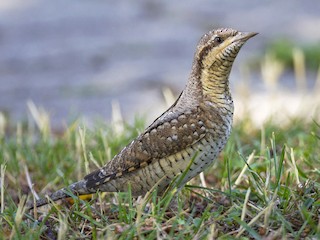
The Eurasian Wryneck, commonly known as Torcicollo in Italian, is a small, cryptic migratory woodpecker. Unlike typical woodpeckers, it rarely pecks wood for food or nesting, instead foraging primarily on ants and other insects on the ground or in decaying wood. Its name 'wryneck' refers to its distinctive defensive display where it twists and turns its head and neck in a snake-like fashion.
Dimensioni e longevità
- Lunghezza
- 16-18 cm
- Apertura alare
- 25-27 cm
- Peso
- 26-50 g
- Longevità
- Up to 5-6 years in the wild
- Dieta
- Insectivore, primarily ants and their larvae/pupae, but also other insects like aphids, small beetles, and caterpillars.
Caratteristiche fisiche
- Piumaggio
- Cryptic, mottled grey-brown and rufous plumage with intricate vermiculations and streaks, providing excellent camouflage against tree bark. A distinctive dark stripe runs from behind the eye down the side of the neck, and a broader dark stripe extends from the nape down the back. The underparts are paler, buffish-white, with fine dark barring. The tail is relatively long and rounded, barred with dark brown.
- Forma del becco
- Short, pointed, and relatively slender, greyish-brown, adapted for probing into ant nests rather than chiseling wood.
- Colore degli occhi
- Dark brown
- Colore delle zampe
- Greyish-brown
- Caratteristiche distintive
- Snake-like head-twisting display, cryptic plumage, lack of stiff tail feathers for support (unlike other woodpeckers), and a distinctive dark stripe from the eye to the shoulder.
- Aspetto giovanile
- Juveniles resemble adults but may have slightly softer, less defined markings and a generally more rufous tone.
- Cambiamenti stagionali
- No significant seasonal plumage changes. The plumage remains consistent throughout the year.
- Dimorfismo sessuale
- Males and females are virtually identical in plumage. Males may be slightly larger on average, but this is not a reliable field mark.
Come identificare
- 1
Plumage
Look for the intricate, cryptic grey-brown and rufous mottling, especially the dark stripe from the eye down the neck and the broad dark stripe down the back. This camouflage makes it blend perfectly with tree bark.
- 2
Behavior
Observe its unique snake-like head-twisting display when disturbed or handled. It also often forages on the ground, unlike most woodpeckers.
- 3
Call
Listen for its distinctive, loud, and repetitive 'que-que-que-que-que' call, which is often the first indication of its presence.
- 4
Flight
Note its undulating, somewhat weak flight pattern, often low between trees, which is less powerful than other woodpeckers.
- 5
Beak
Its short, pointed beak is not designed for chiseling wood, a key difference from other woodpeckers.
Habitat e areale
- Biomi
- Temperate forests, woodlands, orchards, parks, gardens, and open country with scattered trees.
- Areale geografico
- Breeds across most of Europe and temperate Asia, from the UK and Scandinavia east to Japan. Winters in sub-Saharan Africa and parts of South Asia.
- Fascia altitudinale
- Typically found from sea level up to 2,000 meters, occasionally higher in some parts of its range.
- Ambienti preferiti
- Prefers open deciduous or mixed woodlands with old trees, orchards, large gardens, and parkland, especially those with a good supply of ants and suitable nesting cavities. Avoids dense, unbroken forest.
Comportamento
- Periodo di attività
- Diurnal.
- Abitudini alimentari
- Forages primarily on the ground or on tree trunks and branches, using its long, sticky tongue to extract ants and their larvae from crevices, ant nests, and decaying wood. It does not typically excavate wood like other woodpeckers. It can also catch insects in flight.
- Comportamento sociale
- Generally solitary, especially outside the breeding season. During migration, small loose groups may form, but they are not highly social.
- Tipo di volo
- Undulating, rather weak flight, often low to the ground, with rapid wing beats interspersed with short glides. It can be quite agile when maneuvering through trees.
- Migrazione
- Long-distance migratory species. European populations migrate south to sub-Saharan Africa, while Asian populations winter in South Asia. They are one of the earliest passerine migrants to leave their breeding grounds in late summer/early autumn and return in spring.
- Territorialità
- Males establish and defend breeding territories, primarily through vocalizations. Both sexes participate in defending the nest site.
Canto e richiami
- Canto
- A distinctive, loud, and repetitive 'que-que-que-que-que' or 'twee-twee-twee-twee-twee' call, often described as a 'kew-kew-kew' or 'wee-wee-wee' series, delivered rapidly and often for extended periods. It has a somewhat mournful or plaintive quality.
- Richiamo
- In addition to the song, it has a softer 'tek-tek' alarm call and a hissing sound when disturbed at the nest, which is part of its snake-like defensive display.
- Quando vocalizza
- Most vocal during the breeding season, particularly in spring upon arrival and during courtship. Calls can be heard throughout the day.
Riproduzione
- Stagione riproduttiva
- Typically May to July in Europe, varying slightly with latitude.
- Abitudini di nidificazione
- Does not excavate its own nest cavity. Instead, it utilizes existing tree holes, old woodpecker holes (especially those of Great Spotted Woodpeckers), or artificial nest boxes. The nest itself is a simple scrape with little to no lining.
- Dimensione della covata
- 7-10 eggs, but can range from 5 to 14.
- Descrizione dell'uovo
- 5-14 (usually 7-10) pure white, glossy, oval eggs. They are relatively small for the bird's size.
- Periodo di incubazione
- 12-14 days, primarily by the female, though the male may assist.
- Periodo di involo
- 18-22 days after hatching. Young leave the nest fully feathered and capable of flight.
- Cure parentali
- Both parents feed the young. The male often takes a more active role in feeding after the young hatch, while the female may start a second clutch if conditions are favorable.
Dove trovarlo
Orchards and Vineyards
These habitats often provide old trees with suitable cavities and a good supply of ants.
Open Woodlands and Parkland
Look in areas with scattered mature trees, especially deciduous ones, and clearings where ants are abundant.
Large Gardens and Allotments
Well-established gardens with old fruit trees or decaying wood can attract them, particularly during migration.
Forest Edges and Clearings
They prefer the interface between forest and open areas rather than dense forest interiors.
Consigli sul campo
- Listen for its call. The Wryneck's distinctive, repetitive call is often the easiest way to locate it, especially during the breeding season. They can be surprisingly difficult to spot due to their camouflage.
- Scan tree trunks and branches. While they forage on the ground, they also climb trees. Look for them moving slowly, probing crevices with their beak.
- Check old woodpecker holes. Since they don't excavate their own nests, they rely on existing cavities. Observing old woodpecker holes in spring might reveal a Wryneck pair.
- Be patient and observant. Their cryptic plumage and quiet movements make them challenging to find. Patience and careful observation of subtle movements are key.
- Look for ant activity. As their primary food source is ants, areas with high ant populations are good places to search.
Specie simili
Lesser Spotted Woodpecker
Dryobates minor
The Lesser Spotted Woodpecker is smaller, has a more distinct black and white barred back, and a red crown (male). It also has a typical woodpecker flight and behavior, actively pecking wood, unlike the Wryneck.
Great Spotted Woodpecker
Dendrocopos major
Significantly larger than the Wryneck, with bold black and white plumage, red undertail coverts, and a red patch on the nape (male). It is a strong wood-pecker and has a very different flight and call.
Green Woodpecker
Picus viridis
Much larger and predominantly green with a red crown. It also forages on ants on the ground but has a much more powerful, undulating flight and a loud, laughing call ('yaffle').
Fatti rapidi
- Primary Diet:
- Ants
- Nesting:
- Uses existing tree cavities, does not excavate
- Migration:
- Long-distance migrant to Africa and Asia
- Distinguishing Behavior:
- Snake-like head twisting
- Conservation Status:
- Least Concern
Curiosità
- The Wryneck's scientific name 'Jynx' is derived from the Greek word 'iynx', referring to the bird's ability to twist its neck, which was associated with witchcraft and charms in ancient times.
- Its long, sticky tongue can extend up to 2.5 cm beyond its beak, perfectly adapted for extracting ants from deep crevices.
- Unlike other woodpeckers, the Wryneck lacks stiff tail feathers, meaning it cannot prop itself up against tree trunks in the same way.
- It is one of the few migratory woodpecker species, undertaking long journeys between its breeding and wintering grounds.
- The Wryneck's defensive display, involving twisting its head, hissing, and fluffing its feathers, is remarkably effective at deterring predators by mimicking a snake.
Classificazione scientifica
- Regno
- Animalia
- Phylum
- Chordata
- Classe
- Aves
- Ordine
- Piciformes
- Famiglia
- Picidae
- Genere
- Jynx
- Specie
- Jynx torquilla
Esplora Eurasian Wryneck
Identifica uccelli ovunque
Gratis su iOS, Android e Web. Identificazione per foto e suono, database completo e la tua lista personale.