
Visto un uccello? Identificalo all'istante con l'app Birdby
Apri l'appInformazioni
The Nightingale (Luscinia megarhynchos) is a small passerine bird renowned for its powerful and beautiful song. Despite its drab plumage, its vocal prowess has made it a celebrated figure in literature and folklore. It is a migratory species, breeding across Europe and Asia and wintering in sub-Saharan Africa.
Dimensioni e longevità
- Lunghezza
- 15-17 cm
- Apertura alare
- 23-26 cm
- Peso
- 16-27 g
- Longevità
- Up to 8 years in the wild, typically 3-5 years.
- Dieta
- Insectivore, primarily feeding on insects and other invertebrates.
Caratteristiche fisiche
- Piumaggio
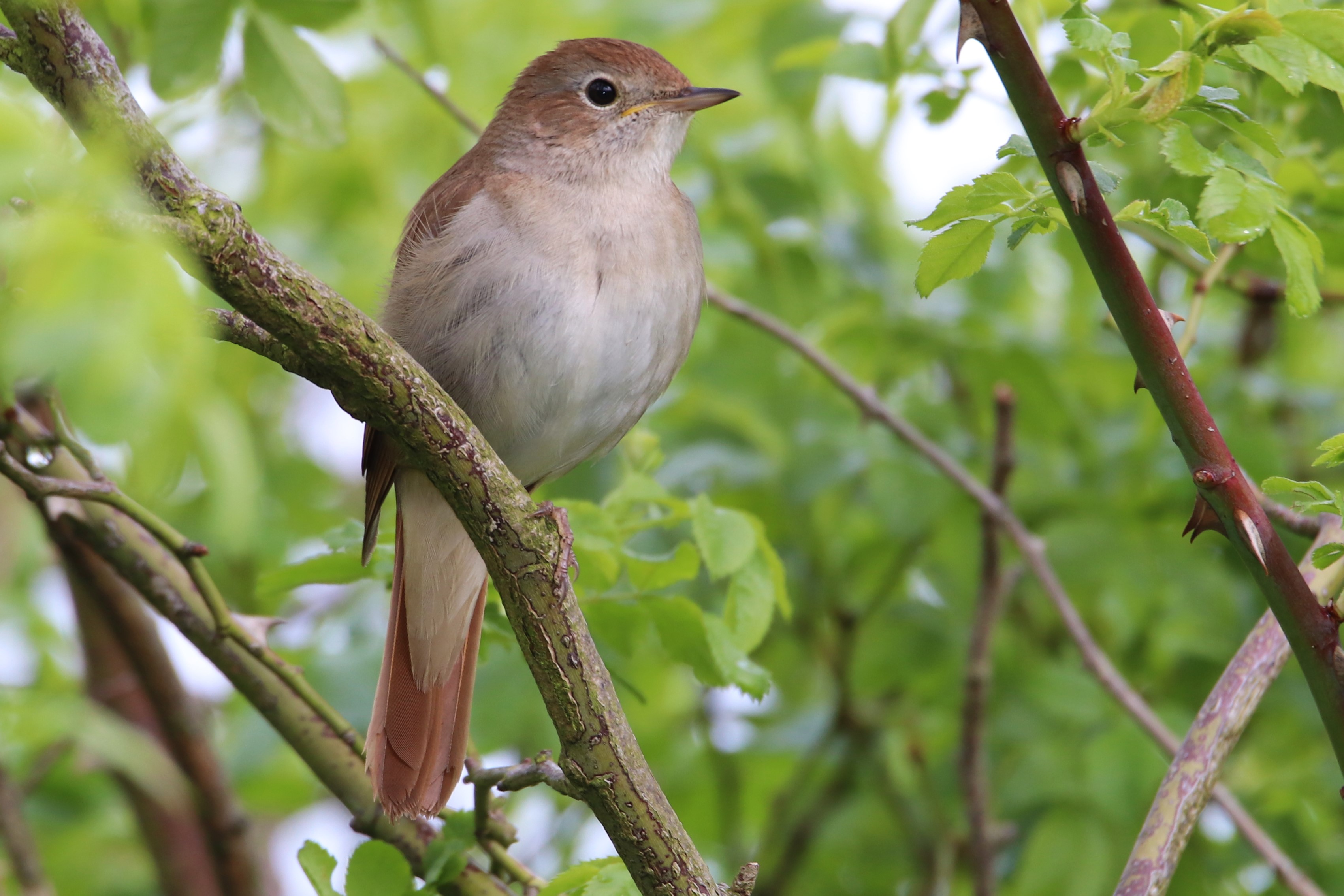
- Upperparts are uniformly plain brown, often with a rufous tinge, especially on the rump and tail. Underparts are dull whitish to pale greyish-brown, often with a slightly mottled or streaked appearance on the breast. The throat is whitish, and there is a faint pale eye-ring.
- Forma del becco
- Slender, pointed, and dark brown to blackish.
- Colore degli occhi
- Dark brown.
- Colore delle zampe
- Pinkish-brown to dark brown.
- Caratteristiche distintive
- Its most distinctive feature is its rich rufous-brown tail, which is often held cocked or flicked. The overall impression is of a rather plain, thrush-like bird, but smaller and more slender.
- Aspetto giovanile
- Juveniles are similar to adults but have a more mottled or scaled appearance on the upperparts and breast, with pale spots on a darker background, giving them a somewhat scaly look.
- Cambiamenti stagionali
- No significant seasonal plumage changes. The plumage remains consistent throughout the year, though it may appear slightly worn before the annual molt.
- Dimorfismo sessuale
- Males and females are virtually identical in plumage.
Come identificare
- 1
Plumage
Look for a plain, uniform brown back and head, with a distinctive rufous-brown tail. The underparts are dull whitish to pale grey-brown, often appearing slightly mottled.
- 2
Tail
The rich rufous-brown tail is a key identifier, often flicked or held cocked, especially when agitated or moving through dense cover.
- 3
Behavior
Observe its secretive nature, often staying hidden in dense undergrowth. It forages on the ground, often with a characteristic hopping movement.
- 4
Song
The most reliable identification feature is its unmistakable, powerful, and varied song, especially when heard at night or during twilight hours. Listen for the characteristic fluting notes and crescendo phrases.
- 5
Habitat
Look for it in dense, often damp, undergrowth in woodlands, scrub, or large gardens, particularly near water.
Habitat e areale
- Biomi
- Deciduous woodlands, scrublands, dense thickets, riparian zones, parks, and large gardens.
- Areale geografico
- Breeds across most of Europe (excluding the far north) and temperate Asia, extending east to Mongolia. Winters in sub-Saharan Africa, from Senegal east to Kenya and south to South Africa.
- Fascia altitudinale
- Typically found from sea level up to 1,500 meters, occasionally higher in some parts of its range.
- Ambienti preferiti
- Prefers dense undergrowth, often near water, with a good mix of shrubs, brambles, and small trees. Requires dense cover for nesting and foraging, often in damp areas.
Comportamento
- Periodo di attività
- Diurnal for foraging, but males are famous for singing both day and night, especially during the breeding season.
- Abitudini alimentari
- Forages primarily on the ground or in low vegetation, gleaning insects and other invertebrates. Diet includes beetles, ants, caterpillars, spiders, and worms. Occasionally consumes berries in late summer and autumn.
- Comportamento sociale
- Generally solitary and secretive, especially during the breeding season. Males are highly territorial. During migration, they may form loose aggregations at stopover sites.
- Tipo di volo
- Flight is typically short, low, and undulating, often between patches of dense cover. Not a strong or sustained flyer over long distances, except during migration.
- Migrazione
- Long-distance nocturnal migrant. Arrives on breeding grounds in April-May and departs for wintering grounds in August-September. Migrates across the Sahara Desert.
- Territorialità
- Males are strongly territorial during the breeding season, defending their territory with song and occasional aggressive displays against rivals.
Canto e richiami
- Canto
- The song is exceptionally rich, varied, and powerful, often described as one of the most beautiful bird songs. It consists of a complex series of whistles, trills, gurgles, and crescendo phrases, often starting softly and building in intensity. It includes distinctive fluting notes and rapid, bubbling passages. Males sing both day and night, particularly at dawn and dusk, and throughout the night before pairing.
- Richiamo
- Common calls include a soft 'hweet' or 'huit' contact call, a harsh 'churr' or 'krr' alarm call, and a sharp 'tack' or 'tuc' note when agitated.
- Quando vocalizza
- Males sing most intensely from their arrival on breeding grounds in April until late June, primarily to attract a mate and defend territory. Singing can occur at any time, but is most prominent at night and during twilight hours.
Riproduzione
- Stagione riproduttiva
- May to July.
- Abitudini di nidificazione
- Nests are typically built on or very close to the ground, well-hidden within dense vegetation, such as brambles, nettles, or low shrubs. The nest is a cup-shaped structure made of dead leaves, grass, moss, and rootlets, lined with finer materials like hair.
- Dimensione della covata
- Typically 4-5 eggs.
- Descrizione dell'uovo
- 3-6 eggs, typically 4-5. Eggs are olive-brown to greenish-blue, often finely speckled with reddish-brown, giving them a somewhat uniform dark appearance.
- Periodo di incubazione
- 13-14 days, primarily by the female.
- Periodo di involo
- 11-13 days after hatching. Young leave the nest before they can fly well and remain hidden in dense cover, attended by both parents.
- Cure parentali
- Both parents feed the nestlings and fledglings, though the female does most of the incubation.
Dove trovarlo
Dense Woodlands
Especially those with a well-developed understory of shrubs and brambles.
Riparian Zones
Areas along rivers and streams with dense vegetation.
Large Gardens and Parks
If they contain suitable dense, shrubby cover.
Scrublands
Areas with thickets and dense bushes.
Consigli sul campo
- Listen for the song. The Nightingale's song is its most prominent feature. Listen for it at dawn, dusk, or even throughout the night during the breeding season (April-June). Its powerful voice can carry a long distance.
- Be patient and quiet. Nightingales are very shy and secretive. Find a suitable habitat patch, remain still and quiet, and listen. You might catch a glimpse as it moves between cover.
- Look low. They spend most of their time on or near the ground, hidden in dense vegetation. Focus your search in the lower layers of shrubs and undergrowth.
- Visit at the right time. The best time to observe or hear Nightingales is during their breeding season, from late April to June, when males are actively singing.
Specie simili
Thrush Nightingale
Luscinia luscinia
The Thrush Nightingale is very similar in appearance but has a slightly greyer-brown plumage, less rufous on the tail, and often a more distinctly mottled breast. Its song is also very similar but generally lacks the clear, fluting crescendo phrases of the Common Nightingale and often has a more 'churring' quality.
Robin
Erithacus rubecula
While also a small, brown bird, the Robin is easily distinguished by its prominent orange-red breast and face, and its more upright posture. Its song is also distinct, though melodious.
Dunnock
Prunella modularis
The Dunnock is a smaller, greyer bird with a more slender bill and a shuffling gait. It lacks the rufous tail of the Nightingale and has a different song and call.
Fatti rapidi
- Primary Diet:
- Insects and invertebrates
- Migration Status:
- Long-distance migratory
- Distinctive Feature:
- Powerful and melodious song
- Habitat Preference:
- Dense undergrowth, often near water
- Conservation Status:
- Least Concern
Curiosità
- The Nightingale's song is so complex that it can contain over 200 different phrases, some of which are unique to individual birds.
- Only male Nightingales sing, primarily to attract a mate and defend their territory. Unpaired males sing more frequently at night.
- Despite its fame for singing at night, the Nightingale also sings during the day, especially at dawn and dusk.
- The name 'Nightingale' literally means 'night songstress', though it is the male that sings.
- Nightingales are often difficult to see due to their secretive nature and drab plumage, making their extraordinary song even more striking.
Classificazione scientifica
- Regno
- Animalia
- Phylum
- Chordata
- Classe
- Aves
- Ordine
- Passeriformes
- Famiglia
- Muscicapidae
- Genere
- Luscinia
- Specie
- L. megarhynchos
Esplora Nightingale
Identifica uccelli ovunque
Gratis su iOS, Android e Web. Identificazione per foto e suono, database completo e la tua lista personale.