
Come identificare Nightingale
Luscinia megarhynchos
Visto un uccello? Identificalo all'istante con l'app Birdby
Apri l'appPer identificare correttamente Nightingale (Luscinia megarhynchos), controlla ciascuna di queste caratteristiche. Gli uccelli possono essere complicati da riconoscere, perché comportamento, habitat e canto spesso confermano ciò che una sola foto non può.
Dimensioni a colpo d'occhio
- Lunghezza
- 15-17 cm
- Apertura alare
- 23-26 cm
- Peso
- 16-27 g
Caratteristiche fisiche da controllare
- 1
Piumaggio
Colorazione e disegno generale del piumaggio.
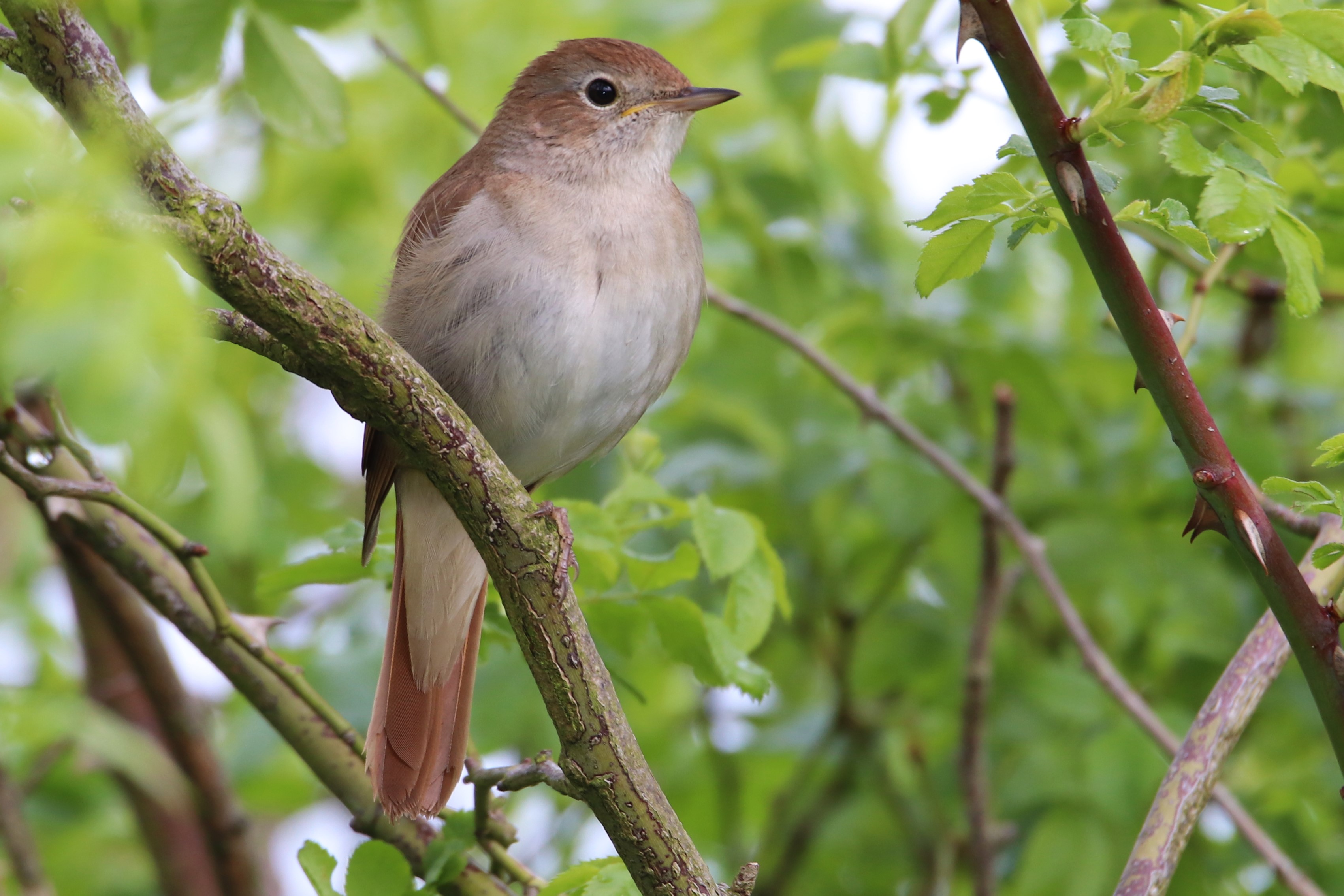
Upperparts are uniformly plain brown, often with a rufous tinge, especially on the rump and tail. Underparts are dull whitish to pale greyish-brown, often with a slightly mottled or streaked appearance on the breast. The throat is whitish, and there is a faint pale eye-ring.
- 2
Forma del becco
Forma e colore del becco, un segno di campo chiave.
Slender, pointed, and dark brown to blackish.
- 3
Colore degli occhi
Colore dell'iride e segni distintivi sugli occhi.
Dark brown.
- 4
Colore delle zampe
Colore di zampe e piedi.
Pinkish-brown to dark brown.
- 5
Caratteristiche distintive
Tratti distintivi che separano questa specie.
Its most distinctive feature is its rich rufous-brown tail, which is often held cocked or flicked. The overall impression is of a rather plain, thrush-like bird, but smaller and more slender.
- 6
Aspetto giovanile
Come i giovani si differenziano dagli adulti.
Juveniles are similar to adults but have a more mottled or scaled appearance on the upperparts and breast, with pale spots on a darker background, giving them a somewhat scaly look.
- 7
Cambiamenti stagionali
Variazione del piumaggio tra stagione riproduttiva e non.
No significant seasonal plumage changes. The plumage remains consistent throughout the year, though it may appear slightly worn before the annual molt.
- 8
Dimorfismo sessuale
Differenze tra maschi e femmine.
Males and females are virtually identical in plumage.
Segni di campo chiave
- Plumage. Look for a plain, uniform brown back and head, with a distinctive rufous-brown tail. The underparts are dull whitish to pale grey-brown, often appearing slightly mottled.
- Tail. The rich rufous-brown tail is a key identifier, often flicked or held cocked, especially when agitated or moving through dense cover.
- Behavior. Observe its secretive nature, often staying hidden in dense undergrowth. It forages on the ground, often with a characteristic hopping movement.
- Song. The most reliable identification feature is its unmistakable, powerful, and varied song, especially when heard at night or during twilight hours. Listen for the characteristic fluting notes and crescendo phrases.
- Habitat. Look for it in dense, often damp, undergrowth in woodlands, scrub, or large gardens, particularly near water.
Esplora Nightingale
Identifica uccelli ovunque
Gratis su iOS, Android e Web. Identificazione per foto e suono, database completo e la tua lista personale.