
Visto un uccello? Identificalo all'istante con l'app Birdby
Apri l'appInformazioni
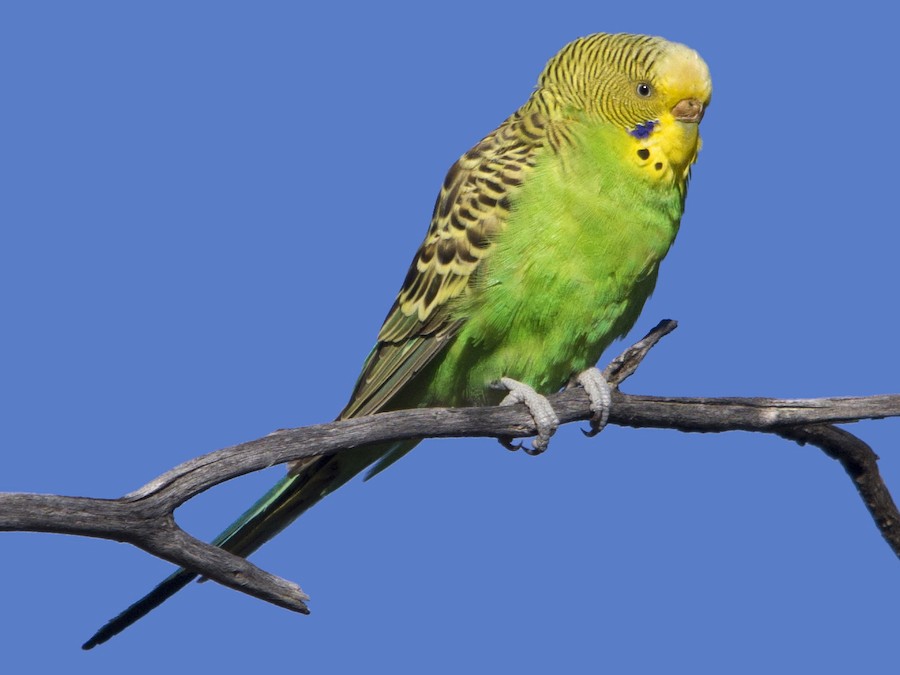
The Budgerigar, also known as the Common Budgerigar or Shell Parakeet, is a small, long-tailed, seed-eating parrot. It is the only species in the genus Melopsittacus. Wild budgerigars are typically green and yellow with black, scalloped markings on the nape, back, and wings. They are native to Australia and are among the most popular pet birds worldwide, leading to numerous color mutations in captivity.
Dimensioni e longevità
- Lunghezza
- 18-20 cm (including tail)
- Apertura alare
- 28-32 cm
- Peso
- 25-40 g
- Longevità
- 3-6 years in the wild, up to 15-20 years in captivity
- Dieta
- Granivore (primarily seeds)
Caratteristiche fisiche
- Piumaggio
- Wild-type plumage is predominantly light green on the abdomen and rump, transitioning to yellow on the head and nape. The back and wing coverts are yellow with black scalloped markings, giving a 'wavy' appearance. The flight feathers are dark with yellow edges. There are three small black spots on each cheek, bordered by a violet-blue patch. The tail is dark blue with yellow flashes on the outer feathers. Captive varieties exhibit a vast array of color mutations including blue, white, yellow, grey, violet, and various pied patterns.
- Forma del becco
- Small, hooked, and strong, adapted for cracking seeds. Color is typically olive-grey to horn-colored in adults, often with a darker tip.
- Colore degli occhi
- Dark brown with a white iris ring in adults. Juveniles have solid dark eyes without the white iris.
- Colore delle zampe
- Greyish-blue to greyish-pink, zygodactyl feet (two toes forward, two backward).
- Caratteristiche distintive
- The distinctive black scalloped markings on the back and wings, the small size, long tapered tail, and the presence of three black throat spots with a violet cheek patch are key identifiers for wild-type birds. The cere (fleshy area above the beak) color is crucial for sexing adults.
- Aspetto giovanile
- Juveniles have duller plumage, less distinct scalloped markings, and a shorter tail. Their eyes are solid dark brown without the white iris ring seen in adults. The cere is pinkish-purple in both sexes until they reach sexual maturity (around 3-4 months). The black cap markings extend further down onto the forehead compared to adults.
- Cambiamenti stagionali
- No significant seasonal plumage changes. Plumage remains consistent year-round, though it may appear duller just before molting.
- Dimorfismo sessuale
- Adult males typically have a bright blue cere, while adult females have a pale brown, tan, or crusty brown cere, especially when in breeding condition. Non-breeding females may have a pale blue or whitish cere. Juveniles of both sexes have a pinkish-purple cere.
Come identificare
- 1
Size and Shape
Look for a small, slender parrot with a relatively long, pointed tail. Its overall body shape is more elongated than many other small parrots.
- 2
Plumage Pattern (Wild Type)
Observe the distinctive black scalloped or wavy markings on the yellow back and wings. The bright green underparts and yellow head are also key. Note the three small black throat spots and violet cheek patches.
- 3
Flight
Watch for their characteristic fast, direct, and slightly undulating flight, often in tight, cohesive flocks. They are very agile in the air.
- 4
Vocalizations
Listen for their constant chattering, chirping, and warbling calls, especially when in flocks. Their calls are distinct from other small Australian parrots.
- 5
Cere Color (Adults)
If close enough, the cere color can distinguish sexes: bright blue for males, pale brown/tan for females. Juveniles have a pinkish-purple cere.
Habitat e areale
- Biomi
- Arid and semi-arid grasslands, open woodlands, shrublands, and savannas.
- Areale geografico
- Endemic to inland Australia, found across most of the continent, avoiding only the coastal areas of the north, east, and southwest, and the densest forests.
- Fascia altitudinale
- Typically found from sea level up to approximately 1,000 meters.
- Ambienti preferiti
- Prefers open country with scattered trees and shrubs, particularly areas with abundant grass seeds and access to water. They are highly nomadic, following rainfall and seed availability.
Comportamento
- Periodo di attività
- Diurnal. Most active during the cooler parts of the day, morning and late afternoon, resting during the midday heat.
- Abitudini alimentari
- Primarily ground feeders, foraging for grass seeds. They also consume leaves, buds, and occasionally insects. They are highly efficient at husking seeds with their specialized beaks and tongues. They require regular access to water and will travel long distances to find it.
- Comportamento sociale
- Highly gregarious, forming large flocks that can number in the thousands, especially around water sources. They are social birds, constantly communicating with each other. Pairs remain together within the flock.
- Tipo di volo
- Fast, direct, and undulating flight, often in large, cohesive flocks. They are agile flyers, capable of rapid changes in direction.
- Migrazione
- Nomadic rather than migratory. Their movements are largely dictated by rainfall and the availability of food and water. They will travel hundreds of kilometers in response to environmental conditions.
- Territorialità
- Generally not territorial outside of the immediate nesting site during breeding season. Flocks share foraging and watering grounds.
Canto e richiami
- Canto
- While not having a complex 'song' in the traditional sense, Budgerigars produce a continuous, chattering, warbling vocalization, often described as a 'twittering song' or 'babbling'. This includes a variety of chirps, trills, and whistles, especially when content or interacting socially.
- Richiamo
- Common calls include a sharp, short 'chip' or 'cheet' contact call, often repeated rapidly. Alarm calls are harsher and more insistent. In flight, they emit constant chattering calls to maintain flock cohesion.
- Quando vocalizza
- Vocalize almost continuously when active, particularly during foraging, flying, and social interactions within the flock. Quieter during rest periods.
Riproduzione
- Stagione riproduttiva
- Highly opportunistic, breeding primarily after rainfall, which can occur at any time of year, but most commonly from June to September in the north and August to January in the south of Australia.
- Abitudini di nidificazione
- Cavity nesters. They utilize hollows in trees, fence posts, logs, or even rock crevices. No nest material is added; eggs are laid directly on the bare surface of the cavity.
- Dimensione della covata
- 4-8 eggs, sometimes up to 10.
- Descrizione dell'uovo
- Small, pure white, oval-shaped eggs. Typically smooth-shelled.
- Periodo di incubazione
- 18-21 days, primarily by the female.
- Periodo di involo
- Approximately 30-35 days after hatching. Young leave the nest fully feathered and capable of flight.
- Cure parentali
- Female incubates and broods the young, while the male feeds her and later assists in feeding the chicks. Both parents care for the fledglings for a short period after they leave the nest.
Dove trovarlo
Inland Australia
Vast arid and semi-arid regions of Australia, particularly areas that have recently received rain and have abundant seeding grasses.
Waterholes and Rivers
Often found in large numbers around water sources, especially during dry periods, as they need to drink daily.
Open Grasslands and Savannas
Look in areas with sparse trees and shrubs, where native grasses are prevalent and provide their primary food source.
Consigli sul campo
- Look for movement and listen for calls. Budgerigars are highly social and vocal. Large flocks can be seen and heard from a distance, especially when they are flying to or from a water source.
- Visit after rain. Their movements are tied to rainfall. Areas that have recently received rain will have fresh grass growth and seeds, attracting large numbers of budgerigars.
- Observe at water sources. During hot periods, stake out waterholes or riverbanks in the early morning or late afternoon. Budgerigars will come to drink in large, often spectacular, numbers.
- Use binoculars. While flocks are often visible, binoculars will help in observing individual plumage details, especially the scalloping and throat spots, and for sexing adults by cere color.
Specie simili
Bourke's Parrot
Neopsephotus bourkii
Bourke's Parrots are slightly larger, predominantly pinkish-brown with blue on the wings and a blue forehead band (males). They lack the distinct black scalloping and throat spots of the Budgerigar. Their flight is more undulating and less direct.
Scarlet-chested Parrot
Neophema splendida
Scarlet-chested Parrots are more brightly colored, with males having a brilliant red breast and blue face. They are slightly larger and have a different body shape and less pronounced scalloping on the back. Their habitat preferences also differ slightly.
Fatti rapidi
- Native Range:
- Australia
- Diet:
- Grass seeds, leaves, buds
- Sociality:
- Highly gregarious, forms large flocks
- Breeding:
- Opportunistic, cavity nester
- Conservation Status:
- Least Concern
Curiosità
- The name 'Budgerigar' is believed to come from the Gamilaraay Aboriginal language, possibly meaning 'good food' or 'good to eat'.
- Budgerigars are one of the most popular pet birds globally, second only to canaries in some regions. All pet budgerigars descend from the wild Australian species.
- They are highly intelligent and can be taught to mimic human speech, with some individuals developing extensive vocabularies.
- Wild budgerigars are nomadic, following rainfall and seed availability across vast distances in the Australian outback.
- Their ability to survive in harsh arid environments is partly due to their efficient water conservation and their capacity to extract moisture from seeds.
Classificazione scientifica
- Regno
- Animalia
- Phylum
- Chordata
- Classe
- Aves
- Ordine
- Psittaciformes
- Famiglia
- Psittaculidae
- Genere
- Melopsittacus
- Specie
- Melopsittacus undulatus
Esplora Budgerigar
Identifica uccelli ovunque
Gratis su iOS, Android e Web. Identificazione per foto e suono, database completo e la tua lista personale.