
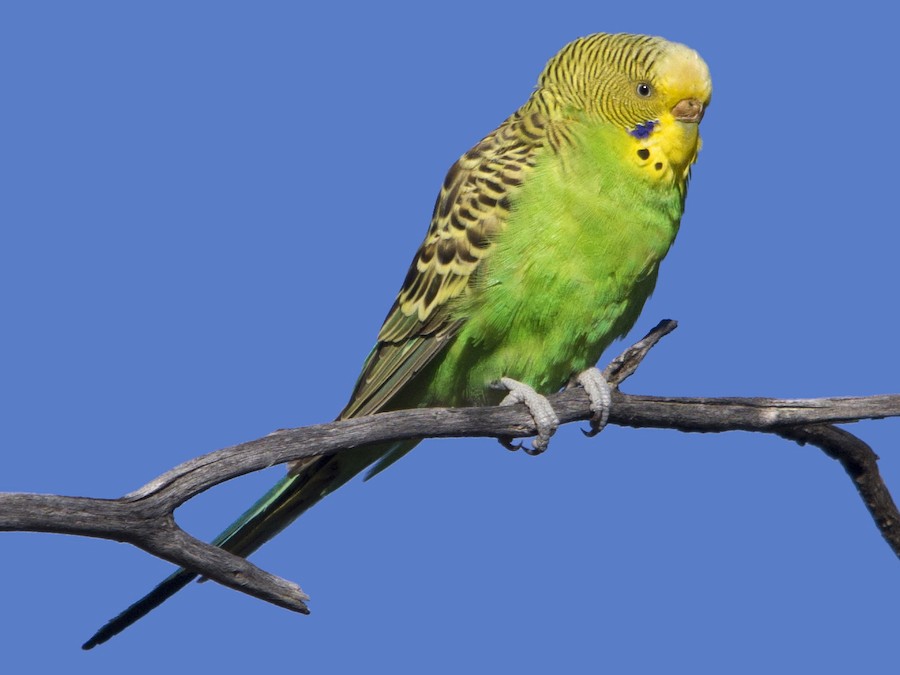
Come identificare Budgerigar
Melopsittacus undulatus
Visto un uccello? Identificalo all'istante con l'app Birdby
Apri l'appPer identificare correttamente Budgerigar (Melopsittacus undulatus), controlla ciascuna di queste caratteristiche. Gli uccelli possono essere complicati da riconoscere, perché comportamento, habitat e canto spesso confermano ciò che una sola foto non può.
Dimensioni a colpo d'occhio
- Lunghezza
- 18-20 cm (including tail)
- Apertura alare
- 28-32 cm
- Peso
- 25-40 g
Caratteristiche fisiche da controllare
- 1
Piumaggio
Colorazione e disegno generale del piumaggio.
Wild-type plumage is predominantly light green on the abdomen and rump, transitioning to yellow on the head and nape. The back and wing coverts are yellow with black scalloped markings, giving a 'wavy' appearance. The flight feathers are dark with yellow edges. There are three small black spots on each cheek, bordered by a violet-blue patch. The tail is dark blue with yellow flashes on the outer feathers. Captive varieties exhibit a vast array of color mutations including blue, white, yellow, grey, violet, and various pied patterns.
- 2
Forma del becco
Forma e colore del becco, un segno di campo chiave.
Small, hooked, and strong, adapted for cracking seeds. Color is typically olive-grey to horn-colored in adults, often with a darker tip.
- 3
Colore degli occhi
Colore dell'iride e segni distintivi sugli occhi.
Dark brown with a white iris ring in adults. Juveniles have solid dark eyes without the white iris.
- 4
Colore delle zampe
Colore di zampe e piedi.
Greyish-blue to greyish-pink, zygodactyl feet (two toes forward, two backward).
- 5
Caratteristiche distintive
Tratti distintivi che separano questa specie.
The distinctive black scalloped markings on the back and wings, the small size, long tapered tail, and the presence of three black throat spots with a violet cheek patch are key identifiers for wild-type birds. The cere (fleshy area above the beak) color is crucial for sexing adults.
- 6
Aspetto giovanile
Come i giovani si differenziano dagli adulti.
Juveniles have duller plumage, less distinct scalloped markings, and a shorter tail. Their eyes are solid dark brown without the white iris ring seen in adults. The cere is pinkish-purple in both sexes until they reach sexual maturity (around 3-4 months). The black cap markings extend further down onto the forehead compared to adults.
- 7
Cambiamenti stagionali
Variazione del piumaggio tra stagione riproduttiva e non.
No significant seasonal plumage changes. Plumage remains consistent year-round, though it may appear duller just before molting.
- 8
Dimorfismo sessuale
Differenze tra maschi e femmine.
Adult males typically have a bright blue cere, while adult females have a pale brown, tan, or crusty brown cere, especially when in breeding condition. Non-breeding females may have a pale blue or whitish cere. Juveniles of both sexes have a pinkish-purple cere.
Segni di campo chiave
- Size and Shape. Look for a small, slender parrot with a relatively long, pointed tail. Its overall body shape is more elongated than many other small parrots.
- Plumage Pattern (Wild Type). Observe the distinctive black scalloped or wavy markings on the yellow back and wings. The bright green underparts and yellow head are also key. Note the three small black throat spots and violet cheek patches.
- Flight. Watch for their characteristic fast, direct, and slightly undulating flight, often in tight, cohesive flocks. They are very agile in the air.
- Vocalizations. Listen for their constant chattering, chirping, and warbling calls, especially when in flocks. Their calls are distinct from other small Australian parrots.
- Cere Color (Adults). If close enough, the cere color can distinguish sexes: bright blue for males, pale brown/tan for females. Juveniles have a pinkish-purple cere.
Esplora Budgerigar
Identifica uccelli ovunque
Gratis su iOS, Android e Web. Identificazione per foto e suono, database completo e la tua lista personale.