
Visto un uccello? Identificalo all'istante con l'app Birdby
Apri l'appInformazioni
The Red Kite (Milvus milvus) is a medium-large bird of prey in the family Accipitridae, characterized by its distinctive rufous plumage, deeply forked tail, and graceful, buoyant flight. It is primarily a scavenger and opportunistic predator, often seen soaring over open country and woodlands.
Dimensioni e longevità
- Lunghezza
- 60-70 cm (24-28 in)
- Apertura alare
- 175-195 cm (69-77 in)
- Peso
- 800-1300 g (1.8-2.9 lb)
- Longevità
- Typically 10-15 years in the wild, up to 26 years recorded.
- Dieta
- Omnivore (primarily carrion, small mammals, birds, invertebrates, and occasionally fruit)
Caratteristiche fisiche
- Piumaggio
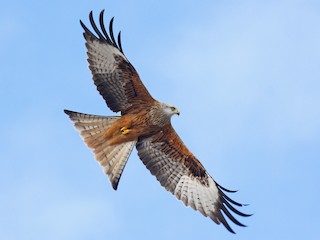
- Adults have a striking rufous-red body and tail, contrasting with a pale grey head and neck that can appear almost white. The underparts are rufous-brown with dark streaking. The upperparts are rufous-brown. The primaries are blackish, and a prominent white patch is visible on the underside of the primary flight feathers, near the wingtip, which is a key identification feature. The deeply forked tail is rufous, often appearing rusty orange, and is frequently twisted during flight.
- Forma del becco
- Strong, hooked beak, greyish-horn colored with a yellow cere.
- Colore degli occhi
- Pale yellow to amber, giving a piercing gaze.
- Colore delle zampe
- Bright yellow.
- Caratteristiche distintive
- Deeply forked rufous tail (often twisted), large white patches on the underwing primaries, buoyant and graceful flight, pale grey head.
- Aspetto giovanile
- Juveniles have duller plumage overall, with a less distinct rufous coloration and a more streaked breast. Their head is often browner, and the white underwing patches are less prominent or absent. The tail fork is also less pronounced than in adults.
- Cambiamenti stagionali
- No significant seasonal plumage changes. Plumage may appear slightly duller when worn before molting.
- Dimorfismo sessuale
- Males and females are generally similar in plumage, though females tend to be slightly larger and heavier than males.
Come identificare
- 1
Tail Shape
Look for the deeply forked, rufous-red tail, which is often twisted in flight. This is the most distinctive feature.
- 2
Underwing Pattern
Observe the large, prominent white patches on the underside of the primary flight feathers, near the wingtips. These contrast sharply with the blackish primaries.
- 3
Plumage Coloration
Note the overall rufous-red body and tail, contrasting with a pale grey (almost white) head and neck.
- 4
Flight Style
Watch for its characteristic buoyant, graceful, and often lazy soaring flight, with the tail frequently twisting to steer.
Habitat e areale
- Biomi
- Woodlands, open country, farmland, pastures, river valleys, and sometimes suburban areas.
- Areale geografico
- Primarily Western Palearctic, ranging from Western Europe (including the UK, France, Spain, Germany) east to parts of Central Europe, and south to parts of North Africa. Strongholds are in Spain, France, and Germany, with successful reintroduction programs in the UK and Ireland. A distinct subspecies, Milvus milvus fasciicauda, was formerly recognized on the Cape Verde Islands but is now extinct.
- Fascia altitudinale
- Typically found from sea level up to 1,500 meters (5,000 feet), occasionally higher in mountainous regions.
- Ambienti preferiti
- Mosaic landscapes of deciduous or mixed woodlands for nesting, interspersed with open areas for foraging. Often associated with human activity, including agricultural land and even urban fringes where food sources are available.
Comportamento
- Periodo di attività
- Diurnal, active during daylight hours.
- Abitudini alimentari
- Highly opportunistic. Primarily a scavenger, feeding on carrion (roadkill, dead livestock). Also preys on small mammals (voles, mice, rabbits), small birds, amphibians, reptiles, and large invertebrates (earthworms, insects). Known to steal food from other birds (kleptoparasitism) and occasionally takes fish. Often seen soaring low over fields, scanning for food.
- Comportamento sociale
- Generally solitary or found in pairs during the breeding season. Outside of breeding, they can form communal roosts, sometimes numbering dozens or even hundreds of individuals, especially in winter or at abundant food sources.
- Tipo di volo
- Distinctive buoyant and graceful flight, often soaring in circles on upswept wings. The deeply forked tail is frequently twisted and used as a rudder for steering, especially when soaring or maneuvering. Wings are held in a shallow 'V' shape or slightly bowed. Appears light and agile in the air.
- Migrazione
- Populations vary in migratory behavior. Northern and eastern European populations are largely migratory, moving south and west for the winter. Western and southern European populations are largely resident or undertake short-distance dispersal. British and French populations are mostly resident. Migrants typically move between September-November and return March-April.
- Territorialità
- Territorial during the breeding season, defending their nesting area. Outside of breeding, they are less territorial, especially at communal roosts or feeding sites.
Canto e richiami
- Canto
- Red Kites do not have a complex song. Their vocalizations are typically calls.
- Richiamo
- A distinctive, high-pitched, drawn-out 'pee-wee-ooo' or 'weee-ooo' call, often described as a plaintive, mewing whistle. Also produces a rapid 'kek-kek-kek' alarm call, especially near the nest or when agitated.
- Quando vocalizza
- Most vocal during the breeding season, particularly around the nest, and when interacting with other kites. Calls can also be heard during soaring displays.
Riproduzione
- Stagione riproduttiva
- Typically March to July, with egg-laying occurring from late March to May.
- Abitudini di nidificazione
- Nests are usually built in tall trees (often deciduous, but also conifers) in woodlands or isolated trees, often near the edge of a forest or in open country. Both sexes contribute to nest building, which is a bulky structure of sticks, lined with wool, grass, and often decorated with various human-made items like plastic, paper, or cloth.
- Dimensione della covata
- 1-4 eggs (most commonly 2-3).
- Descrizione dell'uovo
- Typically 1-4 (usually 2-3) eggs, dull white or pale bluish-white, often sparsely marked with reddish-brown or purplish blotches and spots.
- Periodo di incubazione
- 31-32 days per egg, primarily by the female, with the male providing food.
- Periodo di involo
- 50-60 days after hatching. Young remain dependent on parents for several weeks after fledging.
- Cure parentali
- Both parents are involved in raising the young. The female incubates and broods, while the male provides most of the food during this period. Both parents feed the chicks once they hatch.
Dove trovarlo
Woodlands and Forest Edges
Look for them nesting or roosting in tall trees, especially deciduous or mixed woodlands adjacent to open areas.
Open Farmland and Pastures
Often seen soaring over agricultural fields, meadows, and pastures while foraging for carrion or small prey.
River Valleys and Floodplains
These areas provide a good mix of foraging habitat and nesting trees.
Roadsides
Frequently seen scavenging roadkill, so keep an eye out along rural roads.
Consigli sul campo
- Scan the Sky. Red Kites spend a lot of time soaring. Look up, especially on sunny days, for their distinctive silhouette and flight pattern.
- Look for Communal Roosts. In winter, Red Kites often gather in large communal roosts. Finding one can offer spectacular views of many individuals.
- Visit Reintroduction Areas. In countries like the UK, areas where Red Kites have been reintroduced (e.g., Chilterns, Galloway) are excellent places to see them.
- Listen for Calls. Their distinctive 'pee-wee-ooo' whistle can often alert you to their presence before you see them.
Specie simili
Black Kite
Milvus migrans
The Black Kite has a less deeply forked tail (often appearing almost straight or slightly notched), darker overall plumage (brownish, lacking the rufous tones of the Red Kite), and lacks the prominent white underwing patches. Its flight is less buoyant and more direct. The head is also darker, not pale grey.
Common Buzzard
Buteo buteo
The Common Buzzard has a much shorter, fan-shaped tail (not forked), broader wings, and a more compact appearance. Its plumage is highly variable but generally brown, lacking the rufous body and pale head of the Red Kite. It often soars on flat wings or in a shallow 'V', but its flight is heavier and less agile than the Red Kite's. Lacks the white underwing patches.
Eurasian Marsh Harrier
Circus aeruginosus
Marsh Harriers have a longer, narrower body and wings, and a longer tail that is not forked. They fly with wings held in a strong 'V' shape and often 'quarter' over reedbeds. Plumage is distinct, with males having grey wings and tail, and females being largely brown with a creamy cap and throat. They lack the rufous body and white underwing patches of the Red Kite.
Fatti rapidi
- Distinctive Feature:
- Deeply forked rufous tail
- Primary Diet:
- Carrion and small prey
- Flight Style:
- Buoyant, graceful soaring
- Conservation Success:
- Successful reintroduction programs in several countries
Curiosità
- Red Kites were once common scavengers in medieval European cities, much like gulls or pigeons today, cleaning up refuse.
- They were persecuted to near extinction in many parts of their range, particularly in the UK, due to perceived threats to game birds and livestock, and for taxidermy.
- The Red Kite's scientific name, Milvus milvus, is a tautonym, meaning the genus and species names are the same.
- They are known to 'decorate' their nests with unusual items, including brightly colored plastic bags, underwear, or other human refuse, possibly as a display or to deter predators.
Classificazione scientifica
- Regno
- Animalia
- Phylum
- Chordata
- Classe
- Aves
- Ordine
- Accipitriformes
- Famiglia
- Accipitridae
- Genere
- Milvus
- Specie
- Milvus milvus
Esplora Red Kite
Identifica uccelli ovunque
Gratis su iOS, Android e Web. Identificazione per foto e suono, database completo e la tua lista personale.