
Visto un uccello? Identificalo all'istante con l'app Birdby
Apri l'appInformazioni
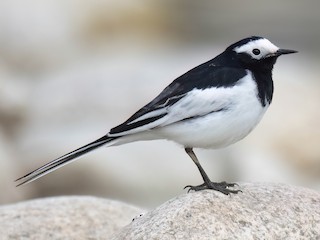
The White Wagtail (Motacilla alba), known in Italian as 'Ballerina bianca', is a small passerine bird of the wagtail family Motacillidae. It is a slender, long-tailed bird, typically characterized by its striking black, white, and grey plumage and its distinctive tail-wagging habit. It is a widespread and common species across much of Eurasia and parts of North Africa, often found in open habitats close to human settlements and water.
Dimensioni e longevità
- Lunghezza
- 16.5-19 cm (including tail)
- Apertura alare
- 25-30 cm
- Peso
- 17-25 g
- Longevità
- 2-5 years (up to 10 years recorded)
- Dieta
- Insectivore
Caratteristiche fisiche
- Piumaggio
- Adult males in breeding plumage typically have a black crown, nape, and throat, contrasting with a white face and underparts. The back is grey, and the wings are black with prominent white wing-bars. The long tail is black with white outer tail feathers. Females are similar but often have a duller black on the head and throat, sometimes appearing more greyish-black. Non-breeding adults have less extensive black on the head and throat, often with a white throat and a black crescent on the breast.
- Forma del becco
- Slender, pointed, and dark (blackish) for insect catching.
- Colore degli occhi
- Dark brown
- Colore delle zampe
- Blackish
- Caratteristiche distintive
- Long, constantly wagging tail; striking black, white, and grey plumage; undulating flight pattern; often seen running on the ground.
- Aspetto giovanile
- Juveniles are generally duller and browner than adults. They have a greyish-brown crown and back, a buffy-white face, and a dirty white throat and underparts. The black bib is absent or very faint, replaced by a greyish wash on the breast. The wing bars are buffy rather than pure white.
- Cambiamenti stagionali
- Adults undergo a partial pre-breeding moult in late winter/early spring, acquiring their crisp black and white breeding plumage. A complete post-breeding moult occurs in late summer/autumn, leading to the duller non-breeding plumage with reduced black on the head and throat.
- Dimorfismo sessuale
- Subtle. Males in breeding plumage have more extensive and intense black on the crown, nape, and throat. Females may have a duller black or more greyish-black, and sometimes a less defined black bib. In non-breeding plumage, differences are minimal.
Come identificare
- 1
Plumage Pattern
Look for the distinct black, white, and grey pattern. White face, black cap and bib (in adults), grey back, and black wings with white wing-bars are key. Juveniles are browner and duller.
- 2
Tail Wagging
The most characteristic behavior is the constant, rhythmic up-and-down wagging of its long tail, even when standing still. This is a strong field mark.
- 3
Gait and Foraging
Observe its distinctive running and stopping gait on the ground, often in open areas. It will dart forward, pause, and then pick up insects.
- 4
Call
Listen for its sharp, disyllabic 'chi-tsip' or 'chissick' call, often given in flight. This is a reliable auditory cue.
- 5
Habitat
Look in open, often disturbed areas near water or human habitation, such as car parks, riverbanks, fields, and urban parks.
Habitat e areale
- Biomi
- Temperate grasslands, urban and suburban areas, agricultural lands, wetlands, coastal areas.
- Areale geografico
- Widespread across Eurasia, from Western Europe to Eastern Asia, including parts of North Africa and Alaska. Breeding range extends from the Arctic Circle south to the Mediterranean and Himalayas. Winters in southern Europe, Africa, and South Asia.
- Fascia altitudinale
- Sea level up to 3,000 meters in some mountainous regions, though typically found at lower elevations.
- Ambienti preferiti
- Open, short-grass areas, often near water bodies (rivers, lakes, ponds), human settlements (towns, villages, farms), car parks, sports fields, and industrial areas. They prefer disturbed or artificial habitats with scattered vegetation and bare ground for foraging.
Comportamento
- Periodo di attività
- Diurnal. Active from dawn to dusk.
- Abitudini alimentari
- Primarily insectivorous, feeding on a wide variety of small invertebrates such as flies, beetles, ants, moths, and their larvae. They forage by running rapidly on the ground, stopping abruptly to pick up prey, or making short aerial sallies to catch flying insects. They often follow livestock or agricultural machinery to catch disturbed insects.
- Comportamento sociale
- Typically seen singly or in pairs during the breeding season. Outside of breeding, they can form large communal roosts, sometimes numbering in the thousands, especially during migration and winter. These roosts are often in urban areas, in trees or reeds.
- Tipo di volo
- Undulating flight, characterized by a series of short, rapid wing beats followed by a brief glide, often close to the ground. They are agile in the air when pursuing insects.
- Migrazione
- Many populations are migratory, moving south for the winter. Northern and eastern populations are generally more migratory than western and southern ones. They migrate during the day, often in loose flocks. Some populations in milder climates (e.g., Western Europe) are resident or partially migratory.
- Territorialità
- Males establish and defend breeding territories, often aggressively, against other wagtails. They use song and display flights to advertise their presence and deter rivals.
Canto e richiami
- Canto
- A rather simple, rambling, and unmusical warbling song, often incorporating mimicry of other birds. It's a series of chirps, trills, and whistles, delivered from a perch or in flight. Not particularly loud or melodious.
- Richiamo
- The most common call is a sharp, disyllabic 'chi-tsip' or 'chissick', often given in flight or when disturbed. Also a softer 'tseep' contact call.
- Quando vocalizza
- Calls are given year-round, especially when disturbed or in flight. Song is primarily heard during the breeding season, from early spring to mid-summer.
Riproduzione
- Stagione riproduttiva
- Typically April to August, with variations depending on geographic location. Often raises two broods per season.
- Abitudini di nidificazione
- Nests are usually built in crevices or cavities, often in man-made structures like walls, bridges, sheds, or under eaves. Natural sites include rock faces, tree holes, or dense vegetation. The nest is a cup-shaped structure made of grass, moss, roots, and leaves, lined with hair, wool, and feathers.
- Dimensione della covata
- 4-6 eggs (occasionally 3-7)
- Descrizione dell'uovo
- 4-6 eggs, typically pale greyish-white or buff, finely speckled with grey, brown, or black, often concentrated at the broader end. Eggs measure approximately 20 x 15 mm.
- Periodo di incubazione
- 12-14 days, primarily by the female.
- Periodo di involo
- 12-15 days after hatching. Young leave the nest but are still fed by parents for some time.
- Cure parentali
- Both parents participate in feeding the nestlings and fledglings. The male often feeds the first brood while the female starts incubating the second clutch.
Dove trovarlo
Urban and Suburban Areas
Parks, gardens, car parks, industrial estates, and residential areas, especially where there are open grassy patches and buildings for nesting.
Agricultural Land
Fields, pastures, and farmyards, where they can forage for insects disturbed by livestock or machinery.
Water Bodies
Riverbanks, lake shores, pond edges, and coastal areas, as they often forage for aquatic insects.
Open Ground
Any open, short-grass or bare ground areas, including sports fields, airfields, and construction sites.
Consigli sul campo
- Look for movement. Their constant tail-wagging and darting movements on the ground make them quite conspicuous, even from a distance.
- Listen for calls. Their distinctive 'chi-tsip' call is often heard before the bird is seen, especially when they are flying overhead.
- Check open, disturbed areas. Unlike many passerines, they thrive in human-modified landscapes. Focus your search on areas with short grass, pavement, or bare earth.
- Observe communal roosts. In autumn and winter, look for large flocks gathering at dusk in urban trees or reedbeds to roost.
Specie simili
Pied Wagtail
Motacilla alba yarrellii
The Pied Wagtail is a subspecies of the White Wagtail found primarily in Great Britain and Ireland. Males have a black back (instead of grey) and more extensive black on the flanks. Females also show more black on the back than continental White Wagtails. Juveniles are very similar.
Grey Wagtail
Motacilla cinerea
Distinguished by its bright yellow underparts (especially the vent), grey back, and a longer tail than the White Wagtail. Males have a black throat in breeding plumage. Its call is a sharper, more metallic 'tseet'.
Yellow Wagtail
Motacilla flava
Characterized by its predominantly yellow underparts and olive-green upperparts. Head patterns vary significantly between subspecies, but none have the extensive black and white of the White Wagtail. Its call is a softer 'pslie'.
Fatti rapidi
- Tail Wagging:
- Constant, distinctive up-and-down tail movement.
- Diet:
- Almost exclusively insects.
- Habitat Preference:
- Open areas, often near water and human activity.
- Migration:
- Partial to full migrant depending on population.
- Conservation Status:
- Least Concern (widespread and common).
Curiosità
- The White Wagtail is the national bird of Latvia.
- Its scientific name 'Motacilla' comes from Latin, meaning 'mover of the tail', perfectly describing its most famous characteristic.
- Despite its small size, the White Wagtail is known for its long-distance migrations, with some individuals traveling thousands of kilometers between breeding and wintering grounds.
- They are highly adaptable and have successfully colonized a wide range of habitats, including bustling city centers.
- The purpose of the tail-wagging is still debated, but theories include flushing out insects, signaling to other wagtails, or indicating vigilance to predators.
Classificazione scientifica
- Regno
- Animalia
- Phylum
- Chordata
- Classe
- Aves
- Ordine
- Passeriformes
- Famiglia
- Motacillidae
- Genere
- Motacilla
- Specie
- Motacilla alba
Esplora White Wagtail
Identifica uccelli ovunque
Gratis su iOS, Android e Web. Identificazione per foto e suono, database completo e la tua lista personale.