
Visto un uccello? Identificalo all'istante con l'app Birdby
Apri l'appInformazioni
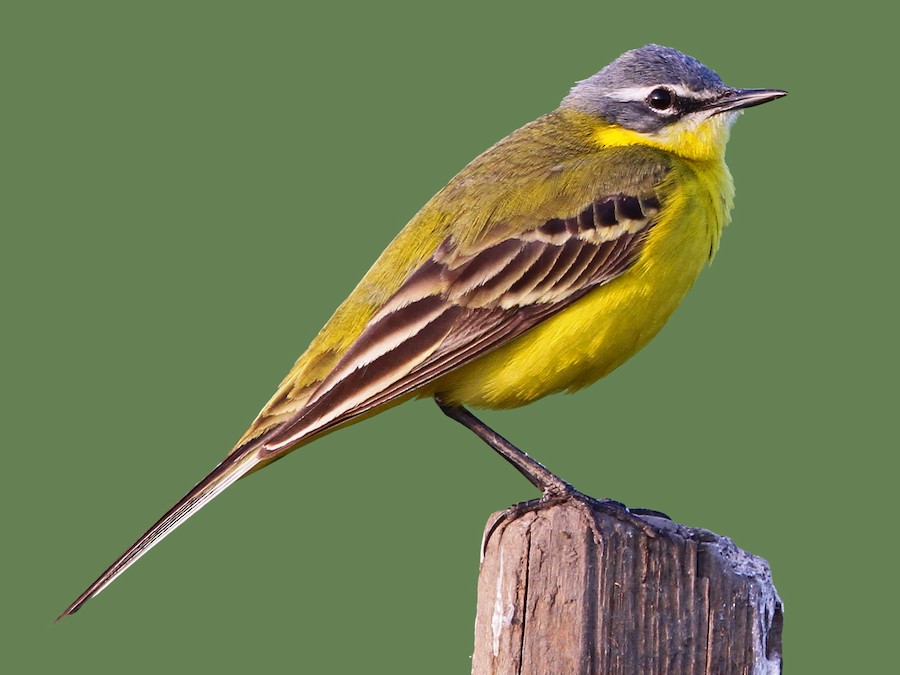
The Western Yellow Wagtail (Motacilla flava) is a small, slender passerine bird in the wagtail family Motacillidae. It is characterized by its long tail, which it constantly wags, and its predominantly yellow underparts, though plumage varies significantly across its numerous subspecies. It is a migratory species, breeding across much of temperate Europe and Asia and wintering in Africa and South Asia.
Dimensioni e longevità
- Lunghezza
- 15-16 cm
- Apertura alare
- 23-27 cm
- Peso
- 12-26 g
- Longevità
- Typically 2-5 years in the wild, with a maximum recorded age of around 8 years.
- Dieta
- Insectivore
Caratteristiche fisiche
- Piumaggio
- Highly variable depending on subspecies and sex. Generally, males in breeding plumage have bright yellow underparts, olive-green upperparts, and a variable head pattern (grey, blue-grey, or green with white supercilium, depending on subspecies). Females are duller, with paler yellow underparts and more olive-brown upperparts. Non-breeding plumage is duller overall, with less vibrant yellow and more brownish tones.
- Forma del becco
- Slender, pointed, and dark (blackish-brown).
- Colore degli occhi
- Dark brown.
- Colore delle zampe
- Dark grey to black.
- Caratteristiche distintive
- Long, constantly wagging tail; slender build; predominantly yellow underparts (especially in males); distinctive head patterns varying by subspecies. The flight is undulating.
- Aspetto giovanile
- Juveniles are duller and browner overall, with buffy-white underparts, often with a yellowish wash on the flanks and vent. They lack the bright yellow of adults and have a less distinct supercilium. They gradually acquire adult plumage through successive molts.
- Cambiamenti stagionali
- Adults undergo a complete post-breeding molt and a partial pre-breeding molt. Breeding plumage is brighter and more contrasting, particularly in males, with vibrant yellow and distinct head patterns. Non-breeding plumage is duller, with more olive-brown tones and less intense yellow.
- Dimorfismo sessuale
- Pronounced in breeding plumage, with males being much brighter and having more distinct head patterns. Females are duller, with less intense yellow and more muted head markings. In non-breeding plumage, differences are less obvious.
Come identificare
- 1
Overall Coloration
Look for bright yellow underparts, especially in breeding males. Females and immatures are duller but usually retain some yellow wash.
- 2
Head Pattern
Pay close attention to the head. Subspecies vary greatly: some have a blue-grey head with a white supercilium (e.g., M. f. flava), others a dark grey head (e.g., M. f. thunbergi), or a green head (e.f., M. f. flavissima). This is key for subspecies identification.
- 3
Tail Wagging
Observe its characteristic constant tail wagging, a trait shared with other wagtails but a good general identifier for the family.
- 4
Habitat
Search in open, damp, grassy areas, especially near water or livestock. This species is rarely found in woodlands.
- 5
Call
Listen for its sharp 'tseep' or 'psit' call, often given in flight.
Habitat e areale
- Biomi
- Grasslands, wetlands, agricultural areas, open fields.
- Areale geografico
- Breeds across most of temperate Europe and Asia, from Western Europe to Alaska. Winters in sub-Saharan Africa, the Arabian Peninsula, and South Asia.
- Fascia altitudinale
- Typically found in lowlands, from sea level up to approximately 1,500 meters, though occasionally higher during migration.
- Ambienti preferiti
- Prefers open, damp habitats with short vegetation, such as wet meadows, pastures, marshes, riverbanks, irrigated fields, and cultivated land. Avoids dense forests and arid regions.
Comportamento
- Periodo di attività
- Diurnal.
- Abitudini alimentari
- Primarily insectivorous, feeding on a wide variety of small invertebrates, including flies, beetles, grasshoppers, caterpillars, spiders, and aquatic insects. Forages on the ground, often running and stopping to pick insects, or making short aerial sallies to catch flying prey. Frequently associates with grazing livestock, catching insects disturbed by their movement.
- Comportamento sociale
- During the breeding season, they are typically found in pairs. Outside of breeding, they can form large flocks, especially during migration and in wintering grounds, often roosting communally.
- Tipo di volo
- Undulating flight, characterized by short bursts of rapid wing beats followed by a brief glide, often close to the ground.
- Migrazione
- Long-distance migratory species. European and Western Asian populations migrate south to sub-Saharan Africa. Eastern Asian populations migrate to South Asia and Southeast Asia. Migration occurs in broad fronts, often at night, with stopovers in suitable habitats.
- Territorialità
- Males establish and defend breeding territories, primarily through song and display. Territories are typically small and centered around nesting sites.
Canto e richiami
- Canto
- A series of high-pitched, often slightly buzzy or trilling notes, typically described as 'tswee-tswee-tswee' or 'sree-sree-sree', often delivered from a prominent perch or in a short song-flight.
- Richiamo
- A sharp, distinctive 'tseep' or 'psit' call, often given in flight or when disturbed. Also a softer 'chissick' call.
- Quando vocalizza
- Most vocal during the breeding season, from spring to early summer. Calls are given year-round, especially during migration.
Riproduzione
- Stagione riproduttiva
- April to July in most of its range.
- Abitudini di nidificazione
- The nest is a cup-shaped structure, typically built on the ground, well-hidden in dense vegetation, often at the base of a tussock or under a bush. It is constructed by the female, primarily from grass, moss, and roots, lined with finer materials like hair or feathers.
- Dimensione della covata
- 3-7 eggs, usually 5-6.
- Descrizione dell'uovo
- 3-7 eggs (typically 5-6), smooth, glossy, whitish or pale buff, heavily speckled and mottled with greyish-brown or reddish-brown, often forming a cap at the broad end. Dimensions average 18 x 14 mm.
- Periodo di incubazione
- 11-13 days, primarily by the female.
- Periodo di involo
- 11-13 days after hatching. Young leave the nest before they can fly well.
- Cure parentali
- Both parents feed the nestlings and fledglings. The female typically incubates, but both participate in chick rearing.
Dove trovarlo
Wet Meadows and Pastures
These are prime habitats, especially those with short grass and grazing animals, which disturb insects.
Agricultural Fields
Irrigated fields, cultivated land, and stubble fields can attract them, particularly during migration.
Riverbanks and Marsh Edges
Areas with low, dense vegetation along water bodies are often frequented.
Sewage Farms and Water Treatment Works
These can be surprisingly good locations due to abundant insect life.
Consigli sul campo
- Scan Open Ground. Yellow Wagtails spend much of their time foraging on the ground. Use binoculars to scan open areas of short grass.
- Look for Movement. Their constant tail wagging and quick, darting movements make them noticeable even in low vegetation.
- Listen for Calls. Their distinctive 'tseep' call is often the first indication of their presence, especially when they are flying overhead.
- Check Near Livestock. They frequently follow cattle or other grazing animals to catch insects disturbed by their hooves.
- Visit During Migration. During spring and autumn migration, they can be found in a wider variety of open habitats, sometimes in large flocks.
Specie simili
Citrine Wagtail
Motacilla citreola
Adult male Citrine Wagtail has a bright yellow head and underparts with a black nape and back (or grey back in some subspecies), lacking the grey or blue-grey cap of many Yellow Wagtail subspecies. Females and immatures are harder to distinguish but often show a more extensive yellow wash on the face and underparts, and a more distinct pale supercilium that extends behind the eye.
Grey Wagtail
Motacilla cinerea
Grey Wagtail has a grey back, yellow vent, and a much longer tail than the Yellow Wagtail. Males have a black throat in breeding plumage. It prefers fast-flowing rivers and streams, unlike the open field habitat of the Yellow Wagtail.
Pied Wagtail (White Wagtail)
Motacilla alba
Pied/White Wagtail is predominantly black and white (or grey and white), lacking the extensive yellow plumage of the Yellow Wagtail. Its habitat preference is also broader, often found in urban areas and open ground, but less tied to wet meadows.
Fatti rapidi
- Subspecies:
- Over 10 recognized subspecies, each with distinct head patterns.
- Tail Wagging:
- A characteristic behavior, though its exact purpose is debated (e.g., flushing prey, signaling).
- Migration Distance:
- Can migrate thousands of kilometers between breeding and wintering grounds.
- Diet Specialization:
- Almost exclusively insectivorous, making them sensitive to pesticide use.
Curiosità
- The scientific name 'Motacilla flava' literally means 'little mover' (Motacilla) and 'yellow' (flava), referring to its constant movement and coloration.
- Due to the extensive variation in head patterns across its many subspecies, the Western Yellow Wagtail is considered a 'species complex' by some ornithologists, with ongoing debate about its taxonomy.
- Some subspecies, like the 'Blue-headed Wagtail' (M. f. flava) and 'Grey-headed Wagtail' (M. f. thunbergi), can interbreed where their ranges overlap, producing intermediate forms.
- They are often among the first migratory birds to arrive in their breeding grounds in spring, signaling the change of seasons.
Classificazione scientifica
- Regno
- Animalia
- Phylum
- Chordata
- Classe
- Aves
- Ordine
- Passeriformes
- Famiglia
- Motacillidae
- Genere
- Motacilla
- Specie
- Motacilla flava
Esplora Western Yellow Wagtail
Identifica uccelli ovunque
Gratis su iOS, Android e Web. Identificazione per foto e suono, database completo e la tua lista personale.