
Visto un uccello? Identificalo all'istante con l'app Birdby
Apri l'appInformazioni
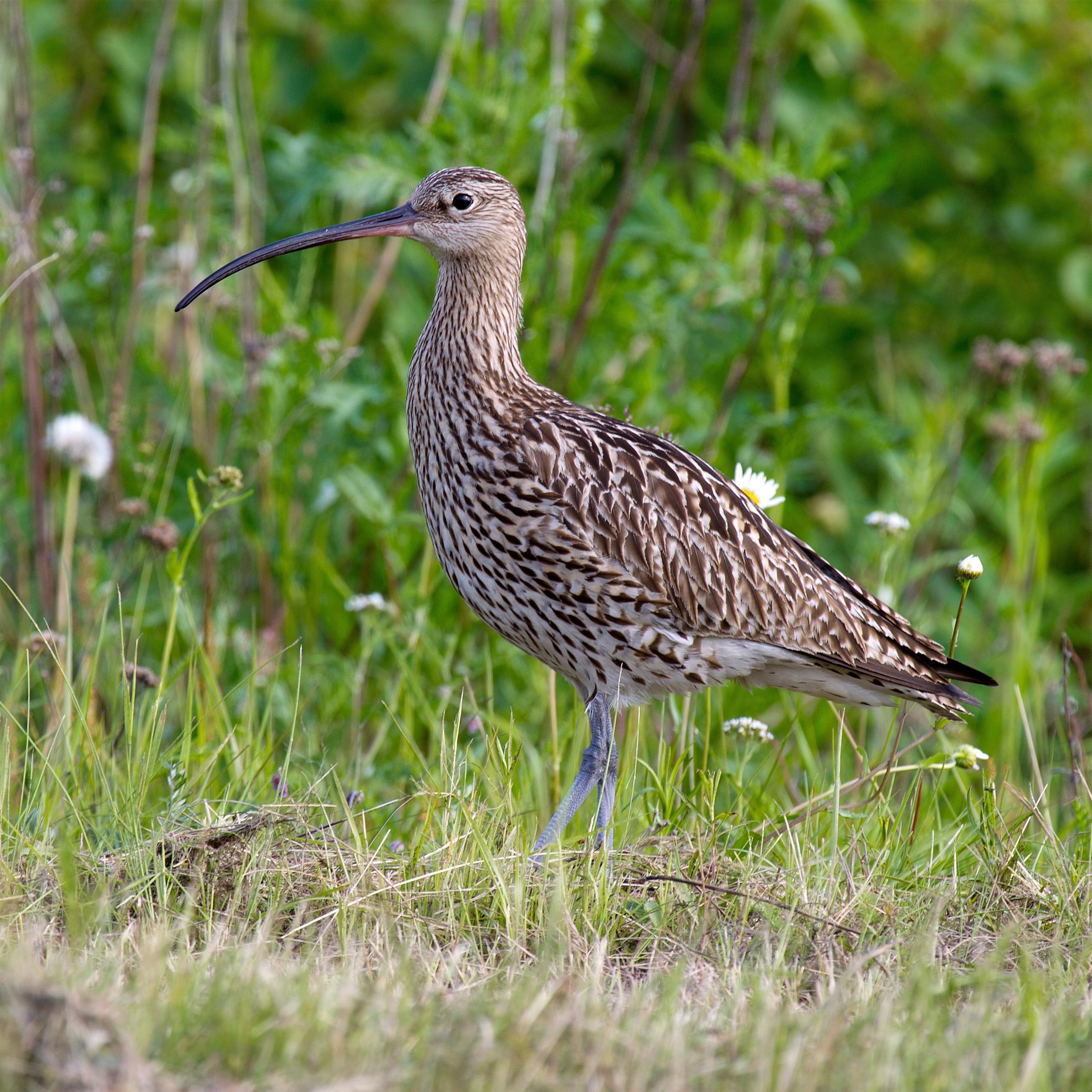
The Eurasian Curlew, known in Italian as Chiurlo maggiore, is the largest wading bird in Europe, easily recognized by its long, downcurved bill and distinctive bubbling call. It is a migratory species, breeding in open country and wetlands across much of temperate Europe and Asia, and wintering on coastal mudflats and estuaries.
Dimensioni e longevità
- Lunghezza
- 50-60 cm (19.7-23.6 in)
- Apertura alare
- 80-100 cm (31.5-39.4 in)
- Peso
- 575-1000 g (1.27-2.2 lbs), with females typically larger than males
- Longevità
- Up to 32 years in the wild, typically 10-15 years
- Dieta
- Omnivore, primarily invertebrates (worms, crustaceans, insects) and some plant material (berries, seeds)
Caratteristiche fisiche
- Piumaggio
- Overall grey-brown streaked plumage. Upperparts are mottled brown with darker streaks, underparts are paler, buffish-white with dark streaking on the breast and flanks. The rump is white, contrasting with the dark tail, and visible in flight. The underwing is white.
- Forma del becco
- Very long (10-15 cm), slender, and distinctly downcurved bill, dark grey to blackish, often paler at the base of the lower mandible.
- Colore degli occhi
- Dark brown.
- Colore delle zampe
- Long, greyish-blue legs.
- Caratteristiche distintive
- Its large size, very long downcurved bill, and distinctive bubbling call are the most prominent distinguishing features. The white rump is also a key field mark in flight.
- Aspetto giovanile
- Juveniles resemble adults but have a shorter, straighter bill that gradually curves and lengthens with age. Their plumage may appear slightly fresher and more uniformly patterned.
- Cambiamenti stagionali
- No significant seasonal plumage changes. Breeding and non-breeding plumages are essentially identical.
- Dimorfismo sessuale
- Females are generally larger than males and tend to have a longer bill, though this can be difficult to discern in the field without direct comparison.
Come identificare
- 1
Size and Shape
Look for a very large, long-legged wader with a distinctive, very long, downcurved bill. It's the largest wader in Europe.
- 2
Plumage
Observe the streaky brown upperparts and paler, streaked underparts. Note the white rump, which is a key identifier in flight.
- 3
Bill
The extremely long, decurved bill is unmistakable and unique among European waders of this size.
- 4
Call
Listen for the characteristic melancholic 'cur-lee' or bubbling trill, especially during the breeding season. This is often the first indication of its presence.
- 5
Habitat
Consider the habitat: open moorlands and wet grasslands in summer, coastal mudflats and estuaries in winter.
Habitat e areale
- Biomi
- Temperate grasslands, moorlands, bogs, wet meadows, agricultural fields (breeding); coastal mudflats, estuaries, saltmarshes, sandy beaches (non-breeding/wintering).
- Areale geografico
- Breeds across much of temperate Europe and Asia, from the UK and Scandinavia eastwards to Siberia and Mongolia. Winters in coastal areas of Western Europe, the Mediterranean, Africa, the Middle East, and South Asia.
- Fascia altitudinale
- Typically found from sea level up to 1000 meters, occasionally higher in some breeding areas.
- Ambienti preferiti
- During breeding, prefers open, damp habitats with tussocky vegetation for nesting. In winter, it favors intertidal zones with soft substrates for foraging.
Comportamento
- Periodo di attività
- Diurnal, but may also forage at night, especially on tidal flats when the tide is out.
- Abitudini alimentari
- Forages by probing its long, curved bill deep into soft mud or soil to extract invertebrates. It can also pick prey from the surface. Diet includes ragworms, lugworms, crabs, small molluscs, insects (beetles, grasshoppers), and occasionally berries or seeds.
- Comportamento sociale
- During the breeding season, they are territorial and typically found in pairs. Outside the breeding season, they are highly gregarious, forming large flocks on coastal mudflats and estuaries, often associating with other waders.
- Tipo di volo
- Strong, direct flight with relatively slow, deliberate wingbeats. In display flight, males perform aerial acrobatics with deep wingbeats and glides. The white rump is conspicuous in flight.
- Migrazione
- A long-distance migratory species. Northern and eastern populations migrate south and west for the winter. Western European populations may be resident or undertake shorter migrations. Migration occurs in broad fronts, often at night.
- Territorialità
- Highly territorial during the breeding season, defending nesting sites and foraging areas from conspecifics and other potential threats. Males perform elaborate aerial displays to establish and defend territories.
Canto e richiami
- Canto
- The breeding song is a distinctive, far-carrying, melancholic, and fluting 'cur-lee' or 'coor-lee' call, often repeated and rising in pitch, sometimes developing into a bubbling trill. It is one of the most evocative sounds of European wetlands and moorlands.
- Richiamo
- Common calls include a loud, clear 'cour-lee' or 'coo-ee' contact call, and a sharp 'kwee-kwee-kwee' alarm call when disturbed. Flocks often emit a continuous series of 'cur-lee' notes.
- Quando vocalizza
- Most vocal during the breeding season (spring and early summer) when establishing territories and attracting mates. Also vocal during migration and in wintering flocks, especially when disturbed or communicating.
Riproduzione
- Stagione riproduttiva
- April to July, with peak egg-laying in April-May.
- Abitudini di nidificazione
- Nests on the ground in a shallow scrape, often concealed within tussocks of grass or heather. The nest is typically lined with grass, moss, and other plant material.
- Dimensione della covata
- Usually 4 eggs.
- Descrizione dell'uovo
- Typically 4 eggs, pear-shaped, olive-green to buffish-brown with dark brown or blackish spots and blotches, particularly concentrated at the broader end.
- Periodo di incubazione
- 27-29 days, incubated by both parents.
- Periodo di involo
- Chicks are precocial and leave the nest shortly after hatching. They are able to fly at about 32-38 days old.
- Cure parentali
- Both parents share incubation duties and care for the chicks. The female often leaves the brood before the young fledge, leaving the male to complete parental care.
Dove trovarlo
Breeding Grounds
Moorlands, bogs, wet grasslands, and agricultural fields across northern and western Europe, particularly the UK, Ireland, and Scandinavia.
Wintering Grounds
Coastal estuaries, mudflats, and saltmarshes along the Atlantic coast of Europe, the Mediterranean, and parts of Africa and Asia.
Consigli sul campo
- Listen for the call. The distinctive 'cur-lee' call is often heard before the bird is seen, especially in dense breeding habitats.
- Scan open areas. During breeding, look for them in open, damp fields or moorlands. In winter, scan large expanses of mudflats at low tide.
- Look for probing behavior. Observe their feeding technique: long bills probing deep into the substrate.
- Check for white rump in flight. When a large wader flies away, the contrasting white rump is a strong indicator of a Eurasian Curlew.
Specie simili
Whimbrel
Numenius phaeopus
The Whimbrel is smaller than the Eurasian Curlew, has a shorter and less dramatically downcurved bill, and a distinct dark stripe through the eye with a pale supercilium and a dark crown stripe. Its call is a rapid, trilling 'titti-titti-titti'.
Slender-billed Curlew
Numenius tenuirostris
Critically endangered and possibly extinct. It is slightly smaller than the Eurasian Curlew, with a shorter, more slender bill and more distinct heart-shaped spots on the flanks. Field identification is extremely challenging and requires expert knowledge.
Fatti rapidi
- Largest European Wader:
- Yes
- Bill Shape:
- Long, distinctly downcurved
- Key Call:
- Melancholic 'cur-lee' or bubbling trill
- Conservation Status:
- Near Threatened
- Habitat (Winter):
- Coastal mudflats and estuaries
Curiosità
- The name 'Curlew' is onomatopoeic, derived from its distinctive call.
- Eurasian Curlews are known for their impressive long-distance migrations, with some individuals traveling thousands of kilometers between breeding and wintering grounds.
- The female's bill is typically longer than the male's, allowing them to exploit slightly different food resources and potentially reduce competition.
- They are considered an indicator species for the health of wetland and grassland ecosystems.
Classificazione scientifica
- Regno
- Animalia
- Phylum
- Chordata
- Classe
- Aves
- Ordine
- Charadriiformes
- Famiglia
- Scolopacidae
- Genere
- Numenius
- Specie
- Numenius arquata
Esplora Eurasian Curlew
Identifica uccelli ovunque
Gratis su iOS, Android e Web. Identificazione per foto e suono, database completo e la tua lista personale.