
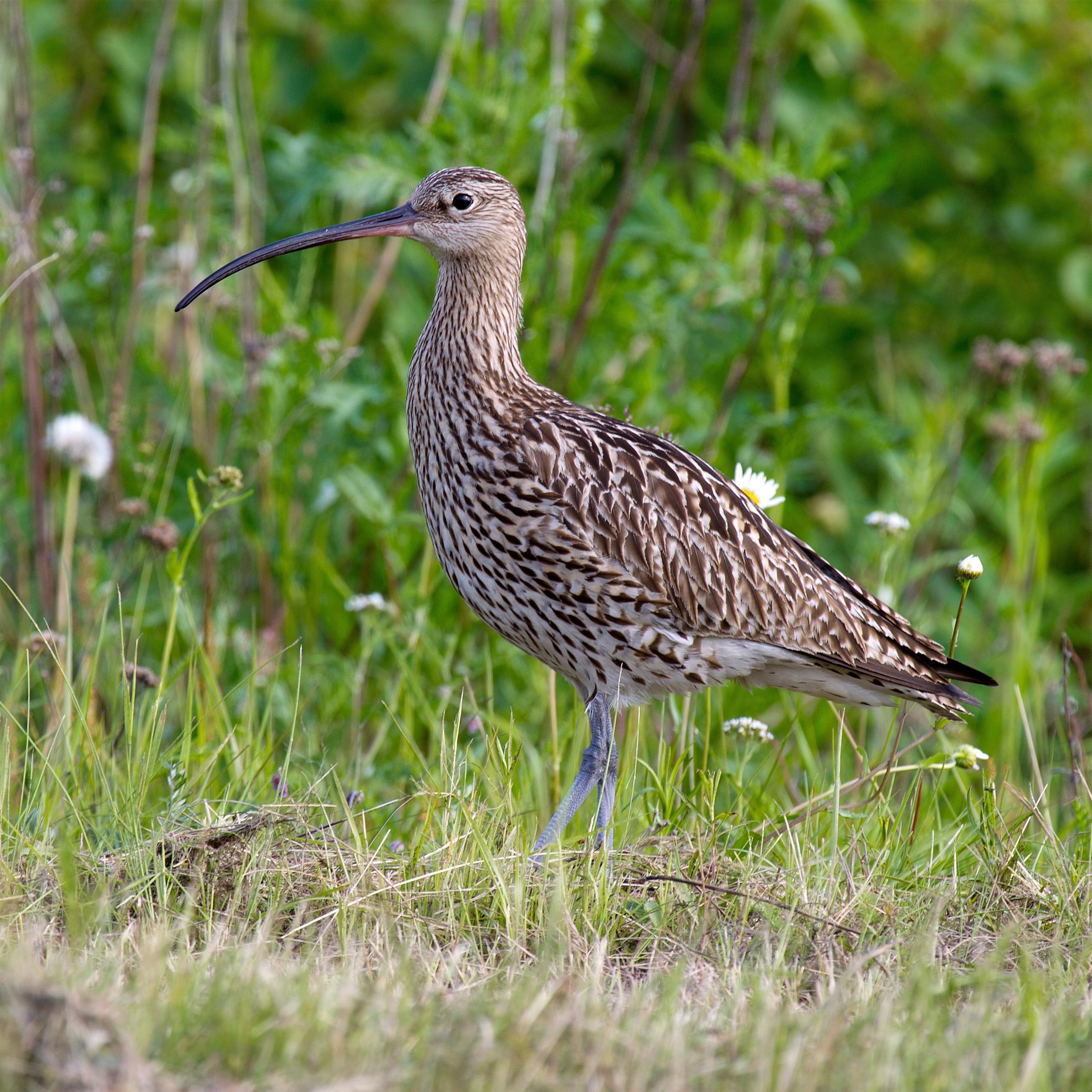
Come identificare Eurasian Curlew
Numenius arquata
Visto un uccello? Identificalo all'istante con l'app Birdby
Apri l'appPer identificare correttamente Eurasian Curlew (Numenius arquata), controlla ciascuna di queste caratteristiche. Gli uccelli possono essere complicati da riconoscere, perché comportamento, habitat e canto spesso confermano ciò che una sola foto non può.
Dimensioni a colpo d'occhio
- Lunghezza
- 50-60 cm (19.7-23.6 in)
- Apertura alare
- 80-100 cm (31.5-39.4 in)
- Peso
- 575-1000 g (1.27-2.2 lbs), with females typically larger than males
Caratteristiche fisiche da controllare
- 1
Piumaggio
Colorazione e disegno generale del piumaggio.
Overall grey-brown streaked plumage. Upperparts are mottled brown with darker streaks, underparts are paler, buffish-white with dark streaking on the breast and flanks. The rump is white, contrasting with the dark tail, and visible in flight. The underwing is white.
- 2
Forma del becco
Forma e colore del becco, un segno di campo chiave.
Very long (10-15 cm), slender, and distinctly downcurved bill, dark grey to blackish, often paler at the base of the lower mandible.
- 3
Colore degli occhi
Colore dell'iride e segni distintivi sugli occhi.
Dark brown.
- 4
Colore delle zampe
Colore di zampe e piedi.
Long, greyish-blue legs.
- 5
Caratteristiche distintive
Tratti distintivi che separano questa specie.
Its large size, very long downcurved bill, and distinctive bubbling call are the most prominent distinguishing features. The white rump is also a key field mark in flight.
- 6
Aspetto giovanile
Come i giovani si differenziano dagli adulti.
Juveniles resemble adults but have a shorter, straighter bill that gradually curves and lengthens with age. Their plumage may appear slightly fresher and more uniformly patterned.
- 7
Cambiamenti stagionali
Variazione del piumaggio tra stagione riproduttiva e non.
No significant seasonal plumage changes. Breeding and non-breeding plumages are essentially identical.
- 8
Dimorfismo sessuale
Differenze tra maschi e femmine.
Females are generally larger than males and tend to have a longer bill, though this can be difficult to discern in the field without direct comparison.
Segni di campo chiave
- Size and Shape. Look for a very large, long-legged wader with a distinctive, very long, downcurved bill. It's the largest wader in Europe.
- Plumage. Observe the streaky brown upperparts and paler, streaked underparts. Note the white rump, which is a key identifier in flight.
- Bill. The extremely long, decurved bill is unmistakable and unique among European waders of this size.
- Call. Listen for the characteristic melancholic 'cur-lee' or bubbling trill, especially during the breeding season. This is often the first indication of its presence.
- Habitat. Consider the habitat: open moorlands and wet grasslands in summer, coastal mudflats and estuaries in winter.
Esplora Eurasian Curlew
Identifica uccelli ovunque
Gratis su iOS, Android e Web. Identificazione per foto e suono, database completo e la tua lista personale.