
Visto un uccello? Identificalo all'istante con l'app Birdby
Apri l'appInformazioni
The Northern Wheatear is a small, migratory passerine bird known for its distinctive white rump and tail pattern. It is a widespread species, breeding across vast areas of the Northern Hemisphere and undertaking long-distance migrations to Africa and southern Asia.
Dimensioni e longevità
- Lunghezza
- 14-16 cm
- Apertura alare
- 26-32 cm
- Peso
- 17-30 g
- Longevità
- Typically 2-5 years in the wild, with records up to 10 years.
- Dieta
- Insectivore, primarily feeding on insects and other invertebrates.
Caratteristiche fisiche
- Piumaggio
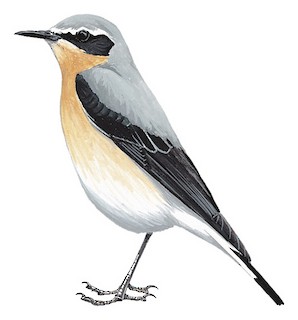
- Males in breeding plumage have a pale grey crown and nape, a black mask extending from the bill through the eye, white supercilium, and buffy-white underparts. The back is grey, and wings are blackish. The most striking feature is the white rump and basal half of the tail, with a black inverted 'T' pattern at the tail tip. Females are duller, with brownish-grey upperparts, a less defined brownish mask, and buffier underparts. Non-breeding males resemble females but retain some grey on the head. Juveniles are mottled brownish with pale spots.
- Forma del becco
- Slender, pointed, and black.
- Colore degli occhi
- Dark brown.
- Colore delle zampe
- Black.
- Caratteristiche distintive
- The prominent white rump and the inverted 'T' pattern on the tail are the most reliable field marks. Its upright posture and habit of flicking its tail are also characteristic.
- Aspetto giovanile
- Juveniles are heavily mottled and spotted brown on the upperparts and breast, with a scaly appearance. They lack the distinct grey and black patterns of adult males and the uniform brown of adult females.
- Cambiamenti stagionali
- Males transition from a brighter breeding plumage (grey back, black mask) to a duller non-breeding plumage (browner upperparts, less defined mask) in autumn. Females show less dramatic seasonal variation, remaining generally brownish, though breeding plumage can appear slightly fresher.
- Dimorfismo sessuale
- Pronounced in breeding plumage, with males being brighter and having a distinct black mask and grey upperparts. Females are duller and browner.
Come identificare
- 1
Rump and Tail Pattern
Look for the bright white rump and the distinctive inverted black 'T' pattern on the tail. This is the most reliable field mark in all plumages.
- 2
Male Breeding Plumage
Identify the grey crown and nape, black mask through the eye, white supercilium, and buffy-white underparts. The grey back contrasts with blackish wings.
- 3
Female/Non-breeding Plumage
Note the duller, brownish-grey upperparts and buffier underparts. The facial mask is less defined and brownish. The white rump and tail pattern remain key.
- 4
Behavior
Observe its upright posture, frequent tail flicking, and habit of perching on prominent rocks or mounds in open habitats.
- 5
Call
Listen for the sharp 'chack' call, which is often given when disturbed or as an alarm.
Habitat e areale
- Biomi
- Tundra, moorland, rocky outcrops, open grasslands, steppes, semi-deserts, and agricultural land with sparse vegetation.
- Areale geografico
- Breeds across a vast range in the Northern Hemisphere, including Europe, Asia, Greenland, eastern Canada, and Alaska. Winters in sub-Saharan Africa, Arabia, and parts of India.
- Fascia altitudinale
- From sea level up to 3,000 meters in mountainous regions during breeding, and similar ranges in wintering grounds.
- Ambienti preferiti
- Open, treeless or sparsely vegetated areas with scattered rocks, boulders, or low walls that provide perching sites and nesting crevices. Often found in disturbed areas, quarries, and coastal dunes.
Comportamento
- Periodo di attività
- Diurnal.
- Abitudini alimentari
- Primarily an insectivore, foraging on the ground by running, hopping, and making short flights to catch insects. It often perches on prominent rocks or mounds to scan for prey. Diet includes beetles, ants, flies, caterpillars, spiders, and occasionally berries.
- Comportamento sociale
- Generally solitary or found in pairs during the breeding season. During migration, they can form loose flocks.
- Tipo di volo
- Undulating flight with rapid wing beats, often low to the ground. When disturbed, it flies a short distance and lands, often flicking its tail.
- Migrazione
- Long-distance migratory species. European and Asian populations winter in Africa, while North American populations winter in Africa. Known for one of the longest migratory journeys of any passerine, with some individuals traveling from Arctic Canada to Africa.
- Territorialità
- Males establish and defend breeding territories, often using song and display flights. Both sexes participate in defending the nest site.
Canto e richiami
- Canto
- A varied, warbling song, often delivered from a prominent perch or in a display flight. It includes a mix of harsh, scratchy notes and sweeter, more melodious phrases, sometimes incorporating mimicry of other birds.
- Richiamo
- Common calls include a sharp, hard 'chack' or 'chick' often repeated, and a soft, whistled 'hoo-eet' or 'whee-t'. The alarm call is a rapid series of 'chack-chack-chack'.
- Quando vocalizza
- Most vocal during the breeding season, particularly at dawn and dusk, and throughout the day when establishing territories or attracting mates.
Riproduzione
- Stagione riproduttiva
- Typically April to July, varying with geographic location.
- Abitudini di nidificazione
- Nests are usually built in crevices or holes in rocks, stone walls, old burrows (e.g., rabbit burrows), or under dense vegetation. The nest is a cup-shaped structure made of grass, moss, roots, and lined with finer materials like hair, wool, and feathers.
- Dimensione della covata
- Typically 4-7 eggs, usually 5-6.
- Descrizione dell'uovo
- 4-7 eggs, pale blue, sometimes with fine reddish-brown speckles, measuring approximately 20 x 15 mm.
- Periodo di incubazione
- 13-15 days, primarily by the female.
- Periodo di involo
- 14-17 days after hatching. Young are fed by both parents.
- Cure parentali
- Both parents feed the nestlings and fledglings. Males often bring food to the incubating female.
Dove trovarlo
Open, Rocky Habitats
Look in areas with sparse vegetation, scattered rocks, boulders, scree slopes, and stone walls, particularly in upland or coastal regions.
Moorland and Tundra
In northern breeding grounds, they are common in open moorland, heathland, and tundra environments.
Agricultural and Disturbed Land
During migration, they can be found in open fields, pastures, quarries, and other disturbed open areas.
Consigli sul campo
- Scan prominent perches. Wheatears often perch conspicuously on rocks, fence posts, or low bushes to survey their surroundings for prey or intruders.
- Look for tail flicking. Their characteristic tail-flicking behavior is a good indicator, even from a distance.
- Observe ground foraging. Watch for birds running and hopping on the ground, making short dashes to catch insects.
- Listen for calls. Their sharp 'chack' call can often draw attention to their presence before you see them.
- Check migration hotspots. During spring and autumn migration, coastal areas, islands, and open habitats along migratory routes can host large numbers of wheatears.
Specie simili
Isabelline Wheatear
Oenanthe isabellina
Larger and paler overall, with a less distinct facial mask. The tail pattern is similar but the black 'T' is often less prominent, and the white extends further up the tail. It also has a more upright stance and a longer bill.
Pied Wheatear
Oenanthe pleschanka
Males are strikingly black and white, with a black back and crown, and a more extensive black throat and face. Females are browner but still show a more contrasting pattern than Northern Wheatear females.
Black-eared Wheatear
Oenanthe hispanica
Males have a black throat and ear coverts (or just ear coverts in the 'white-throated' morph), and a whiter crown and nape. Females are generally paler and sandier than Northern Wheatear females.
Fatti rapidi
- Etymology:
- The name 'wheatear' is not derived from 'wheat' or 'ear', but from 'white' and 'arse' (or 'rump'), referring to its prominent white rump.
- Migration Champion:
- Some populations undertake one of the longest migratory journeys of any passerine, traveling up to 15,000 km (9,300 miles) each way between Arctic breeding grounds and African wintering grounds.
- Habitat Specialist:
- Strongly associated with open, rocky, and often treeless habitats.
- Nest Site Flexibility:
- Known to use a wide variety of cavities for nesting, from rock crevices to old burrows.
Curiosità
- The Greenland subspecies (O. o. leucorhoa) is larger and undertakes an even more epic migration, crossing vast stretches of the Atlantic Ocean.
- Wheatears are one of the few passerine species that breed in both the Old World and the New World (North America).
- Their ability to navigate such long distances over open ocean and land is a marvel of avian migration.
Classificazione scientifica
- Regno
- Animalia
- Phylum
- Chordata
- Classe
- Aves
- Ordine
- Passeriformes
- Famiglia
- Muscicapidae
- Genere
- Oenanthe
- Specie
- Oenanthe oenanthe
Esplora Northern Wheatear
Identifica uccelli ovunque
Gratis su iOS, Android e Web. Identificazione per foto e suono, database completo e la tua lista personale.