
Visto un uccello? Identificalo all'istante con l'app Birdby
Apri l'appInformazioni
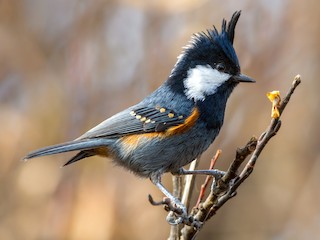
The Coal Tit (Periparus ater) is a small passerine bird in the tit family Paridae. It is a widespread and common resident breeder throughout temperate Europe and Asia, often found in coniferous and mixed woodlands. Known for its distinctive black cap, white cheek patches, and a prominent white patch on the nape, it is an active and agile feeder, often seen clinging to branches and cones.
Dimensioni e longevità
- Lunghezza
- 10-11.5 cm
- Apertura alare
- 17-21 cm
- Peso
- 7-12 g
- Longevità
- 2-5 years (up to 9 years recorded)
- Dieta
- Omnivore (primarily insectivorous, especially during breeding season; seeds and nuts in winter)
Caratteristiche fisiche
- Piumaggio
- Adults have a glossy black head with prominent white cheek patches and a distinctive white patch on the nape. The back is slate-grey, and the underparts are buffy-white, often with a slight yellowish or brownish wash, particularly on the flanks. The wings and tail are dark grey with faint paler edgings to the flight feathers. There are two narrow white wing-bars.
- Forma del becco
- Small, conical, and pointed; black in color.
- Colore degli occhi
- Dark brown.
- Colore delle zampe
- Dark grey to blackish.
- Caratteristiche distintive
- The most distinctive features are the glossy black cap, the large white cheek patches, and especially the prominent white patch on the nape (back of the neck), which is unique among European tits. The two white wing-bars are also a good field mark.
- Aspetto giovanile
- Juveniles resemble adults but have duller plumage. The black areas of the head are less glossy, more sooty-brown, and the white cheek patches and nape patch are often tinged yellowish or buffy. The underparts are also more yellowish-buff.
- Cambiamenti stagionali
- No significant seasonal plumage changes. The plumage remains consistent throughout the year, though it may appear slightly worn or faded towards the end of the breeding season before the annual molt.
- Dimorfismo sessuale
- Males and females are generally monomorphic in plumage, appearing identical. There might be slight size differences, with males being marginally larger on average, but this is not discernible in the field.
Come identificare
- 1
Head Pattern
Look for the glossy black cap, prominent white cheek patches, and most importantly, the distinct white patch on the nape (back of the neck). This nape patch is the key identifier.
- 2
Plumage Coloration
Note the slate-grey back and buffy-white underparts. The two narrow white wing-bars are also a good feature to observe.
- 3
Size and Shape
It's a small, compact tit, slightly smaller than a Great Tit and similar in size to a Blue Tit, but with a more slender build than the latter.
- 4
Behavior
Observe its active foraging style, often hanging upside down or clinging to conifer cones. Its preference for coniferous trees is also a strong clue.
- 5
Vocalizations
Listen for its characteristic 'pee-choo, pee-choo' song, which sounds like a bicycle pump, and its sharp 'tsee-tsee-tsee' calls.
Habitat e areale
- Biomi
- Temperate forests, boreal forests, mixed woodlands, parks, gardens.
- Areale geografico
- Widespread across Europe and Asia, from the British Isles and Iberia eastward through Scandinavia, central and eastern Europe, Russia, and across Siberia to Japan and China. Also found in parts of North Africa.
- Fascia altitudinale
- Sea level up to 2,000 meters, occasionally higher in mountainous regions (e.g., up to 3,000 meters in the Himalayas).
- Ambienti preferiti
- Strong preference for coniferous forests (pine, spruce, fir), but also common in mixed woodlands, especially those with a significant conifer component. Can be found in deciduous woods, parks, and large gardens, particularly outside the breeding season.
Comportamento
- Periodo di attività
- Diurnal.
- Abitudini alimentari
- Primarily insectivorous during spring and summer, feeding on insects, spiders, and their larvae. In autumn and winter, their diet shifts to seeds, especially conifer seeds, and nuts. They are adept at extracting seeds from cones and will also feed on beech mast and acorns. Known for caching food (seeds and nuts) in crevices, under bark, or in the ground for later retrieval, a crucial survival strategy in winter. They forage actively, often hanging upside down or clinging to the tips of branches.
- Comportamento sociale
- During the breeding season, they are territorial and typically found in pairs. Outside the breeding season, they often join mixed-species foraging flocks, particularly with other tit species, Goldcrests, and Treecreepers. They can be quite bold at bird feeders.
- Tipo di volo
- Undulating flight, typical of small passerines, with rapid wing beats interspersed with short glides.
- Migrazione
- Mostly resident throughout their range, but some northern and eastern populations undertake short-distance irruptive movements in years of poor food supply. Juveniles may disperse further from their natal sites. Generally considered a sedentary species.
- Territorialità
- Highly territorial during the breeding season, defending their nesting and foraging areas from conspecifics and sometimes other small birds.
Canto e richiami
- Canto
- The song is a distinctive, high-pitched, and repetitive 'pee-choo, pee-choo, pee-choo' or 'si-tu, si-tu, si-tu', often described as sounding like a bicycle pump. It is delivered rapidly and can be quite loud for such a small bird. Variations include a faster 'wit-chee, wit-chee' or a more drawn-out 'tsee-tsee-tsee'.
- Richiamo
- Common calls include a sharp 'tsee-tsee-tsee' or 'sitt-sitt-sitt' contact call, a thin 'tsee' or 'tsip', and a scolding 'churr' or 'chick-a-dee-dee' when alarmed or agitated. The alarm call is a rapid, high-pitched 'tsee-tsee-tsee-tsee'.
- Quando vocalizza
- Most vocal during the breeding season (spring and early summer) when males sing to attract mates and defend territory. Calls are given year-round, especially when foraging or in mixed flocks.
Riproduzione
- Stagione riproduttiva
- Typically April to July, with peak activity in May and June. Often raises two broods per year.
- Abitudini di nidificazione
- Nests are usually built in holes in trees (often old woodpecker holes), stumps, or banks, but also readily uses nest boxes. They prefer small, dark cavities. The nest is a cup-shaped structure made of moss, hair, wool, and feathers, often lined with finer materials.
- Dimensione della covata
- 7-11 eggs, sometimes up to 13.
- Descrizione dell'uovo
- Eggs are white with reddish-brown speckles, particularly concentrated at the broader end. They are small and oval-shaped.
- Periodo di incubazione
- 14-16 days, primarily by the female.
- Periodo di involo
- 18-20 days after hatching. Both parents feed the nestlings.
- Cure parentali
- Both parents participate in feeding the young. The female incubates, while the male brings food to her and later to the nestlings. After fledging, the young are fed by both parents for a short period before becoming independent.
Dove trovarlo
Coniferous Forests
The primary habitat, especially pine, spruce, and fir forests. Look among the needles and cones.
Mixed Woodlands
Areas with a mix of conifers and deciduous trees, particularly where conifers are abundant.
Parks and Gardens
In winter, they may visit parks and gardens, especially those with mature trees or bird feeders.
Bird Feeders
They are frequent visitors to feeders offering seeds (especially sunflower seeds) and suet, particularly in colder months.
Consigli sul campo
- Listen for the song. The repetitive 'pee-choo' song is often the first indication of a Coal Tit's presence, even before you see it.
- Check conifer trees. Focus your search on coniferous trees, where they actively forage for insects and seeds. Look for small, active birds moving quickly through the branches.
- Observe mixed flocks. In autumn and winter, join mixed-species tit flocks. Coal Tits are often part of these groups, moving through the canopy.
- Look for the nape patch. Once you spot a small tit, quickly scan for the white patch on the back of its neck – this is the definitive field mark for a Coal Tit.
Specie simili
Great Tit
Parus major
The Great Tit is significantly larger, has a black head with white cheeks, but lacks the white nape patch. It has a prominent black stripe running down its yellow underparts, which the Coal Tit lacks. Its song is a louder, more ringing 'tee-cher, tee-cher'.
Blue Tit
Cyanistes caeruleus
The Blue Tit is smaller and much more colorful, with a blue cap, blue wings, and yellow underparts. It also has a black eye-stripe and a white face, but no white nape patch. Its calls and songs are distinctively different, often a high-pitched 'tsee-tsee-tsee' followed by a trill.
Marsh Tit
Poecile palustris
The Marsh Tit has a glossy black cap and white cheeks, but lacks the white nape patch and the two white wing-bars of the Coal Tit. Its back is brownish-grey, not slate-grey. Its call is a distinctive explosive 'pitchou' or 'psh-choo'.
Willow Tit
Poecile montanus
Very similar to Marsh Tit, also lacking the white nape patch and wing-bars. Distinguished from Marsh Tit by a slightly larger, duller black cap, a pale panel on the wing (due to paler feather edges), and a more shaggy appearance. Its call is a drawn-out, nasal 'zee-zee-choo-choo-choo'.
Fatti rapidi
- Family:
- Paridae (Tits)
- Diet:
- Insects, spiders, seeds, nuts
- Habitat:
- Coniferous and mixed woodlands
- Conservation Status:
- Least Concern
- Distinguishing Feature:
- White nape patch
Curiosità
- The Coal Tit is one of the smallest European tits, often overlooked due to its size and preference for dense foliage.
- It is an expert at caching food, sometimes storing thousands of seeds and nuts in a season, remembering the locations for later retrieval.
- Despite its name, 'Coal' refers to its dark cap, not its habitat or diet.
- Several subspecies exist across its vast range, showing slight variations in plumage coloration, particularly in the extent of buff or grey on the underparts and back.
- Its ability to extract seeds from conifer cones makes it a vital disperser of conifer seeds in its ecosystem.
Classificazione scientifica
- Regno
- Animalia
- Phylum
- Chordata
- Classe
- Aves
- Ordine
- Passeriformes
- Famiglia
- Paridae
- Genere
- Periparus
- Specie
- Periparus ater
Esplora Coal Tit
Identifica uccelli ovunque
Gratis su iOS, Android e Web. Identificazione per foto e suono, database completo e la tua lista personale.