
Visto un uccello? Identificalo all'istante con l'app Birdby
Apri l'appInformazioni
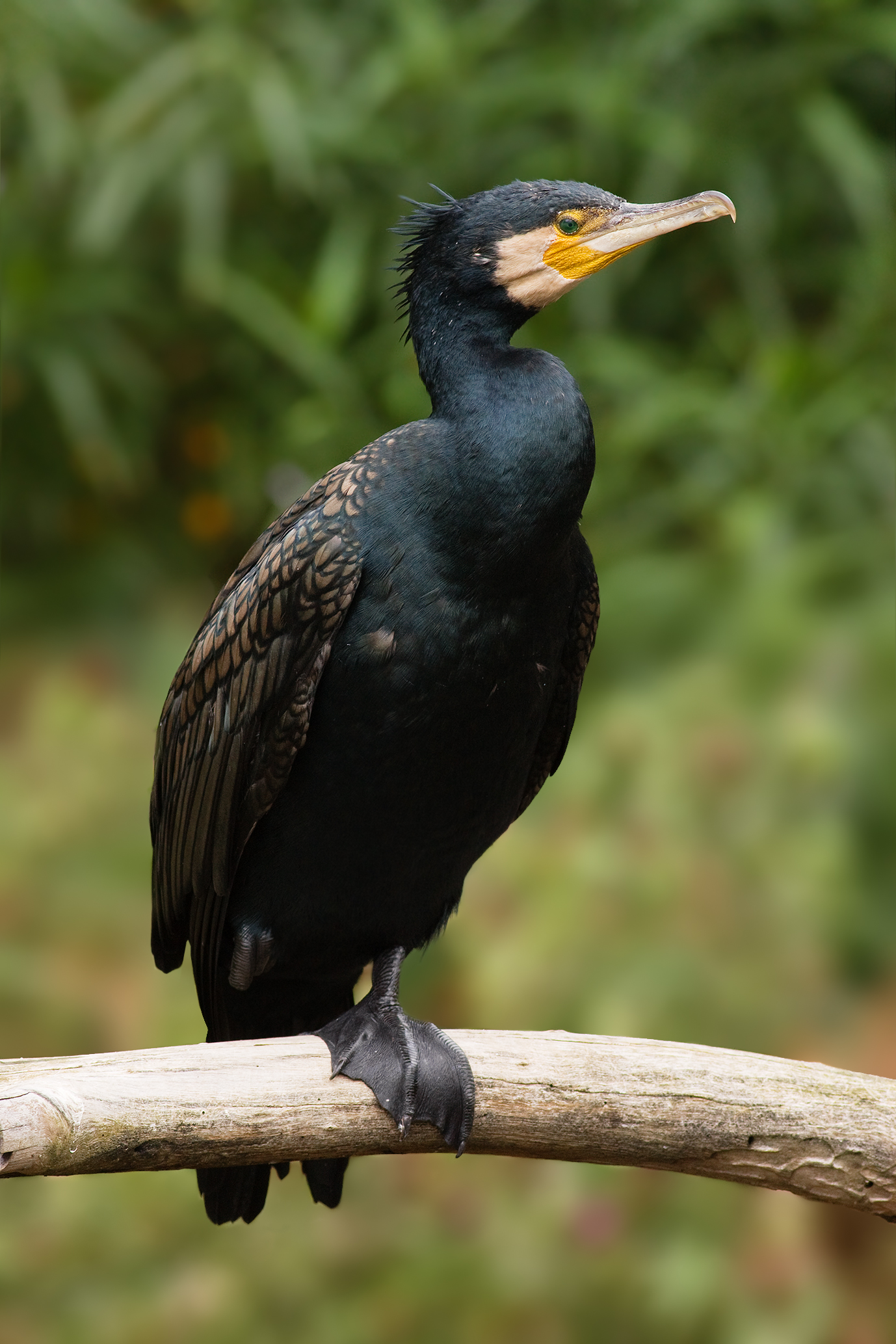
The Great Cormorant is a large, dark-plumaged aquatic bird found across a wide range of freshwater and coastal habitats. Renowned for its diving prowess, it feeds primarily on fish, which it pursues underwater. It is often seen perched with wings outstretched to dry its plumage, which is not fully waterproof.
Dimensioni e longevità
- Lunghezza
- 80-100 cm
- Apertura alare
- 130-160 cm
- Peso
- 1.5-5.3 kg
- Longevità
- Up to 15-20 years in the wild
- Dieta
- Carnivore (piscivorous)
Caratteristiche fisiche
- Piumaggio
- Adults are predominantly glossy black with a metallic green sheen, especially on the back and wings. The throat and cheeks are white, bordered by a yellow gular patch. During breeding season, adults develop white patches on the flanks and fine white streaking on the head and neck.
- Forma del becco
- Long, slender, and hooked at the tip, dark grey to black. The upper mandible is slightly longer than the lower.
- Colore degli occhi
- Bright green, surrounded by a bare yellow patch of skin.
- Colore delle zampe
- Black, with fully webbed feet.
- Caratteristiche distintive
- Large size, dark plumage, prominent yellow gular patch, and the characteristic habit of perching with wings spread to dry. The hooked bill is also distinctive.
- Aspetto giovanile
- Juveniles are browner overall, with a paler, often whitish, belly and throat. The yellow gular patch is less developed, and they lack the white flank patches and head streaking of breeding adults. They gradually acquire adult plumage over 2-3 years.
- Cambiamenti stagionali
- During the breeding season, adults develop a prominent white patch on each flank (thigh patch) and fine white filoplumes on the head and neck. These features are lost outside the breeding season.
- Dimorfismo sessuale
- Males are generally slightly larger than females, but plumage is identical.
Come identificare
- 1
Size and Shape
Look for a large, heavy-bodied waterbird with a long neck, stout body, and a long, hooked bill. Appears somewhat 'reptilian'.
- 2
Plumage (Adult)
Glossy black plumage with a metallic sheen. Distinctive white throat and cheek patch, bordered by a yellow-orange gular skin. Breeding adults show white flank patches and fine white head streaking.
- 3
Plumage (Juvenile)
Browner overall with a paler, often whitish, belly and throat. Lacks the strong yellow gular patch and breeding adornments of adults.
- 4
Behavior
Often seen diving for fish, then perching with wings outstretched to dry. Flies with strong, direct wingbeats, often in V-formation.
- 5
Habitat
Found in both freshwater (large lakes, rivers) and coastal marine environments.
Habitat e areale
- Biomi
- Coastal marine environments, large freshwater lakes, rivers, estuaries, and reservoirs.
- Areale geografico
- Widespread across Europe, Asia, Africa, Australasia, and parts of North America (Greenland and eastern Canada).
- Fascia altitudinale
- Typically found from sea level up to a few hundred meters, primarily associated with water bodies.
- Ambienti preferiti
- Prefers shallow, productive waters for foraging, with nearby undisturbed areas for roosting and nesting, such as cliffs, islands, or tall trees.
Comportamento
- Periodo di attività
- Diurnal, actively foraging during daylight hours.
- Abitudini alimentari
- Primarily piscivorous, diving from the surface to pursue fish underwater. They use their powerful webbed feet for propulsion and their hooked bill to grasp prey. They can dive to considerable depths and remain submerged for up to a minute. They often hunt cooperatively in groups.
- Comportamento sociale
- Highly social, especially outside the breeding season, forming large roosting and feeding flocks. Breeds colonially, often in mixed-species colonies with other waterbirds.
- Tipo di volo
- Strong, direct flight with powerful, steady wing beats. Often flies in V-formations or in long lines when moving between feeding and roosting sites. Appears heavy in flight, with the neck extended.
- Migrazione
- Northern populations are migratory, moving south for the winter. Southern populations are largely resident or undertake short-distance dispersal. Migration occurs in broad fronts, often along coastlines or major river systems.
- Territorialità
- Territorial around the nest site during the breeding season, but generally tolerant of other cormorants outside this period.
Canto e richiami
- Canto
- Generally silent away from the breeding colony. No true song.
- Richiamo
- At colonies, they produce a variety of guttural grunts, croaks, and hisses, particularly during courtship, territorial disputes, and when disturbed. Calls include 'gra-gra-gra' or 'karr-karr'.
- Quando vocalizza
- Mainly vocal during the breeding season at nesting colonies.
Riproduzione
- Stagione riproduttiva
- Varies geographically, typically from February to July in temperate regions, year-round in tropical areas.
- Abitudini di nidificazione
- Nests colonially on cliffs, rocky islets, in trees, or on artificial structures like derelict buildings or platforms. Nests are bulky structures made of sticks, seaweed, and other vegetation, cemented with guano.
- Dimensione della covata
- 3-4 eggs
- Descrizione dell'uovo
- Typically 3-4 eggs (range 1-6), pale blue or greenish-blue, covered with a chalky white layer that often gets stained.
- Periodo di incubazione
- 28-31 days
- Periodo di involo
- 50-60 days, but young may leave the nest earlier and remain in the vicinity, being fed by parents.
- Cure parentali
- Both parents share incubation duties and care for the young. Chicks are altricial, born naked and helpless, and require extensive parental feeding.
Dove trovarlo
Coastal Areas
Look along rocky coastlines, estuaries, and sheltered bays, especially where there are good fishing grounds and undisturbed roosting sites.
Large Inland Waters
Check large lakes, reservoirs, and slow-moving rivers, particularly those with abundant fish populations and suitable perching trees or islands.
Breeding Colonies
During the breeding season, locate nesting colonies on cliffs, islands, or in tall trees near water bodies. These can be very noisy and active.
Consigli sul campo
- Look for drying behavior. Cormorants frequently perch with their wings spread wide to dry their feathers after diving. This is a very characteristic posture and makes them easy to spot.
- Observe diving patterns. Watch for birds that dive smoothly from the surface, often disappearing for 30-60 seconds before resurfacing, usually with a fish.
- Check roosting sites. At dawn and dusk, observe large groups flying to and from communal roosts, which can be on isolated trees, cliffs, or artificial structures.
- Listen at colonies. During the breeding season, their guttural calls can help locate active nesting colonies.
Specie simili
European Shag
Phalacrocorax aristotelis
The European Shag is smaller and more slender, with a more delicate bill. Adults have a prominent crest during breeding season (lacking in Great Cormorant). The Shag's gular patch is dark, not yellow, and it lacks the white flank patches of breeding Great Cormorants. Shags are almost exclusively marine, while Great Cormorants use both fresh and saltwater.
Double-crested Cormorant
Phalacrocorax auritus
Found in North America. Similar in size and appearance, but the Double-crested Cormorant has a more orange-yellow gular pouch and lacks the white throat/cheek patch of the Great Cormorant. Breeding adults have two small crests (often inconspicuous). The Great Cormorant (subspecies P. c. carbo) in North America is restricted to the Atlantic coast and has a more extensive white throat patch.
Fatti rapidi
- Diet:
- Fish
- Habitat:
- Freshwater and coastal marine
- Sociality:
- Colonial
- Distinguishing Feature:
- Yellow gular patch, white throat, drying wings
- Conservation Status:
- Least Concern
Curiosità
- Cormorants have less preen oil than most other waterbirds, which allows their feathers to become waterlogged. This reduces buoyancy, making it easier for them to dive and pursue fish underwater. They then need to dry their wings after fishing.
- In some parts of Asia, particularly China and Japan, cormorants have historically been trained by fishermen to catch fish. A ring is placed around the bird's neck to prevent it from swallowing larger fish, which are then retrieved by the fisherman.
- The Great Cormorant is one of the most widespread cormorant species globally, with a distribution spanning multiple continents.
- Despite their large size, cormorants are agile underwater predators, capable of rapid acceleration and maneuvering to catch fast-moving fish.
Classificazione scientifica
- Regno
- Animalia
- Phylum
- Chordata
- Classe
- Aves
- Ordine
- Suliformes
- Famiglia
- Phalacrocoracidae
- Genere
- Phalacrocorax
- Specie
- Phalacrocorax carbo
Esplora Great Cormorant
Identifica uccelli ovunque
Gratis su iOS, Android e Web. Identificazione per foto e suono, database completo e la tua lista personale.