
Visto un uccello? Identificalo all'istante con l'app Birdby
Apri l'appInformazioni
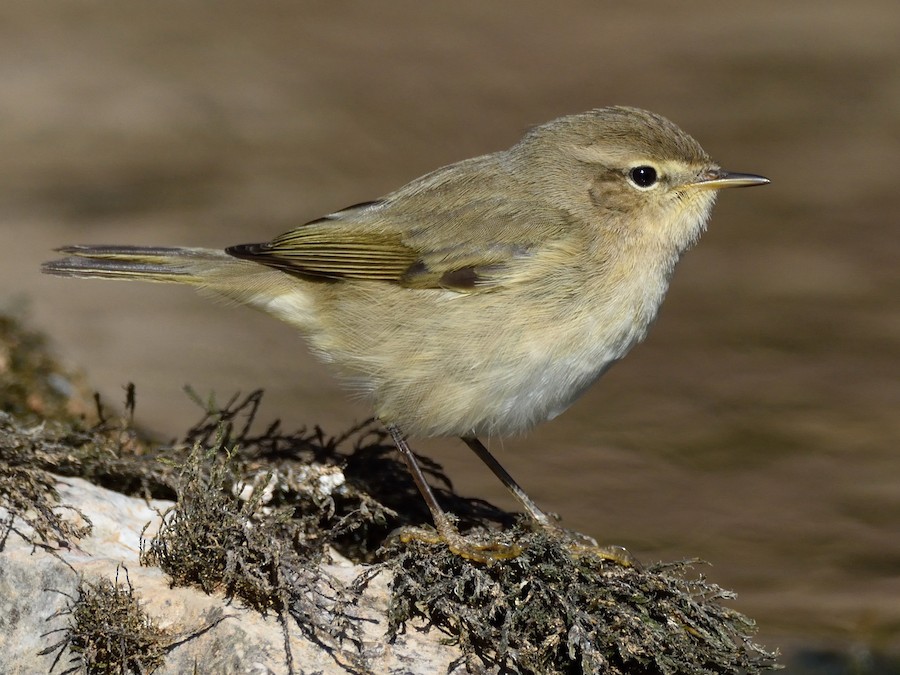
The Common Chiffchaff, known in Italian as 'Luì piccolo', is a small, active, and widespread Old World warbler. It is best known for its distinctive, repetitive song, which gives it its onomatopoeic name in many languages. It is a migratory species across much of its range, undertaking long journeys between its breeding grounds in Europe and Asia and its wintering areas in southern Europe, Africa, and parts of Asia.
Dimensioni e longevità
- Lunghezza
- 10-12 cm
- Apertura alare
- 15-21 cm
- Peso
- 6-10 g
- Longevità
- 2-3 years (up to 7 years in the wild)
- Dieta
- Insectivore
Caratteristiche fisiche
- Piumaggio
- Overall dull greenish-brown upperparts, off-white to yellowish-white underparts. The flanks often show a yellowish wash. The rump and uppertail coverts are slightly brighter green. The primary projection is relatively short. It lacks prominent wing bars.
- Forma del becco
- Small, fine, pointed bill, dark horn-colored with a paler base to the lower mandible.
- Colore degli occhi
- Dark brown
- Colore delle zampe
- Typically dark brown to blackish, though some subspecies (e.g., 'tristis') can have paler legs. This is a variable and often unreliable identification feature.
- Caratteristiche distintive
- Small size, active foraging behavior, often flicks its tail downwards. The supercilium (eyebrow stripe) is usually short and indistinct, often yellowish-buff. The eye-ring is pale and often incomplete. The tertials often have pale edges.
- Aspetto giovanile
- Juveniles are similar to adults but often have a slightly browner wash to the upperparts and a more yellowish tinge to the underparts, especially on the throat and breast. They quickly attain adult-like plumage after their post-juvenile molt.
- Cambiamenti stagionali
- No significant seasonal plumage changes. The plumage may appear slightly fresher and brighter after the post-breeding molt in late summer/autumn, and more worn and duller by late spring.
- Dimorfismo sessuale
- None; sexes are outwardly identical in plumage and size.
Come identificare
- 1
Song
The most reliable identification feature. Listen for the repetitive 'chiff-chaff, chiff-chaff' song. If you hear a melodious, descending trill, it's likely a Willow Warbler.
- 2
Plumage
Look for dull greenish-brown upperparts and off-white to yellowish-white underparts. Note the lack of strong contrasts or prominent wing bars.
- 3
Leg Color
While variable, typically dark brown to blackish legs are a good indicator, especially when compared to the often paler legs of Willow Warblers. However, some Chiffchaff subspecies (e.g., 'tristis') can have pale legs, so use with caution.
- 4
Primary Projection
Observe the length of the primary feathers extending beyond the tertials. Chiffchaffs have a relatively short primary projection compared to Willow Warblers.
- 5
Tail Flicks
Chiffchaffs frequently flick their tails downwards, a characteristic behavior that can help distinguish them from Willow Warblers, which tend to wag their tails from side to side.
- 6
Supercilium
The supercilium is usually short, indistinct, and yellowish-buff, not as prominent or bright as in Willow Warblers.
Habitat e areale
- Biomi
- Temperate forests, woodlands, scrub, parks, gardens, riparian zones, hedgerows.
- Areale geografico
- Breeds across most of Europe and temperate Asia, from Ireland and Portugal east to Siberia. Winters in southern Europe, North Africa, the Middle East, and parts of tropical Asia.
- Fascia altitudinale
- Sea level up to 2,000 meters, occasionally higher in some parts of its breeding range.
- Ambienti preferiti
- Prefers deciduous and mixed woodlands with a good understory, often near water. Also common in parks, large gardens, orchards, and scrubland. Requires dense vegetation for nesting and foraging.
Comportamento
- Periodo di attività
- Diurnal.
- Abitudini alimentari
- Primarily insectivorous, feeding on small insects and their larvae, spiders, and other invertebrates gleaned from leaves and twigs. It is an active forager, constantly moving through the foliage, often hovering briefly or making short sallies to catch flying insects. Occasionally consumes berries in autumn.
- Comportamento sociale
- Solitary or in pairs during the breeding season. Outside the breeding season, it can be found singly or in loose mixed-species foraging flocks, especially during migration.
- Tipo di volo
- Undulating, rather weak, and fluttering flight over short distances. When migrating, it undertakes long, sustained flights.
- Migrazione
- A long-distance migrant across much of its range. European populations typically migrate south to the Mediterranean basin, North Africa, and sub-Saharan Africa. Asian populations winter further south in the Middle East and tropical Asia. Some western European populations are increasingly resident or undertake shorter migrations.
- Territorialità
- Males are highly territorial during the breeding season, defending their territory with song and occasional aggressive displays against rivals.
Canto e richiami
- Canto
- A distinctive, repetitive, and often monotonous 'chiff-chaff, chiff-chaff, chiff-chiff-chaff' song, varying in tempo and emphasis. The song is typically delivered from a prominent perch within its territory.
- Richiamo
- A soft, plaintive 'hweet' or 'hoo-eet' call, often given when agitated or in contact with other chiffchaffs. Also a sharp 'twick' alarm call.
- Quando vocalizza
- Mainly sings from early spring (February/March) through the breeding season (until July/August). Calls are given year-round, especially during foraging or when disturbed.
Riproduzione
- Stagione riproduttiva
- April to July in most of Europe, with variations depending on latitude.
- Abitudini di nidificazione
- The nest is a domed structure, often referred to as a 'ball of moss', built close to the ground (usually within 50 cm) in dense vegetation, such as brambles, nettles, or low bushes. It is constructed by the female using moss, grass, leaves, and lined with finer materials like feathers and hair.
- Dimensione della covata
- 5-7 eggs
- Descrizione dell'uovo
- Typically 5-7 eggs, white with fine reddish-brown or purplish-brown speckles, often concentrated at the broader end. Eggs measure approximately 15 x 12 mm.
- Periodo di incubazione
- 13-15 days, primarily by the female.
- Periodo di involo
- 12-15 days after hatching. Young are fed by both parents.
- Cure parentali
- Both parents feed the nestlings and fledglings, though the female does most of the incubation. Often raises two broods per season.
Dove trovarlo
Deciduous and Mixed Woodlands
Look in the canopy and understory of broadleaf trees, especially those with dense foliage.
Parks and Gardens
Common in urban and suburban green spaces with mature trees and shrubs.
Riparian Zones
Often found along riverbanks and near water bodies where vegetation is lush.
Consigli sul campo
- Listen for the song. The distinctive 'chiff-chaff' song is the easiest way to locate this species, especially during spring and early summer. They often sing from high perches.
- Observe foraging behavior. Watch for small, active birds constantly moving through foliage, gleaning insects from leaves and twigs. They are rarely still for long.
- Check understory vegetation. While they forage in the canopy, they also frequent lower shrubs and bushes, especially when nesting or during migration.
- Patience and binoculars. Their small size and active nature make them challenging to observe clearly. Patience and good binoculars are essential.
Specie simili
Willow Warbler
Phylloscopus trochilus
The Willow Warbler is very similar in appearance but generally has paler, often pinkish-brown legs (though variable), a longer primary projection (wingtip extends further beyond tertials), and a more prominent, yellowish supercilium. Crucially, its song is a distinctive, melodious, descending cascade of notes, very different from the Chiffchaff's repetitive song. Its call is a soft 'hoo-eet' or 'huit', similar but often softer than the Chiffchaff's.
Wood Warbler
Phylloscopus sibilatrix
The Wood Warbler is larger and brighter, with a striking lemon-yellow throat and breast contrasting with pure white underparts. It has bright yellow-green upperparts and a prominent yellow supercilium. Its legs are pale. Its song is a distinctive, accelerating trill followed by a sighing 'swee-swee-swee'.
Bonelli's Warbler
Phylloscopus bonelli
Bonelli's Warbler (now split into Western and Eastern Bonelli's Warbler) has a plainer, greyer-brown upperparts, clean white underparts, and a distinct pale panel on the wing formed by pale-edged flight feathers. Its legs are pale pinkish-brown. Its song is a rapid, mechanical trill.
Fatti rapidi
- Song:
- Repetitive 'chiff-chaff'
- Diet:
- Insects and spiders
- Habitat:
- Woodlands, parks, gardens
- Migration:
- Long-distance migrant
- Nest:
- Domed, near ground
Curiosità
- The Common Chiffchaff's scientific name, 'collybita', is derived from the Greek word 'kollubistes', meaning 'money-changer', possibly referring to the sound of its song resembling the clinking of coins.
- Despite their small size, Chiffchaffs undertake impressive migratory journeys, often covering thousands of kilometers between their breeding and wintering grounds.
- There are several recognized subspecies of Chiffchaff, some of which have distinct calls and songs, leading to ongoing taxonomic debate and potential future splits (e.g., Siberian Chiffchaff, 'tristis').
- In some parts of its range, particularly in Western Europe, Chiffchaffs are increasingly overwintering rather than migrating, possibly due to climate change and milder winters.
Classificazione scientifica
- Regno
- Animalia
- Phylum
- Chordata
- Classe
- Aves
- Ordine
- Passeriformes
- Famiglia
- Phylloscopidae
- Genere
- Phylloscopus
- Specie
- Phylloscopus collybita
Esplora Common Chiffchaff
Identifica uccelli ovunque
Gratis su iOS, Android e Web. Identificazione per foto e suono, database completo e la tua lista personale.