
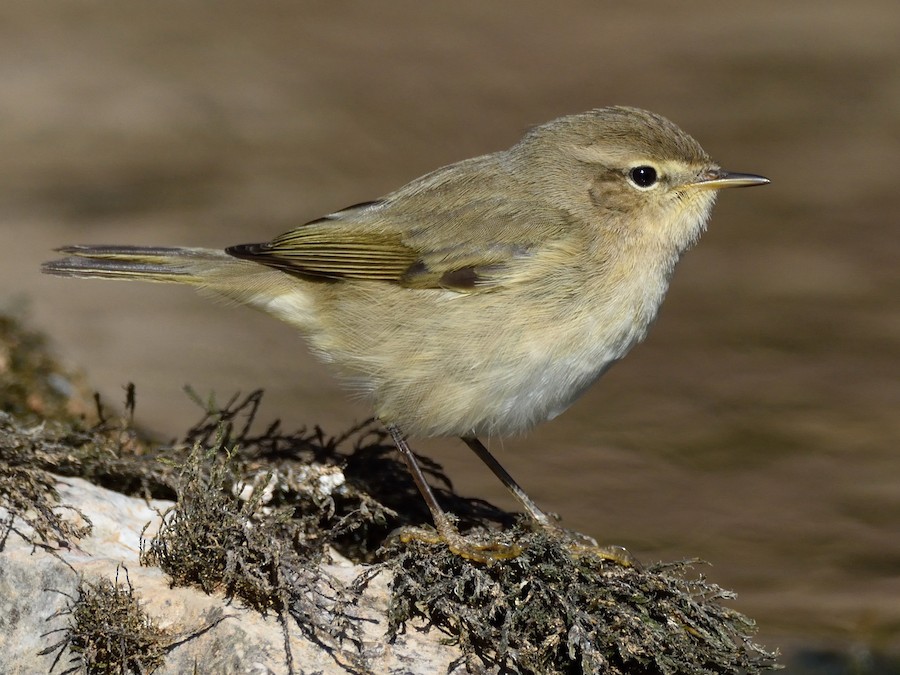
Come identificare Common Chiffchaff
Phylloscopus collybita
Visto un uccello? Identificalo all'istante con l'app Birdby
Apri l'appPer identificare correttamente Common Chiffchaff (Phylloscopus collybita), controlla ciascuna di queste caratteristiche. Gli uccelli possono essere complicati da riconoscere, perché comportamento, habitat e canto spesso confermano ciò che una sola foto non può.
Dimensioni a colpo d'occhio
- Lunghezza
- 10-12 cm
- Apertura alare
- 15-21 cm
- Peso
- 6-10 g
Caratteristiche fisiche da controllare
- 1
Piumaggio
Colorazione e disegno generale del piumaggio.
Overall dull greenish-brown upperparts, off-white to yellowish-white underparts. The flanks often show a yellowish wash. The rump and uppertail coverts are slightly brighter green. The primary projection is relatively short. It lacks prominent wing bars.
- 2
Forma del becco
Forma e colore del becco, un segno di campo chiave.
Small, fine, pointed bill, dark horn-colored with a paler base to the lower mandible.
- 3
Colore degli occhi
Colore dell'iride e segni distintivi sugli occhi.
Dark brown
- 4
Colore delle zampe
Colore di zampe e piedi.
Typically dark brown to blackish, though some subspecies (e.g., 'tristis') can have paler legs. This is a variable and often unreliable identification feature.
- 5
Caratteristiche distintive
Tratti distintivi che separano questa specie.
Small size, active foraging behavior, often flicks its tail downwards. The supercilium (eyebrow stripe) is usually short and indistinct, often yellowish-buff. The eye-ring is pale and often incomplete. The tertials often have pale edges.
- 6
Aspetto giovanile
Come i giovani si differenziano dagli adulti.
Juveniles are similar to adults but often have a slightly browner wash to the upperparts and a more yellowish tinge to the underparts, especially on the throat and breast. They quickly attain adult-like plumage after their post-juvenile molt.
- 7
Cambiamenti stagionali
Variazione del piumaggio tra stagione riproduttiva e non.
No significant seasonal plumage changes. The plumage may appear slightly fresher and brighter after the post-breeding molt in late summer/autumn, and more worn and duller by late spring.
- 8
Dimorfismo sessuale
Differenze tra maschi e femmine.
None; sexes are outwardly identical in plumage and size.
Segni di campo chiave
- Song. The most reliable identification feature. Listen for the repetitive 'chiff-chaff, chiff-chaff' song. If you hear a melodious, descending trill, it's likely a Willow Warbler.
- Plumage. Look for dull greenish-brown upperparts and off-white to yellowish-white underparts. Note the lack of strong contrasts or prominent wing bars.
- Leg Color. While variable, typically dark brown to blackish legs are a good indicator, especially when compared to the often paler legs of Willow Warblers. However, some Chiffchaff subspecies (e.g., 'tristis') can have pale legs, so use with caution.
- Primary Projection. Observe the length of the primary feathers extending beyond the tertials. Chiffchaffs have a relatively short primary projection compared to Willow Warblers.
- Tail Flicks. Chiffchaffs frequently flick their tails downwards, a characteristic behavior that can help distinguish them from Willow Warblers, which tend to wag their tails from side to side.
- Supercilium. The supercilium is usually short, indistinct, and yellowish-buff, not as prominent or bright as in Willow Warblers.
Esplora Common Chiffchaff
Identifica uccelli ovunque
Gratis su iOS, Android e Web. Identificazione per foto e suono, database completo e la tua lista personale.