
Visto un uccello? Identificalo all'istante con l'app Birdby
Apri l'appInformazioni
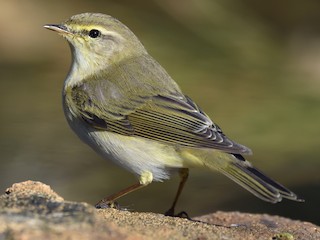
The Willow Warbler, known in Italian as Beccamoschino, is a small, migratory passerine bird belonging to the 'leaf warbler' family. It is a common and widespread summer visitor across most of Europe and Asia, known for its distinctive, melancholic song and preference for open woodland and scrub habitats. Despite its abundance, it is often confused with its close relative, the Common Chiffchaff, due to similar appearance.
Dimensioni e longevità
- Lunghezza
- 11-12.5 cm
- Apertura alare
- 17-22 cm
- Peso
- 6.5-12 g
- Longevità
- Typically 2-3 years in the wild, with a maximum recorded age of around 9 years.
- Dieta
- Insectivore
Caratteristiche fisiche
- Piumaggio
- Upperparts are olive-green to brownish-green, underparts are off-white to pale yellow, particularly on the flanks and vent. It has a distinct yellowish supercilium (eyebrow stripe) and a dark eye-stripe. The throat and breast are often washed with pale yellow, especially in fresh plumage. The rump is concolorous with the back.
- Forma del becco
- Small, slender, pointed, and dark brown to blackish, with a paler base to the lower mandible.
- Colore degli occhi
- Dark brown.
- Colore delle zampe
- Legs are typically pale, ranging from light brown to yellowish-brown or even pinkish-brown. This is a key distinguishing feature from the Chiffchaff, which usually has dark legs.
- Caratteristiche distintive
- Longer primary projection (the length of the primary feathers beyond the tertials when the wing is folded) compared to the Chiffchaff, giving it a more 'pointed' wing appearance. Pale legs are a crucial field mark. Its overall appearance is often described as 'neater' or 'cleaner' than the Chiffchaff.
- Aspetto giovanile
- Juveniles are generally brighter yellow on the underparts and supercilium, and their upperparts can be a more vibrant olive-green. Their plumage is softer and looser than adults.
- Cambiamenti stagionali
- Plumage remains largely consistent throughout the year, though fresh autumn plumage can appear slightly brighter and more yellowish, with wear making spring birds appear duller and greyer-green.
- Dimorfismo sessuale
- Males and females are virtually identical in plumage. Males are typically slightly larger on average, but this is not discernible in the field.
Come identificare
- 1
Song
The most reliable identification feature. Listen for the distinctive, melancholic, descending series of fluty notes that fades away.
- 2
Leg Color
Observe the legs. Willow Warblers typically have pale, yellowish-brown to pinkish-brown legs, contrasting with the usually dark legs of the Chiffchaff.
- 3
Primary Projection
When the bird is perched, look at the length of the primary feathers extending beyond the tertials. Willow Warblers have a noticeably longer primary projection, giving their wing a more pointed appearance compared to the shorter, blunter wing of the Chiffchaff.
- 4
Supercilium
Note the yellowish supercilium (eyebrow stripe). It is usually quite distinct and extends further back than in the Chiffchaff.
- 5
Plumage Tone
Overall, Willow Warblers tend to have a slightly brighter, cleaner olive-green upperparts and a more yellowish wash on the flanks and breast, especially when fresh.
Habitat e areale
- Biomi
- Temperate forests, boreal forests, taiga, scrubland, heathland, parks, gardens.
- Areale geografico
- Breeds across most of Europe and northern Asia, from Ireland and Portugal east to eastern Siberia. Winters in sub-Saharan Africa.
- Fascia altitudinale
- Typically found from sea level up to 2,000 meters, though generally prefers lower elevations.
- Ambienti preferiti
- Prefers open deciduous or mixed woodland with a well-developed understory, scrub, young plantations, clearings, forest edges, and areas with scattered trees and bushes. Avoids dense, mature forests and treeless areas. Often found near water.
Comportamento
- Periodo di attività
- Diurnal, most active during daylight hours, particularly in the morning and late afternoon.
- Abitudini alimentari
- Primarily insectivorous, feeding on a wide variety of small insects and their larvae, such as flies, beetles, aphids, caterpillars, and spiders. It forages actively in the foliage of trees and bushes, gleaning insects from leaves and twigs. It also performs short, agile aerial sallies to catch flying insects.
- Comportamento sociale
- Solitary or found in pairs during the breeding season. Outside of breeding, they are generally solitary but may join mixed-species feeding flocks during migration.
- Tipo di volo
- Light, buoyant, and undulating flight, often flitting between branches with rapid wing beats. During migration, it undertakes long-distance, sustained flights.
- Migrazione
- A long-distance migratory species. European populations migrate south to sub-Saharan Africa for the winter, typically arriving in breeding grounds from April to May and departing from August to September. Asian populations also migrate south to tropical Asia and Africa.
- Territorialità
- Males are highly territorial during the breeding season, defending their breeding territory with song and displays. They will chase off rivals and other small birds.
Canto e richiami
- Canto
- A distinctive, gentle, and melancholic descending series of liquid, fluty notes, often described as 'hoo-weet hoo-weet hoo-weet hoo-wit wit wit wit'. It starts strong and then fades away, often with a slight acceleration towards the end. It is a beautiful and easily recognizable song.
- Richiamo
- A soft, plaintive 'hoo-eet' or 'hweet', often given as a contact call or alarm call. It is softer and less emphatic than the Chiffchaff's 'chiff-chaff' call.
- Quando vocalizza
- Males sing frequently from arrival on breeding grounds in spring until late summer. Calls are given throughout the day, especially when foraging or disturbed.
Riproduzione
- Stagione riproduttiva
- May to July in Europe.
- Abitudini di nidificazione
- The female builds a dome-shaped nest, often referred to as a 'domed' or 'oven-shaped' nest, on or very close to the ground, typically well-hidden amongst dense vegetation, grass tussocks, or at the base of a small bush. It is constructed from grass, moss, leaves, and lined with fine grass, hair, and feathers.
- Dimensione della covata
- Typically 4-7 eggs, usually 5-6.
- Descrizione dell'uovo
- 4-7 (typically 5-6) white or creamy-white eggs, sparsely speckled with reddish-brown or purplish-brown spots, mainly at the broader end. Eggs measure approximately 15 x 12 mm.
- Periodo di incubazione
- 12-14 days, primarily by the female.
- Periodo di involo
- 12-15 days after hatching. Young are fed by both parents.
- Cure parentali
- Both parents feed the nestlings and fledglings. The female incubates the eggs, and both participate in raising the young. They may raise one or two broods per season.
Dove trovarlo
Open Woodlands
Look in deciduous or mixed woodlands with a good understory of shrubs and young trees.
Scrubland and Heathland
Areas with scattered bushes, gorse, and heather are favored habitats.
Forest Edges and Clearings
They often prefer the transitional zones between open areas and denser woodland.
Parks and Gardens
In suburban areas, they can be found in larger parks and gardens with suitable vegetation.
Consigli sul campo
- Listen for the song. During the breeding season (spring and early summer), the song is the easiest way to locate and identify a Willow Warbler. They sing frequently from prominent perches.
- Observe foraging behavior. Watch for small birds actively gleaning insects from leaves and twigs in the mid-canopy or understory. They are constantly on the move.
- Check leg color. If you get a good view, pay close attention to the leg color, as this is a crucial distinguishing feature from the Chiffchaff.
- Patience and binoculars. These are small, active birds that can be difficult to observe clearly. Patience and a good pair of binoculars are essential.
Specie simili
Common Chiffchaff
Phylloscopus collybita
The most common confusion species. Key differences: Willow Warbler has pale legs (Chiffchaff usually dark), longer primary projection (more pointed wing), and a more distinct, longer supercilium. The song is the most reliable differentiator: Willow Warbler's descending, fluty song vs. Chiffchaff's repetitive 'chiff-chaff' song. Willow Warbler's call is a soft 'hoo-eet' vs. Chiffchaff's sharper 'hweet'.
Wood Warbler
Phylloscopus sibilatrix
Larger and brighter yellow on the throat and breast, with a very prominent yellow supercilium. It has a more striking contrast between its bright yellow underparts and white belly. Its song is a distinctive shivering trill followed by a series of accelerating 'pip' notes. It also has a shorter primary projection and a more upright posture.
Bonelli's Warbler
Phylloscopus bonelli
Generally greyer-green upperparts, whiter underparts, and a less distinct supercilium. It has a pale rump, which is a key field mark, and pale legs. Its song is a rapid, dry trill.
Fatti rapidi
- Migration Distance:
- One of the longest migrations for a small passerine, covering thousands of kilometers to sub-Saharan Africa.
- Nest Type:
- Dome-shaped, often on the ground.
- Primary Food:
- Insects and spiders.
- Conservation Status:
- Least Concern, but some regional declines have been noted.
Curiosità
- The Willow Warbler undertakes one of the longest migrations of any small passerine, with some individuals traveling over 10,000 km from their breeding grounds in northern Europe to their wintering grounds in southern Africa.
- Despite their similar appearance, Willow Warblers and Chiffchaffs rarely hybridize, primarily due to their distinct songs and calls which prevent interbreeding.
- The scientific name 'Phylloscopus' means 'leaf-gleaner', referring to its foraging behavior among foliage, and 'trochilus' is from the Greek for a small bird, possibly a wren.
Classificazione scientifica
- Regno
- Animalia
- Phylum
- Chordata
- Classe
- Aves
- Ordine
- Passeriformes
- Famiglia
- Phylloscopidae
- Genere
- Phylloscopus
- Specie
- Phylloscopus trochilus
Esplora Willow Warbler
Identifica uccelli ovunque
Gratis su iOS, Android e Web. Identificazione per foto e suono, database completo e la tua lista personale.