
Come identificare Willow Warbler
Phylloscopus trochilus
Visto un uccello? Identificalo all'istante con l'app Birdby
Apri l'appPer identificare correttamente Willow Warbler (Phylloscopus trochilus), controlla ciascuna di queste caratteristiche. Gli uccelli possono essere complicati da riconoscere, perché comportamento, habitat e canto spesso confermano ciò che una sola foto non può.
Dimensioni a colpo d'occhio
- Lunghezza
- 11-12.5 cm
- Apertura alare
- 17-22 cm
- Peso
- 6.5-12 g
Caratteristiche fisiche da controllare
- 1
Piumaggio
Colorazione e disegno generale del piumaggio.
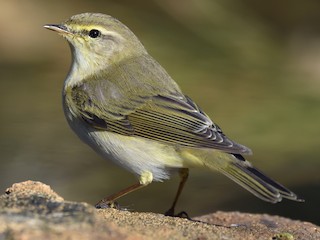
Upperparts are olive-green to brownish-green, underparts are off-white to pale yellow, particularly on the flanks and vent. It has a distinct yellowish supercilium (eyebrow stripe) and a dark eye-stripe. The throat and breast are often washed with pale yellow, especially in fresh plumage. The rump is concolorous with the back.
- 2
Forma del becco
Forma e colore del becco, un segno di campo chiave.
Small, slender, pointed, and dark brown to blackish, with a paler base to the lower mandible.
- 3
Colore degli occhi
Colore dell'iride e segni distintivi sugli occhi.
Dark brown.
- 4
Colore delle zampe
Colore di zampe e piedi.
Legs are typically pale, ranging from light brown to yellowish-brown or even pinkish-brown. This is a key distinguishing feature from the Chiffchaff, which usually has dark legs.
- 5
Caratteristiche distintive
Tratti distintivi che separano questa specie.
Longer primary projection (the length of the primary feathers beyond the tertials when the wing is folded) compared to the Chiffchaff, giving it a more 'pointed' wing appearance. Pale legs are a crucial field mark. Its overall appearance is often described as 'neater' or 'cleaner' than the Chiffchaff.
- 6
Aspetto giovanile
Come i giovani si differenziano dagli adulti.
Juveniles are generally brighter yellow on the underparts and supercilium, and their upperparts can be a more vibrant olive-green. Their plumage is softer and looser than adults.
- 7
Cambiamenti stagionali
Variazione del piumaggio tra stagione riproduttiva e non.
Plumage remains largely consistent throughout the year, though fresh autumn plumage can appear slightly brighter and more yellowish, with wear making spring birds appear duller and greyer-green.
- 8
Dimorfismo sessuale
Differenze tra maschi e femmine.
Males and females are virtually identical in plumage. Males are typically slightly larger on average, but this is not discernible in the field.
Segni di campo chiave
- Song. The most reliable identification feature. Listen for the distinctive, melancholic, descending series of fluty notes that fades away.
- Leg Color. Observe the legs. Willow Warblers typically have pale, yellowish-brown to pinkish-brown legs, contrasting with the usually dark legs of the Chiffchaff.
- Primary Projection. When the bird is perched, look at the length of the primary feathers extending beyond the tertials. Willow Warblers have a noticeably longer primary projection, giving their wing a more pointed appearance compared to the shorter, blunter wing of the Chiffchaff.
- Supercilium. Note the yellowish supercilium (eyebrow stripe). It is usually quite distinct and extends further back than in the Chiffchaff.
- Plumage Tone. Overall, Willow Warblers tend to have a slightly brighter, cleaner olive-green upperparts and a more yellowish wash on the flanks and breast, especially when fresh.
Esplora Willow Warbler
Identifica uccelli ovunque
Gratis su iOS, Android e Web. Identificazione per foto e suono, database completo e la tua lista personale.