
Visto un uccello? Identificalo all'istante con l'app Birdby
Apri l'appInformazioni
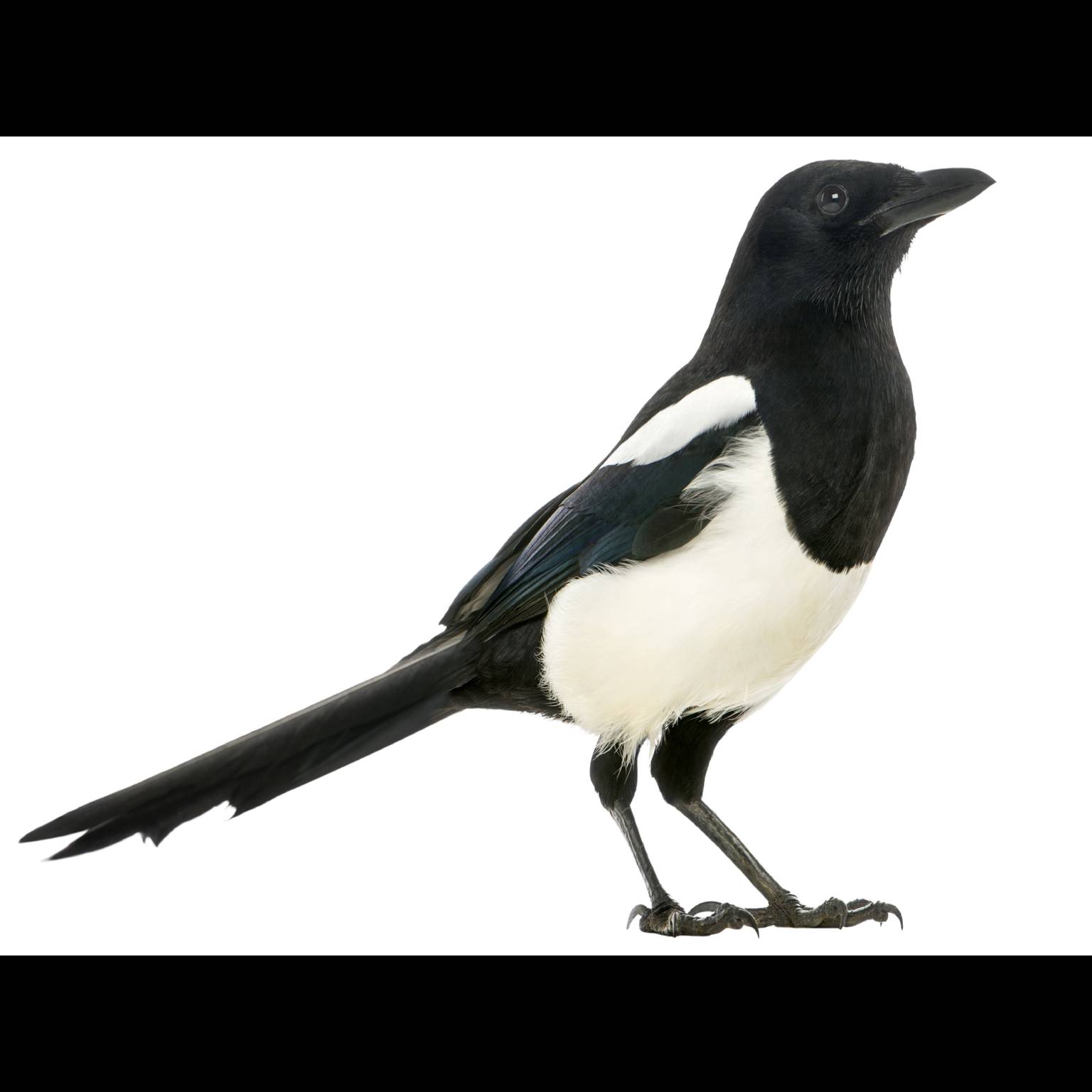
The Eurasian Magpie (Pica pica), known in Italian as 'Gazza comune', is a highly intelligent and distinctive passerine bird belonging to the crow family, Corvidae. It is easily recognized by its striking black and white plumage and long, iridescent tail. Magpies are known for their opportunistic feeding habits, complex social structures, and ability to mimic sounds. They are widespread across Eurasia and parts of North Africa, thriving in a variety of habitats, particularly those influenced by human activity.
Dimensioni e longevità
- Lunghezza
- 44-50 cm (including tail, which can be 20-30 cm)
- Apertura alare
- 52-62 cm
- Peso
- 180-250 g
- Longevità
- Up to 15 years in the wild, typically 3-5 years
- Dieta
- Omnivore
Caratteristiche fisiche
- Piumaggio
- Adults have glossy black plumage on the head, neck, back, and breast, with a metallic green, blue, and purple iridescence visible in good light, especially on the wings and tail. The belly, flanks, and shoulder patches are pure white. The primary flight feathers are also white with black tips, creating a prominent white flash in flight. The long, graduated tail is black with a strong green and purplish-blue sheen.
- Forma del becco
- Strong, conical, and pointed black beak.
- Colore degli occhi
- Dark brown
- Colore delle zampe
- Black
- Caratteristiche distintive
- The most distinguishing features are its pied (black and white) plumage, exceptionally long tail (often longer than its body), and the iridescent sheen on its black feathers. The white primary patches are very noticeable in flight.
- Aspetto giovanile
- Juveniles resemble adults but have duller, less iridescent black plumage, a shorter tail, and often a slightly brownish tinge to the black areas. Their white patches may also appear less crisp.
- Cambiamenti stagionali
- No significant seasonal changes in plumage. The iridescence may appear more vibrant in fresh plumage after the annual molt.
- Dimorfismo sessuale
- Males and females are largely monomorphic in plumage, though males tend to be slightly larger and have longer tails than females. This difference is often subtle and not reliable for field identification.
Come identificare
- 1
Plumage
Look for the unmistakable black and white pattern. The black areas are glossy and iridescent, especially on the tail and wings, showing green, blue, and purple hues in sunlight. The white belly, flanks, and shoulder patches are pure white.
- 2
Tail
The extremely long, graduated tail is a key identifier, often appearing longer than the bird's body. It is black with a strong metallic sheen.
- 3
Flight
Observe its undulating flight pattern, characterized by rapid wing beats and short glides. The white primary patches are very conspicuous during flight.
- 4
Vocalizations
Listen for its characteristic harsh, chattering calls ('chac-chac-chac' or 'shack-shack-shack'), especially when alarmed or interacting with others.
- 5
Behavior
Magpies are often seen foraging on the ground, walking with a distinctive swagger. They are bold and curious, frequently seen in urban and suburban environments.
Habitat e areale
- Biomi
- Temperate forests, woodlands, agricultural land, urban and suburban areas, parks, gardens, scrubland.
- Areale geografico
- Widespread across most of Europe, much of Asia (from Siberia to Japan), and parts of North Africa. Absent from Iceland and some Mediterranean islands.
- Fascia altitudinale
- Sea level up to 2,500 meters, occasionally higher in mountainous regions.
- Ambienti preferiti
- Highly adaptable, preferring open country with scattered trees, hedgerows, and human settlements. They thrive in areas with a mosaic of open ground for foraging and tall trees or structures for nesting and roosting.
Comportamento
- Periodo di attività
- Diurnal
- Abitudini alimentari
- Highly opportunistic and omnivorous. Diet includes insects, worms, snails, slugs, carrion, small mammals, nestlings, eggs, fruits, berries, seeds, and human food scraps. They are known to cache food.
- Comportamento sociale
- Often seen in pairs or small family groups. Outside the breeding season, they can form large communal roosts, sometimes numbering hundreds of individuals. They are highly social and intelligent, exhibiting complex problem-solving abilities.
- Tipo di volo
- Characterized by a distinctive undulating flight pattern, with rapid wing beats followed by short glides. The long tail is prominent during flight.
- Migrazione
- Mostly resident throughout their range. Northern populations may undertake short-distance movements or irruptions in harsh winters, but generally, they are non-migratory.
- Territorialità
- Breeding pairs are territorial, defending their nesting area vigorously. Non-breeding birds may form loose flocks.
Canto e richiami
- Canto
- Magpies do not have a melodious song. Their vocalizations are primarily a series of harsh, chattering calls, often described as a 'chac-chac-chac' or 'shack-shack-shack'. They can also produce softer, more varied gurgling and whistling sounds, especially during courtship or when communicating with their mate.
- Richiamo
- The most common call is a loud, rapid, and harsh 'chac-chac-chac' or 'shack-shack-shack', often given when alarmed or to announce their presence. They also produce a more drawn-out, nasal 'mag-mag' or 'karr-karr' sound. They are known for their ability to mimic other bird calls and even human speech.
- Quando vocalizza
- Vocalize throughout the day, particularly active in the mornings and evenings, and when disturbed or interacting with other magpies.
Riproduzione
- Stagione riproduttiva
- Typically March to June, with peak egg-laying in April.
- Abitudini di nidificazione
- Build large, domed nests, usually high in trees or tall bushes, often thorny ones, for protection. The nest is a bulky structure of sticks, mud, and roots, lined with fine materials like hair and grass. A distinctive feature is the thorny dome or roof over the nest cup, providing excellent protection against predators.
- Dimensione della covata
- Usually 5-8 eggs, but can range from 3 to 10.
- Descrizione dell'uovo
- Typically 5-8 eggs, olive-green to bluish-green, heavily spotted and blotched with dark brown or grey. Average size is about 33 x 23 mm.
- Periodo di incubazione
- 17-24 days, primarily by the female.
- Periodo di involo
- 22-31 days after hatching. Young remain dependent on parents for several weeks after fledging.
- Cure parentali
- Both parents feed and care for the young. The male often feeds the female during incubation.
Dove trovarlo
Urban and Suburban Parks
Common in parks, gardens, and green spaces within towns and cities, where they can find food and nesting sites.
Agricultural Land
Frequently found in open farmland with scattered trees, hedgerows, and farm buildings.
Woodland Edges and Scrubland
Prefer the edges of woodlands and areas with dense scrub, which provide cover and foraging opportunities.
Roadsides and Railway Lines
Often seen along transportation corridors, scavenging for roadkill or discarded food.
Consigli sul campo
- Look for movement. Their striking black and white plumage makes them relatively easy to spot against green foliage or open ground. Look for their distinctive walking gait or undulating flight.
- Listen for calls. Their loud, chattering calls are often the first indication of their presence, especially when they are alarmed or communicating with each other.
- Check high vantage points. Magpies often perch on the tops of tall trees, utility poles, or buildings, providing good views of their surroundings.
- Observe feeding behavior. Watch for them foraging on the ground, turning over leaves, or investigating potential food sources. They are often seen scavenging.
Specie simili
Black-billed Magpie
Pica hudsonia
The Black-billed Magpie, found in North America, is very similar in appearance to the Eurasian Magpie. Historically, it was considered a subspecies of P. pica. The main differences are subtle: P. hudsonia generally has a slightly shorter tail, and the white on the primary feathers is typically less extensive. Genetic studies have confirmed them as distinct species.
Oriental Magpie
Pica serica
Found in East Asia, the Oriental Magpie was also formerly considered a subspecies of P. pica. It is very similar but tends to have a more extensive blue-green iridescence on the tail and wings, and often a slightly more robust bill. Genetic evidence supports its species status.
Azure-winged Magpie
Cyanopica cyanus
While also a magpie, the Azure-winged Magpie is distinctly different. It is smaller, has a blue tail and wings, a black cap, and a greyish-brown body. It lacks the prominent black and white pied pattern of the Eurasian Magpie.
Fatti rapidi
- Intelligence:
- Considered one of the most intelligent non-human animals, capable of self-recognition in a mirror test.
- Dietary Flexibility:
- Highly adaptable omnivores, consuming a wide range of food items from insects to carrion and human scraps.
- Nest Structure:
- Build large, domed nests with a thorny roof for protection, a unique feature among passerines.
- Social Roosts:
- Form large communal roosts outside the breeding season, sometimes involving hundreds of individuals.
- Iridescent Plumage:
- The black feathers exhibit a beautiful metallic green, blue, and purple sheen in good light.
Curiosità
- Magpies are one of the few non-mammalian species known to pass the mirror self-recognition test, indicating a high level of cognitive ability.
- Despite popular folklore, there is little scientific evidence to support the idea that magpies are particularly attracted to shiny objects. While they may investigate novel items, they do not hoard them more than other corvids.
- Their complex social behavior includes 'funerals' where magpies gather around a deceased individual, a behavior that has fascinated researchers.
- Magpies are excellent mimics and can imitate the calls of other birds, and even human speech, though this is less common than in some other corvids like parrots.
- The long tail of the magpie is not just for show; it aids in balance during flight and perching, and can be used for communication.
Classificazione scientifica
- Regno
- Animalia
- Phylum
- Chordata
- Classe
- Aves
- Ordine
- Passeriformes
- Famiglia
- Corvidae
- Genere
- Pica
- Specie
- Pica pica
Esplora Eurasian Magpie
Identifica uccelli ovunque
Gratis su iOS, Android e Web. Identificazione per foto e suono, database completo e la tua lista personale.