
Visto un uccello? Identificalo all'istante con l'app Birdby
Apri l'appInformazioni
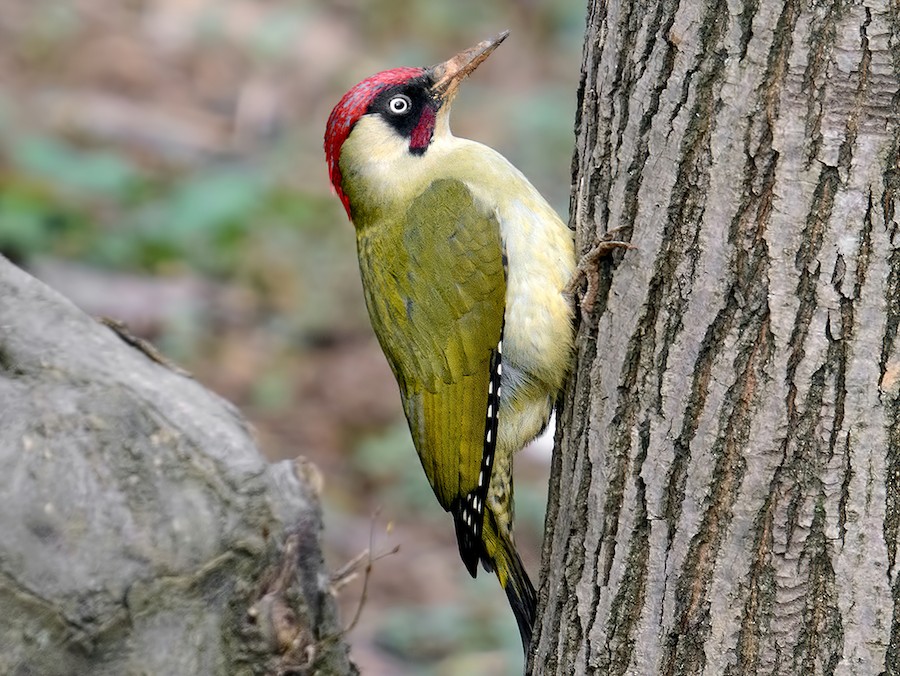
The European Green Woodpecker is a large, distinctive woodpecker with a striking green plumage, a red crown, and a black facial mask. Unlike many other woodpeckers, it spends a significant amount of time foraging on the ground, primarily for ants. Its loud, yaffling call is a characteristic sound of its preferred habitats.
Dimensioni e longevità
- Lunghezza
- 30-36 cm
- Apertura alare
- 40-45 cm
- Peso
- 150-250 g
- Longevità
- Up to 15 years in the wild
- Dieta
- Insectivore, primarily myrmecophagous (ant-eating)
Caratteristiche fisiche
- Piumaggio
- Overall green plumage, brighter green on the back and wings, duller greenish-grey on the underparts. The rump is bright yellow-green, very conspicuous in flight. It has a prominent red crown and nape, and a black mask around the eye extending to the bill. The flight feathers are barred black and white.
- Forma del becco
- Strong, chisel-shaped, dark grey to black bill, paler at the base of the lower mandible.
- Colore degli occhi
- White to pale blue-white with a black pupil.
- Colore delle zampe
- Greyish-green
- Caratteristiche distintive
- Bright green plumage, red crown, black facial mask, and a distinctive yellow-green rump visible in flight. Its undulating flight pattern is also characteristic.
- Aspetto giovanile
- Juveniles are duller and heavily barred and spotted on the underparts, head, and back, giving them a scaly appearance. The red crown is present but often mottled with black. The malar stripe is red with black streaking.
- Cambiamenti stagionali
- No significant seasonal plumage changes. Plumage may appear slightly duller when worn before molting.
- Dimorfismo sessuale
- Males have a red stripe (malar stripe) bordered with black extending from the base of the bill, while females have a completely black malar stripe. Juveniles of both sexes have a red malar stripe with black streaking.
Come identificare
- 1
Plumage Color
Look for the bright green back and wings, duller green underparts, and especially the bright yellow-green rump, which is very noticeable in flight.
- 2
Head Markings
Identify the prominent red crown and nape, and the distinct black mask around the eye. Note the malar stripe: red with a black border in males, all black in females.
- 3
Behavior
Observe its foraging habits. If you see a large green woodpecker on the ground, digging into ant nests, it's almost certainly a European Green Woodpecker.
- 4
Flight Pattern
Watch for its characteristic undulating flight, a series of dips and rises, often accompanied by flashes of the yellow-green rump.
- 5
Vocalization
Listen for its loud, laughing 'yaffle' call, a distinctive sound that carries well through woodlands.
Habitat e areale
- Biomi
- Temperate forests, woodlands, parks, orchards, large gardens, and open country with scattered trees.
- Areale geografico
- Widespread across most of Europe, excluding Ireland, northern Scandinavia, and parts of southern Europe (e.g., southern Iberian Peninsula, Mediterranean islands). Extends eastward into western Asia.
- Fascia altitudinale
- Sea level up to 2000 meters, occasionally higher in some mountain ranges.
- Ambienti preferiti
- Prefers mosaic habitats with a mix of mature deciduous trees (especially oaks, ashes, poplars) for nesting and roosting, and open grassy areas (pastures, lawns, heathland) for foraging. Requires soft wood for excavating nest holes.
Comportamento
- Periodo di attività
- Diurnal, active from dawn to dusk.
- Abitudini alimentari
- Primarily terrestrial, spending much of its time on the ground foraging for ants, which constitute the vast majority of its diet. It uses its strong bill to dig into ant nests (Formica spp. and Lasius spp.) and its long, sticky tongue to extract ants and their larvae. It also feeds on other insects, berries, and fruits, especially in winter. Occasionally forages on tree trunks for insects.
- Comportamento sociale
- Generally solitary or found in pairs, especially during the breeding season. Outside of breeding, individuals may forage alone or occasionally in loose family groups. Not typically gregarious.
- Tipo di volo
- Strong, undulating flight, characterized by a series of rapid wing beats followed by a short glide with wings folded against the body, creating a 'rollercoaster' effect.
- Migrazione
- Mostly sedentary throughout its range, with adults rarely moving far from their breeding territories. Juveniles may disperse short distances after fledging.
- Territorialità
- Highly territorial, especially during the breeding season. Pairs defend their nesting and foraging areas with calls and displays.
Canto e richiami
- Canto
- The most characteristic vocalization is a loud, laughing or 'yaffling' call, often described as 'klyü-klyü-klyü-klyü-klyü' or 'plue-plue-plue-plue'. It starts loud and often fades towards the end. This call is used for territorial advertisement and communication between pairs.
- Richiamo
- Besides the 'yaffle', it has a sharp 'kyack' or 'kewk' call, often given in alarm or when disturbed. Also a softer 'chup' or 'chick' call. Drumming is less frequent and less powerful than in other woodpecker species, typically a short, weak burst.
- Quando vocalizza
- Most vocal during the breeding season (late winter to early summer), but can be heard year-round, especially on sunny days.
Riproduzione
- Stagione riproduttiva
- April to June, with egg-laying typically in late April to May.
- Abitudini di nidificazione
- Nests in tree cavities, which it excavates itself, usually in soft or decaying wood of deciduous trees (e.g., willow, poplar, ash, oak, fruit trees). The entrance hole is typically round or oval, about 6-7 cm in diameter. Both sexes participate in excavation.
- Dimensione della covata
- 4-9 eggs, most commonly 5-7.
- Descrizione dell'uovo
- Typically 5-7 (range 4-9) pure white, glossy, oval eggs.
- Periodo di incubazione
- 18-19 days, incubated by both parents.
- Periodo di involo
- 21-24 days after hatching. Young remain in the nest until fully feathered and capable of flight.
- Cure parentali
- Both parents share incubation duties and feed the nestlings. After fledging, the young are fed by parents for several weeks and learn foraging techniques.
Dove trovarlo
Woodlands and Forests
Look in mature deciduous or mixed woodlands, especially those with open areas and old trees suitable for nesting.
Parks and Gardens
Large parks, orchards, and extensive gardens with mature trees and lawns are excellent places to find them, as these often provide good foraging grounds for ants.
Pastures and Heathland
Areas with scattered trees bordering open grasslands or heathland are prime foraging habitats.
Consigli sul campo
- Listen for its call. The 'yaffle' call is often the first indication of its presence. Learn to recognize it, as the bird can be quite shy.
- Scan the ground. Unlike many other woodpeckers, the Green Woodpecker spends a lot of time on the ground. Look for it foraging on lawns, pastures, or forest floors.
- Look for ant nests. They are often found near large ant nests, which are their primary food source. Observe areas with disturbed soil or small holes where they have been digging.
- Be patient and quiet. They can be wary. Move slowly and quietly, and use binoculars to observe from a distance.
- Early morning or late afternoon. These times are often best for observing them when they are most active in foraging.
Specie simili
Iberian Green Woodpecker
Picus sharpei
Formerly considered a subspecies of European Green Woodpecker. Distinguished by the absence of black around the eye (or very reduced black), and males have a red malar stripe without a black border. Found only in the Iberian Peninsula.
Lesser Green Woodpecker
Picus canus
Also known as Grey-headed Woodpecker. Smaller and greyer overall, with a grey head and a smaller red crown patch (only on the forehead in males, absent in females). The black facial mask is less extensive, and the malar stripe is black in both sexes. Its call is a softer, more melancholic 'kyu-kyu-kyu'.
Fatti rapidi
- Primary Diet:
- Ants
- Distinctive Call:
- Loud 'yaffling' laugh
- Foraging Style:
- Mostly on the ground
- Rump Color:
- Bright yellow-green
- Sexual Dimorphism:
- Malar stripe color
Curiosità
- The European Green Woodpecker is sometimes called the 'Yaffle' due to its distinctive laughing call.
- Its tongue can extend up to 10 cm beyond its beak, allowing it to reach deep into ant tunnels.
- Unlike many other woodpeckers, it rarely drums on trees to communicate or find food, preferring to vocalize.
- Its strong claws and stiff tail feathers help it to brace itself against tree trunks, even though it spends much time on the ground.
Classificazione scientifica
- Regno
- Animalia
- Phylum
- Chordata
- Classe
- Aves
- Ordine
- Piciformes
- Famiglia
- Picidae
- Genere
- Picus
- Specie
- Picus viridis
Esplora European Green Woodpecker
Identifica uccelli ovunque
Gratis su iOS, Android e Web. Identificazione per foto e suono, database completo e la tua lista personale.