
Visto un uccello? Identificalo all'istante con l'app Birdby
Apri l'appInformazioni
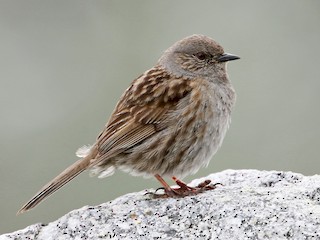
The Dunnock, also known as the Hedge Accentor or Passera Scopaiola in Italian, is a small, inconspicuous passerine bird found throughout much of temperate Eurasia. Often overlooked due to its subtle plumage, it is a fascinating species known for its complex and variable mating systems, ranging from monogamy to polyandry and polygynandry.
Dimensioni e longevità
- Lunghezza
- 13-14.5 cm
- Apertura alare
- 19-21 cm
- Peso
- 16-25 g
- Longevità
- 2-3 years (up to 9 years in captivity)
- Dieta
- Omnivore (primarily insects and spiders in summer, seeds and berries in winter)
Caratteristiche fisiche
- Piumaggio
- Adults have a grey head, throat, and breast, with a streaky brown back and flanks. The underparts are buffish-white, and the legs are reddish-brown. The bill is slender and pointed, dark grey. The overall impression is of a small, mouse-like bird, often seen creeping low in vegetation.
- Forma del becco
- Slender, pointed, and conical; dark grey to blackish.
- Colore degli occhi
- Dark brown.
- Colore delle zampe
- Reddish-brown to orange-brown.
- Caratteristiche distintive
- Its most distinctive features are the slate-grey head and breast contrasting with the streaky brown back, and its habit of skulking low in hedges and bushes. The fine, pointed bill is also a good identifier, distinguishing it from sparrows.
- Aspetto giovanile
- Juveniles are browner overall than adults, with a streaky brown head and breast, lacking the distinct grey coloration. They have a scaly appearance on the back and breast due to pale feather edgings.
- Cambiamenti stagionali
- There are no significant seasonal plumage changes. The plumage remains consistent throughout the year, though wear and tear can make it appear slightly duller before the annual molt.
- Dimorfismo sessuale
- Males and females are virtually identical in plumage, making them difficult to distinguish visually in the field. Males may be slightly larger on average, but this is not a reliable field mark.
Come identificare
- 1
Plumage Coloration
Look for the distinctive slate-grey head, throat, and breast, contrasting with the streaky brown back. This combination is unique among common garden birds.
- 2
Behavior
Observe its movements. Dunnocks typically creep and shuffle low in dense vegetation, often on the ground under bushes, with a characteristic 'mouse-like' movement. They are generally shy and inconspicuous.
- 3
Bill Shape
Note the fine, pointed, dark grey bill. This distinguishes it from the stouter, conical bills of sparrows.
- 4
Song
Listen for its surprisingly loud, rapid, high-pitched warbling song, often delivered from a hidden perch.
Habitat e areale
- Biomi
- Temperate forests, woodlands, scrublands, urban and suburban gardens, parks, hedgerows, agricultural land.
- Areale geografico
- Widespread across Europe, including the British Isles, Scandinavia, and Russia, extending into parts of Asia Minor and the Caucasus. Introduced to New Zealand.
- Fascia altitudinale
- Sea level up to 2,000 meters, occasionally higher in mountainous regions.
- Ambienti preferiti
- Dense undergrowth, hedges, shrubbery, woodland edges, gardens, parks, and areas with good ground cover. They prefer habitats that offer both foraging opportunities on the ground and dense cover for nesting and protection.
Comportamento
- Periodo di attività
- Diurnal.
- Abitudini alimentari
- Forages primarily on the ground, often beneath bushes and hedges, with a characteristic shuffling or 'shuffling' gait. It pecks at insects, spiders, worms, and other invertebrates, especially during the breeding season. In winter, it switches to seeds, small berries, and buds. It can be seen scratching at leaf litter with its feet.
- Comportamento sociale
- Generally solitary or found in pairs, especially during the breeding season. Outside of breeding, they may form small, loose flocks, particularly around food sources. Known for complex mating systems including monogamy, polygyny, polyandry, and polygynandry, often involving multiple males and females sharing a territory and parental duties.
- Tipo di volo
- Flight is typically low, short, and undulating, often between patches of cover. It is not a strong or sustained flyer, preferring to hop and creep through vegetation.
- Migrazione
- Northern populations are migratory, moving south and west for the winter. Central and southern European populations are largely resident or undertake short-distance altitudinal movements. British and Irish populations are mostly resident.
- Territorialità
- Males defend territories, especially during the breeding season. The size and defense of territories can vary depending on the mating system. Females also establish foraging ranges within or overlapping male territories.
Canto e richiami
- Canto
- The song is a rapid, high-pitched, and rather thin warbling, often described as a 'tseep-tseep-tseep-tseep-tiss-tiss-tiss' or 'twee-twee-twee-twee-twee'. It is delivered from a prominent perch, often the top of a bush or tree, or from within dense cover. It is surprisingly loud for such a small bird.
- Richiamo
- Common calls include a sharp, high-pitched 'tseep' or 'tseet' contact call, and a thin, drawn-out 'siiih' alarm call.
- Quando vocalizza
- Sings most frequently from early spring through summer, primarily during the breeding season. Calls are given year-round.
Riproduzione
- Stagione riproduttiva
- Typically from March to August, with two to three broods per year.
- Abitudini di nidificazione
- The nest is a neat, cup-shaped structure built by the female, usually low down in dense bushes, hedges, or conifers. It is constructed from moss, twigs, and roots, lined with hair or feathers. Nests are often well-hidden.
- Dimensione della covata
- 4-6 eggs.
- Descrizione dell'uovo
- Eggs are typically 4-6, unspotted, glossy, and a distinctive bright blue or greenish-blue color. They measure approximately 19 x 14 mm.
- Periodo di incubazione
- 12-14 days, primarily by the female, though males may assist in polyandrous systems.
- Periodo di involo
- 10-14 days after hatching. Young are fed by both parents (or multiple adults in complex mating systems).
- Cure parentali
- Parental care is shared, often by multiple adults depending on the mating system. Both males and females feed the young. In polyandrous systems, multiple males may provision the same brood, increasing the reproductive success of the female.
Dove trovarlo
Gardens and Parks
Common in urban and suburban gardens, especially those with dense shrubbery, hedges, and ground cover.
Woodland Edges and Hedgerows
Frequent in the undergrowth of deciduous and coniferous woodlands, particularly along edges and in areas with thick hedgerows.
Agricultural Land
Found in agricultural areas with field margins, hedgerows, and scattered bushes.
Consigli sul campo
- Look Low. Dunnocks spend most of their time foraging on or very close to the ground, often hidden within dense vegetation. Scan the base of hedges, bushes, and thickets.
- Listen for the Song. While often hidden, their song is quite distinctive and can help pinpoint their location, especially in spring and early summer.
- Be Patient. They are shy birds. Remain still and observe quietly; they may emerge from cover to forage.
- Check Bird Tables. In winter, they may visit bird tables, especially those offering seeds or suet, but they usually prefer to feed on fallen food underneath.
Specie simili
House Sparrow
Passer domesticus
Dunnocks are more slender, have a finer bill, and lack the bold head patterns (grey crown, chestnut nape) and white wing bar of the House Sparrow. Dunnocks are also much more skulking and less gregarious than sparrows.
Tree Sparrow
Passer montanus
Tree Sparrows have a chestnut crown, black cheek patch, and two distinct white wing bars, all absent in the Dunnock. Dunnocks are also generally less upright in posture.
Robin
Erithacus rubecula
While both are small, ground-foraging birds, the Robin is easily distinguished by its prominent orange-red breast and face. Dunnocks are much duller and lack any bright coloration.
Fatti rapidi
- Common Name:
- Dunnock (Hedge Accentor)
- Scientific Name:
- Prunella modularis
- Family:
- Prunellidae
- Size:
- Small (13-14.5 cm)
- Diet:
- Omnivore (insects, seeds)
- Habitat:
- Gardens, hedges, woodlands
- Conservation Status:
- Least Concern
- Distinguishing Feature:
- Grey head/breast, streaky brown back, mouse-like behavior
Curiosità
- Dunnocks are famous for their highly variable and complex mating systems, which can include monogamy, polygyny (one male, multiple females), polyandry (one female, multiple males), and polygynandry (multiple males and females in a group).
- The female Dunnock often solicits copulations from multiple males, especially in polyandrous systems, to ensure more males help provision her chicks, thereby increasing her reproductive success.
- Despite their drab appearance, their social lives are among the most studied and fascinating in ornithology, challenging traditional views of avian monogamy.
- Their scientific name 'Prunella' comes from the Latin 'prunus' meaning 'brownish', referring to their plumage, and 'modularis' from 'modulus' meaning 'a small measure' or 'melody', referring to their song.
Classificazione scientifica
- Regno
- Animalia
- Phylum
- Chordata
- Classe
- Aves
- Ordine
- Passeriformes
- Famiglia
- Prunellidae
- Genere
- Prunella
- Specie
- Prunella modularis
Esplora Dunnock
Identifica uccelli ovunque
Gratis su iOS, Android e Web. Identificazione per foto e suono, database completo e la tua lista personale.