
Visto un uccello? Identificalo all'istante con l'app Birdby
Apri l'appInformazioni
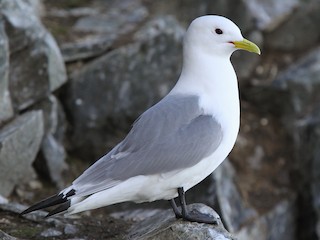
The Black-legged Kittiwake is a medium-sized gull, primarily pelagic outside the breeding season, known for its distinctive short, black legs and relatively small, unmarked yellow bill. It is a highly colonial breeder, forming dense colonies on steep coastal cliffs.
Dimensioni e longevità
- Lunghezza
- 37-41 cm
- Apertura alare
- 91-105 cm
- Peso
- 300-525 g
- Longevità
- Up to 20 years in the wild, typically 10-15 years
- Dieta
- Carnivore (primarily piscivorous)
Caratteristiche fisiche
- Piumaggio
- Adult breeding plumage features a white head, neck, and underparts, with a grey mantle and upperwings. The wingtips are solid black, lacking the white 'mirrors' found in many other gulls. The tail is white and slightly forked. Non-breeding adults have a dusky grey smudge behind the eye and on the nape.
- Forma del becco
- Relatively small, unmarked yellow bill, slightly decurved at the tip.
- Colore degli occhi
- Dark brown eyes, surrounded by a thin red orbital ring in breeding adults.
- Colore delle zampe
- Short, black legs and feet. The hind toe is vestigial or absent, giving rise to the 'tridactyla' (three-toed) name.
- Caratteristiche distintive
- Solid black wingtips without white mirrors, short black legs, and a plain yellow bill are key identifiers. The slightly forked tail is also characteristic.
- Aspetto giovanile
- Juveniles have a distinctive 'W' pattern across their upperwings formed by black primary tips and a black bar on the secondary coverts. They also have a black hind-neck collar, a black bar on the tail, and a dark bill. Their legs are blackish-grey.
- Cambiamenti stagionali
- Adults in non-breeding plumage develop a dusky grey smudge behind the eye and on the nape, and the red orbital ring becomes less prominent or absent. The bill remains yellow.
- Dimorfismo sessuale
- Males and females are morphologically similar in plumage and size.
Come identificare
- 1
Wingtips
Look for solid black wingtips without any white 'mirrors' or spots. This is a key distinguishing feature from most other gulls.
- 2
Legs
Observe the legs; they are short and black. The lack of a prominent hind toe is also characteristic, though difficult to see in the field.
- 3
Bill
Note the plain, unmarked yellow bill, which is relatively small and slightly decurved.
- 4
Tail
The tail is white and slightly forked, especially noticeable in flight.
- 5
Juvenile Plumage
In juveniles, look for the distinctive black 'W' pattern across the upperwings, a black hind-neck collar, and a black tail band.
- 6
Vocalization
Listen for the characteristic 'kitti-waak' call, especially near breeding colonies.
Habitat e areale
- Biomi
- Marine, coastal, pelagic
- Areale geografico
- Circumpolar in the Northern Hemisphere. Breeds on coasts of the North Atlantic and North Pacific, including Greenland, Iceland, Svalbard, northern Europe, Siberia, Alaska, and Canada. Winters widely across the North Atlantic and North Pacific, often far offshore.
- Fascia altitudinale
- Sea level to coastal cliff tops (up to several hundred meters for nesting sites).
- Ambienti preferiti
- Steep coastal cliffs, sea stacks, and offshore islands for breeding. Pelagic waters, often over continental shelves, during the non-breeding season.
Comportamento
- Periodo di attività
- Diurnal, though they may feed at night during periods of high prey availability or under moonlight.
- Abitudini alimentari
- Primarily surface feeders, snatching small fish (e.g., sandeels, capelin, herring, cod fry) and marine invertebrates (e.g., crustaceans, squid) from the water's surface. They often feed in large flocks, sometimes associated with cetaceans or fishing vessels. They do not typically plunge-dive from great heights like terns, but may make shallow dives.
- Comportamento sociale
- Highly colonial breeders, forming dense, noisy colonies on cliffs. Outside the breeding season, they are gregarious, often found in large flocks at sea.
- Tipo di volo
- Graceful and buoyant flight, often with shallow wingbeats. They are highly adapted to oceanic conditions, capable of sustained flight over open water.
- Migrazione
- Migratory. After breeding, they disperse widely across the North Atlantic and North Pacific, spending the non-breeding season far out at sea, often hundreds of kilometers from land. Return to breeding colonies in early spring.
- Territorialità
- Highly territorial within the breeding colony, defending a small nest site. Less territorial outside the breeding season.
Canto e richiami
- Canto
- Does not have a complex song. Vocalizations are primarily calls.
- Richiamo
- The most characteristic call is a nasal, often repeated 'kitti-waak, kitti-waak', which gives the bird its common name. Other calls include harsh 'kree-aah' or 'kya-kya-kya' notes, especially when agitated or in the colony.
- Quando vocalizza
- Most vocal during the breeding season within the colony, but also call at sea, particularly when feeding in flocks.
Riproduzione
- Stagione riproduttiva
- Typically May to August, with peak egg-laying in late May to early June.
- Abitudini di nidificazione
- Nests are built on narrow ledges of steep coastal cliffs, often in very dense colonies. Nests are cup-shaped, constructed from mud, grass, seaweed, and guano, cemented together to form a sturdy structure that can withstand strong winds.
- Dimensione della covata
- 1-3 eggs
- Descrizione dell'uovo
- Typically 1-3 eggs (most commonly 2), olive-buff to pale blue-green, variably marked with dark brown or black spots and blotches.
- Periodo di incubazione
- 24-28 days, incubated by both parents.
- Periodo di involo
- 35-49 days. Young remain at the nest site until they are capable of flight.
- Cure parentali
- Both parents share incubation duties and feed the chicks. Chicks are fed regurgitated fish and invertebrates.
Dove trovarlo
Coastal Cliffs
During the breeding season (spring and summer), look for large, noisy colonies on steep, inaccessible coastal cliffs and sea stacks in the Northern Hemisphere.
Pelagic Waters
Outside the breeding season, they are found far out at sea, often over continental shelves. Pelagic birding trips are the best way to observe them during this period.
Fishing Ports (rarely)
Occasionally, individuals may be seen closer to shore or in fishing ports during severe weather or migration, but this is less common than for other gull species.
Consigli sul campo
- Visit Breeding Colonies. The easiest way to see Black-legged Kittiwakes is to visit known breeding colonies during the summer months. They are very numerous and vocal at these sites.
- Pelagic Trips. For observations during the non-breeding season, consider joining organized pelagic birding trips that venture far offshore into their oceanic wintering grounds.
- Scan for Flocks. At sea, look for large flocks of birds feeding, often associated with schools of fish or marine mammals. Kittiwakes are often part of these mixed feeding frenzies.
- Learn Calls. Familiarize yourself with their distinctive 'kitti-waak' call, which can help locate them, especially in noisy colonies.
Specie simili
Common Gull (Mew Gull)
Larus canus
Common Gulls are larger, have longer legs (yellowish-green), a more robust bill (yellow with a dark band in non-breeding adults/juveniles), and distinct white 'mirrors' on the black wingtips. Their tail is not forked.
Herring Gull
Larus argentatus
Herring Gulls are significantly larger, have pink legs, a larger yellow bill with a red spot on the lower mandible, and prominent white mirrors on the black wingtips. Their tail is not forked.
Red-legged Kittiwake
Rissa brevirostris
The Red-legged Kittiwake is very similar but has distinctive red legs, a shorter bill, and slightly darker grey upperparts. Its range is restricted to the Bering Sea and Aleutian Islands.
Fatti rapidi
- Distinctive Feature:
- Solid black wingtips without white mirrors
- Leg Color:
- Black
- Bill Color:
- Plain yellow
- Breeding Habitat:
- Steep coastal cliffs
- Wintering Habitat:
- Open ocean (pelagic)
- Conservation Status:
- Vulnerable
Curiosità
- The name 'Kittiwake' is an onomatopoeic representation of its distinctive call, 'kitti-waak'.
- Unlike most gulls, Black-legged Kittiwakes rarely scavenge on land or visit urban areas, preferring a strictly marine diet and habitat.
- Their short legs and vestigial hind toe are adaptations for their cliff-nesting lifestyle, making them less agile on flat ground but well-suited for perching on narrow ledges.
- They are one of the most numerous seabirds in the North Atlantic, though populations have been declining in many areas, leading to their 'Vulnerable' status.
- Kittiwakes often nest in incredibly dense colonies, with nests sometimes just inches apart, creating a bustling and noisy environment.
Classificazione scientifica
- Regno
- Animalia
- Phylum
- Chordata
- Classe
- Aves
- Ordine
- Charadriiformes
- Famiglia
- Laridae
- Genere
- Rissa
- Specie
- Rissa tridactyla
Esplora Black-legged Kittiwake
Identifica uccelli ovunque
Gratis su iOS, Android e Web. Identificazione per foto e suono, database completo e la tua lista personale.