
Come identificare Black-legged Kittiwake
Rissa tridactyla
Visto un uccello? Identificalo all'istante con l'app Birdby
Apri l'appPer identificare correttamente Black-legged Kittiwake (Rissa tridactyla), controlla ciascuna di queste caratteristiche. Gli uccelli possono essere complicati da riconoscere, perché comportamento, habitat e canto spesso confermano ciò che una sola foto non può.
Dimensioni a colpo d'occhio
- Lunghezza
- 37-41 cm
- Apertura alare
- 91-105 cm
- Peso
- 300-525 g
Caratteristiche fisiche da controllare
- 1
Piumaggio
Colorazione e disegno generale del piumaggio.
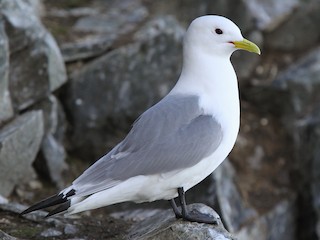
Adult breeding plumage features a white head, neck, and underparts, with a grey mantle and upperwings. The wingtips are solid black, lacking the white 'mirrors' found in many other gulls. The tail is white and slightly forked. Non-breeding adults have a dusky grey smudge behind the eye and on the nape.
- 2
Forma del becco
Forma e colore del becco, un segno di campo chiave.
Relatively small, unmarked yellow bill, slightly decurved at the tip.
- 3
Colore degli occhi
Colore dell'iride e segni distintivi sugli occhi.
Dark brown eyes, surrounded by a thin red orbital ring in breeding adults.
- 4
Colore delle zampe
Colore di zampe e piedi.
Short, black legs and feet. The hind toe is vestigial or absent, giving rise to the 'tridactyla' (three-toed) name.
- 5
Caratteristiche distintive
Tratti distintivi che separano questa specie.
Solid black wingtips without white mirrors, short black legs, and a plain yellow bill are key identifiers. The slightly forked tail is also characteristic.
- 6
Aspetto giovanile
Come i giovani si differenziano dagli adulti.
Juveniles have a distinctive 'W' pattern across their upperwings formed by black primary tips and a black bar on the secondary coverts. They also have a black hind-neck collar, a black bar on the tail, and a dark bill. Their legs are blackish-grey.
- 7
Cambiamenti stagionali
Variazione del piumaggio tra stagione riproduttiva e non.
Adults in non-breeding plumage develop a dusky grey smudge behind the eye and on the nape, and the red orbital ring becomes less prominent or absent. The bill remains yellow.
- 8
Dimorfismo sessuale
Differenze tra maschi e femmine.
Males and females are morphologically similar in plumage and size.
Segni di campo chiave
- Wingtips. Look for solid black wingtips without any white 'mirrors' or spots. This is a key distinguishing feature from most other gulls.
- Legs. Observe the legs; they are short and black. The lack of a prominent hind toe is also characteristic, though difficult to see in the field.
- Bill. Note the plain, unmarked yellow bill, which is relatively small and slightly decurved.
- Tail. The tail is white and slightly forked, especially noticeable in flight.
- Juvenile Plumage. In juveniles, look for the distinctive black 'W' pattern across the upperwings, a black hind-neck collar, and a black tail band.
- Vocalization. Listen for the characteristic 'kitti-waak' call, especially near breeding colonies.
Esplora Black-legged Kittiwake
Identifica uccelli ovunque
Gratis su iOS, Android e Web. Identificazione per foto e suono, database completo e la tua lista personale.