
Visto un uccello? Identificalo all'istante con l'app Birdby
Apri l'appInformazioni
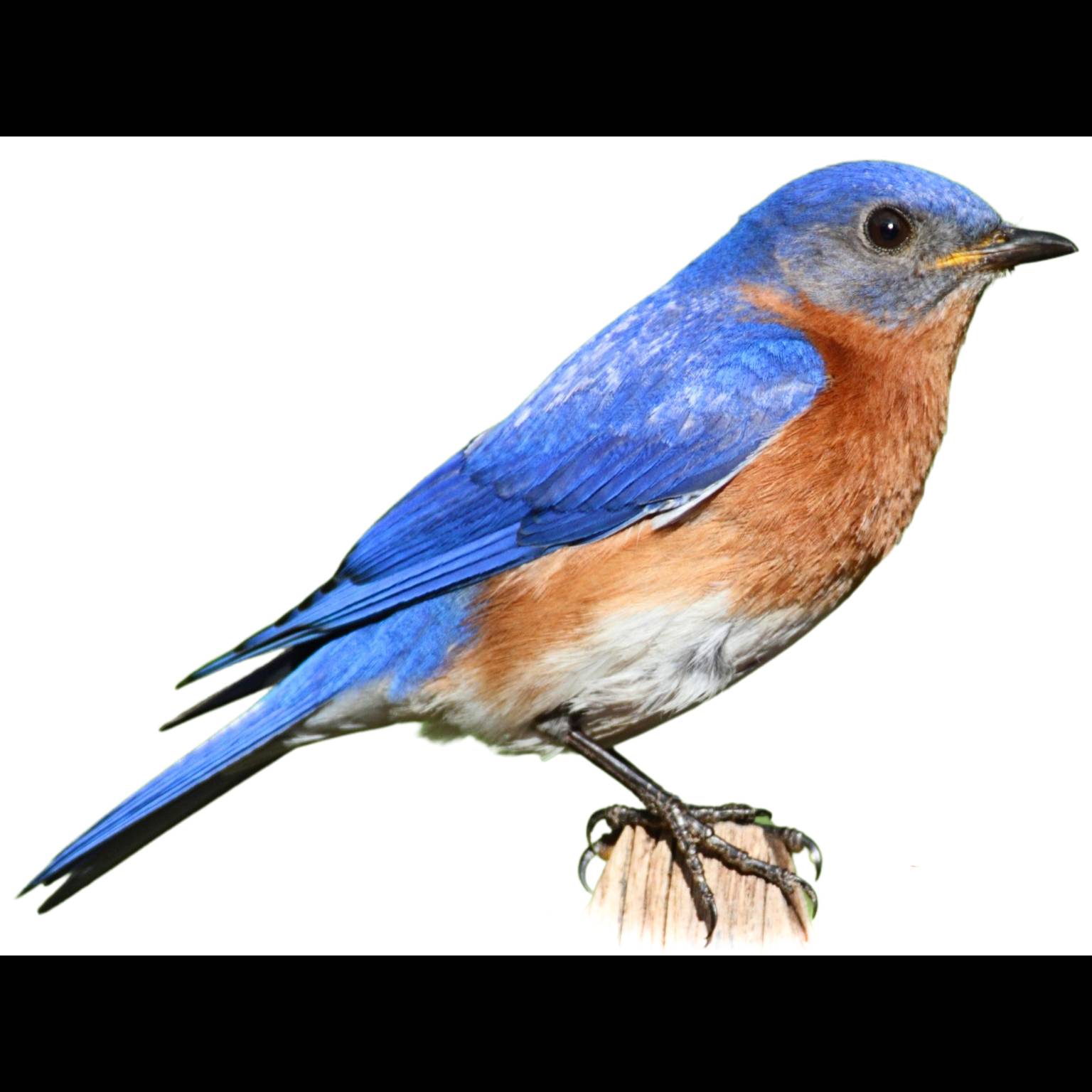
The Eastern Bluebird is a small, migratory thrush found in open woodlands, farmlands, and orchards across eastern North America. Renowned for the male's brilliant blue plumage, it is a beloved species and a symbol of happiness. They are primarily insectivorous during warmer months and switch to berries in winter.
Dimensioni e longevità
- Lunghezza
- 16-21 cm (6.3-8.3 in)
- Apertura alare
- 30-32 cm (11.8-12.6 in)
- Peso
- 27-32 g (0.95-1.13 oz)
- Longevità
- 6-10 years in the wild, with records up to 10 years
- Dieta
- Omnivore (primarily insectivorous in summer, frugivorous in winter)
Caratteristiche fisiche
- Piumaggio
- Males are brilliant sky-blue on the back, head, and wings, with a rusty orange throat and breast, and a white belly. Females are duller, with grayish-blue on the back and wings, a paler orange-brown breast, and a white belly. Juveniles are grayish-brown with white spotting on the back and breast, and blue only on the wings and tail.
- Forma del becco
- Small, slender, pointed black beak, typical of an insectivorous passerine.
- Colore degli occhi
- Dark brown
- Colore delle zampe
- Blackish-gray
- Caratteristiche distintive
- The combination of bright blue upperparts, rusty breast, and white belly is distinctive for males. Females are identified by their more subdued blue and rusty tones. Their upright posture when perched is also characteristic.
- Aspetto giovanile
- Juveniles are mottled gray-brown on the back and breast, with faint streaking. They show hints of blue on the wings and tail, which intensifies with subsequent molts. Their bellies are whitish.
- Cambiamenti stagionali
- Plumage does not change significantly between breeding and non-breeding seasons. However, fresh fall plumage may appear slightly brighter and more vibrant due to less feather wear.
- Dimorfismo sessuale
- Pronounced. Males are much brighter blue and have richer orange coloration than females. Females have duller blue and paler orange-brown.
Come identificare
- 1
Coloration (Male)
Look for the brilliant sky-blue on the back, head, and wings, contrasting with the rusty orange throat and breast, and white belly. This combination is unique among eastern North American birds.
- 2
Coloration (Female)
Observe the duller grayish-blue on the back and wings, with a paler orange-brown breast. The overall shape and habitat preference will help confirm identification.
- 3
Posture and Perching
They often perch upright on wires, fence posts, or dead branches in open areas, scanning the ground for insects. This 'sentinel' behavior is characteristic.
- 4
Flight Style
Watch for their direct, slightly undulating flight, often involving short hovers before dropping to the ground to catch prey.
- 5
Vocalization
Listen for their soft, warbling 'chur-lee' song or their gentle 'tu-a-wee' contact call. These sounds are distinctive and often heard before the bird is seen.
- 6
Habitat
They prefer open woodlands, orchards, pastures, and areas with scattered trees and short grass, rather than dense forests or urban centers.
Habitat e areale
- Biomi
- Temperate forests, grasslands, agricultural lands, suburban areas, open woodlands, orchards, pastures, golf courses.
- Areale geografico
- Eastern North America, from southern Canada (Ontario, Quebec, Maritime provinces) south through the eastern and central United States, and into Mexico and Central America (Honduras, Nicaragua).
- Fascia altitudinale
- Typically found from sea level up to approximately 1,500 meters (5,000 feet), though occasionally higher in some parts of their range.
- Ambienti preferiti
- Open areas with scattered trees, especially those with dead snags or old fence posts for perching, and access to cavities for nesting. They favor areas with short grass for foraging.
Comportamento
- Periodo di attività
- Diurnal
- Abitudini alimentari
- Primarily insectivorous, catching insects (grasshoppers, crickets, beetles, caterpillars) by perching and swooping down to the ground (pouncing). They also hawk insects in flight. In fall and winter, their diet shifts to berries and small fruits (e.g., sumac, mistletoe, hackberry, wild grape).
- Comportamento sociale
- During the breeding season, they are typically found in pairs. Outside of breeding, they may form small flocks, especially in winter, sometimes associating with other thrushes or bluebirds.
- Tipo di volo
- Direct and undulating flight, often with shallow wingbeats. They frequently hover briefly before dropping to the ground to catch prey.
- Migrazione
- Northern populations are migratory, moving south for the winter. Southern populations are largely resident. Migration occurs during the day, often in small flocks. They typically return to breeding grounds in early spring.
- Territorialità
- Males are highly territorial during the breeding season, defending nesting sites and foraging areas from other bluebirds and cavity-nesting competitors.
Canto e richiami
- Canto
- A soft, warbling, melodious song, often described as a series of 'chur-lee, chur-lee' or 'tru-al-ly, tru-al-ly' phrases, with a somewhat melancholy quality. It is often sung from a prominent perch.
- Richiamo
- Common calls include a soft 'tu-a-wee' or 'chur' call, used for contact or alarm. When agitated, they may give a sharper 'chatter' or 'chur-chur-chur'.
- Quando vocalizza
- Most vocal during the breeding season, from early spring through summer. Calls can be heard year-round, especially contact calls within flocks.
Riproduzione
- Stagione riproduttiva
- Typically from March to August, with peak activity in April-July. Can raise 2-3 broods per year.
- Abitudini di nidificazione
- Cavity nesters, utilizing old woodpecker holes, natural tree cavities, or readily accepting human-made nest boxes. The female builds a cup-shaped nest of fine grasses, pine needles, and sometimes hair, inside the cavity.
- Dimensione della covata
- 3-7 eggs
- Descrizione dell'uovo
- 3-7 (typically 4-5) pale blue, unmarked eggs. Occasionally, white eggs are laid.
- Periodo di incubazione
- 12-14 days, primarily by the female.
- Periodo di involo
- 15-20 days after hatching. Young leave the nest but are still fed by parents for several weeks.
- Cure parentali
- Both parents feed the nestlings and fledglings. The male may continue to feed the first brood while the female begins a second clutch.
Dove trovarlo
Open Woodlands
Look in the edges of forests, especially those bordering fields or clearings.
Orchards and Vineyards
These cultivated areas provide ideal foraging and nesting opportunities.
Pastures and Farmlands
Areas with scattered trees, fence lines, and short grass are prime bluebird habitat.
Suburban Parks and Golf Courses
Well-maintained green spaces with mature trees and open lawns can attract bluebirds, especially if nest boxes are present.
Bluebird Trails
Dedicated routes with multiple nest boxes are excellent places to find them during the breeding season.
Consigli sul campo
- Look for perching birds. Bluebirds often perch conspicuously on wires, fence posts, or low branches, scanning the ground for insects. Use binoculars to scan these perches.
- Listen for their song and calls. Their soft, warbling song and gentle contact calls are often the first indication of their presence. Learn these vocalizations.
- Visit nest box trails. Many parks and nature centers maintain bluebird nest box trails. These are excellent places to observe them during the breeding season.
- Observe feeding behavior. Watch for birds dropping from a perch to the ground to catch insects, or hovering briefly before pouncing. In winter, look for them feeding on berries.
- Be patient and quiet. Bluebirds can be somewhat shy. Moving slowly and quietly will increase your chances of a close observation.
Specie simili
Western Bluebird
Sialia mexicana
Western Bluebirds have a rusty patch on their back (males) and a more extensive rusty breast that extends to the flanks, often with blue on the throat. Eastern Bluebirds have a solid blue back and a rusty throat/breast that does not typically extend to the flanks.
Mountain Bluebird
Sialia currucoides
Mountain Bluebirds are entirely sky-blue (males) or grayish-blue (females) with no rusty coloration on the breast or back. Their flight is also more buoyant and hovering.
Indigo Bunting
Passerina cyanea
Indigo Buntings are smaller and entirely deep indigo blue (males) with no rusty coloration. They have a conical, finch-like bill, unlike the slender bill of the bluebird. Females are plain brown with faint streaking.
Fatti rapidi
- Primary Diet:
- Insects (summer), Berries (winter)
- Nesting Type:
- Cavity nester
- Migration Status:
- Partial migrant (northern populations migrate)
- Conservation Status:
- Least Concern (population increasing due to nest box programs)
- Symbolism:
- Happiness, hope, renewal
Curiosità
- Eastern Bluebirds are one of the few thrushes that primarily eat insects, unlike their fruit-eating relatives like the American Robin.
- Their population declined significantly in the mid-20th century due to habitat loss and competition from introduced species like European Starlings and House Sparrows, but has rebounded thanks to widespread nest box programs.
- Males often bring nesting material to the female, but she does most of the actual nest construction.
- Bluebirds can shiver to generate heat in cold weather, and they may huddle together in cavities to stay warm.
- The blue color in their feathers is structural, not pigment-based. It's caused by the scattering of light by tiny air pockets in the feather barbs, similar to how the sky appears blue.
Classificazione scientifica
- Regno
- Animalia
- Phylum
- Chordata
- Classe
- Aves
- Ordine
- Passeriformes
- Famiglia
- Turdidae
- Genere
- Sialia
- Specie
- Sialia sialis
Esplora Eastern Bluebird
Identifica uccelli ovunque
Gratis su iOS, Android e Web. Identificazione per foto e suono, database completo e la tua lista personale.