
Visto un uccello? Identificalo all'istante con l'app Birdby
Apri l'appInformazioni
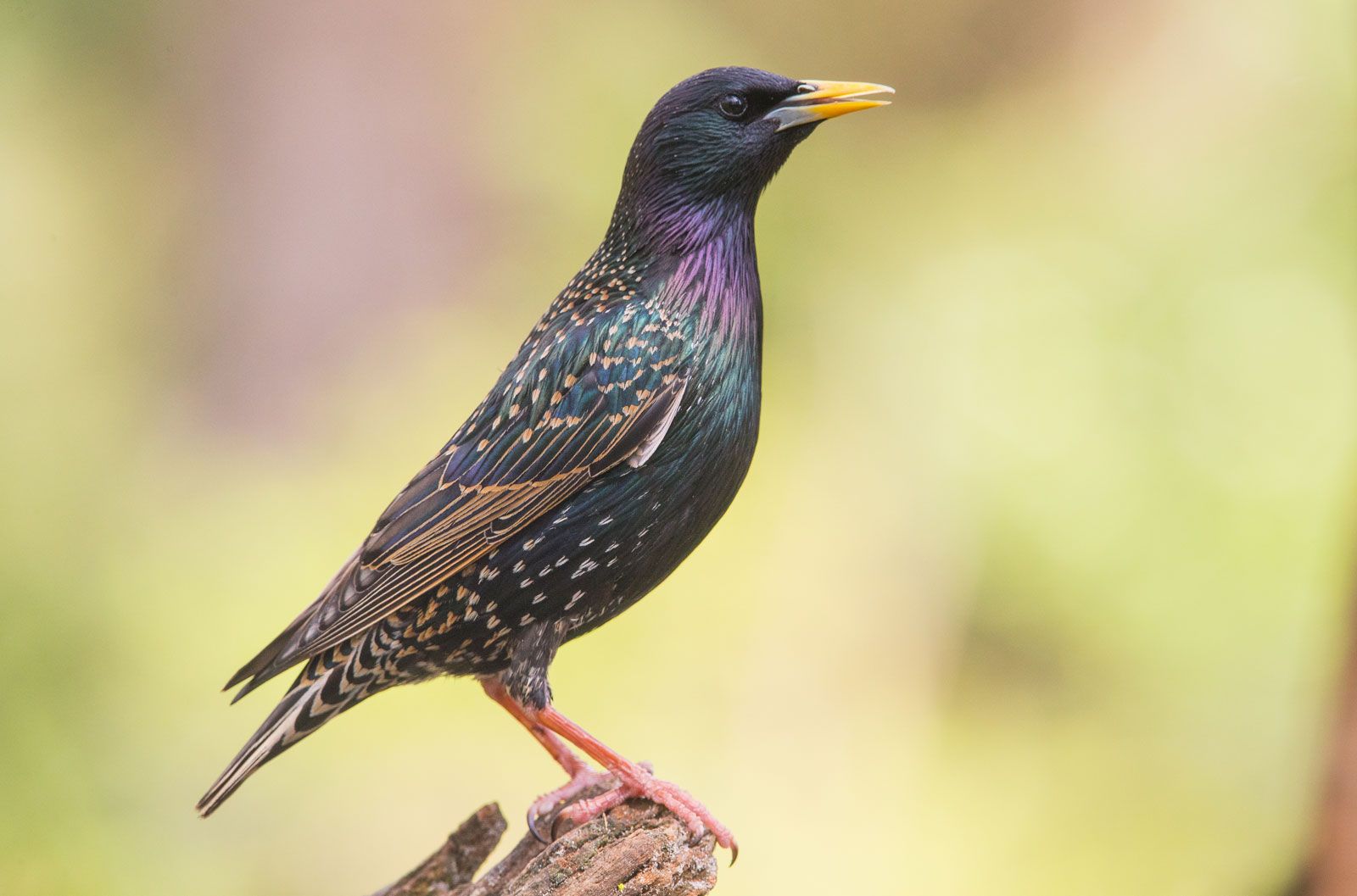
The Common Starling is a medium-sized passerine bird, highly gregarious and known for its iridescent plumage and complex vocalizations. It is a highly adaptable species, thriving in a variety of habitats, particularly those modified by humans. Starlings are well-known for their spectacular murmurations, large flocks that perform intricate aerial displays.
Dimensioni e longevità
- Lunghezza
- 19-23 cm
- Apertura alare
- 31-44 cm
- Peso
- 60-90 g
- Longevità
- 2-5 years (up to 15 years in captivity)
- Dieta
- Omnivore, primarily insectivorous during breeding season, shifting to fruits, seeds, and human-provided food in other seasons.
Caratteristiche fisiche
- Piumaggio
- Adult breeding plumage is glossy black with iridescent purple and green sheens, heavily speckled with small white spots, especially on the flanks and belly. Non-breeding plumage (autumn/winter) shows more prominent white spotting due to pale feather tips, which wear off by spring. Juveniles are dull grey-brown overall, often with a paler throat and streaking on the underparts.
- Forma del becco
- Conical and pointed. In breeding season, the bill is bright yellow with a bluish base in males and a pinkish base in females. In non-breeding season, the bill is dark brown to black.
- Colore degli occhi
- Dark brown.
- Colore delle zampe
- Reddish-brown to pinkish-brown.
- Caratteristiche distintive
- Short tail, triangular wings in flight, direct and powerful flight, iridescent plumage, and distinctive speckled appearance (especially in winter).
- Aspetto giovanile
- Uniformly dull grey-brown, lacking iridescence and spotting. The bill is dark brown to black. They gradually acquire adult plumage through their first autumn and winter.
- Cambiamenti stagionali
- The most significant change is the reduction of white spotting from non-breeding (winter) to breeding (spring) plumage. This is due to the wearing away of pale feather tips, revealing the underlying glossy black plumage. The bill color also changes from dark to bright yellow.
- Dimorfismo sessuale
- Subtle. Males typically have a bluer base to the bill during breeding season and slightly longer, less prominent throat feathers. Females have a pinker base to the bill. In non-breeding plumage, males tend to have fewer and smaller white spots than females, but this can be variable.
Come identificare
- 1
Size and Shape
Medium-sized, plump body with a short tail and pointed, triangular wings in flight.
- 2
Plumage (Adult Breeding)
Glossy black with iridescent purple and green sheens, appearing 'oily' in good light. Bill is bright yellow.
- 3
Plumage (Adult Non-breeding/Winter)
Heavily speckled with small white spots all over the body, especially on flanks and belly. Bill is dark.
- 4
Plumage (Juvenile)
Dull, uniform grey-brown with a dark bill, lacking iridescence and spots.
- 5
Flight
Direct, fast, and powerful flight with rapid wingbeats. Often flies in dense, coordinated flocks (murmurations).
- 6
Vocalization
Complex, varied song including whistles, clicks, rattles, and mimicry. Harsh 'churrr' and 'tsit' calls.
- 7
Behavior
Often seen foraging on lawns and open ground, probing with its bill. Highly social outside breeding season.
Habitat e areale
- Biomi
- Temperate forests, grasslands, urban and suburban areas, agricultural lands, coastal areas.
- Areale geografico
- Native to Europe, Asia, and North Africa. Introduced to North America, Australia, New Zealand, and South Africa, where it has become an invasive species.
- Fascia altitudinale
- Sea level up to 2,500 meters, but most common in lowlands.
- Ambienti preferiti
- Highly adaptable, preferring open country with scattered trees, parks, gardens, cultivated land, and urban environments. Requires cavities for nesting, often found in buildings, tree holes, or nest boxes.
Comportamento
- Periodo di attività
- Diurnal.
- Abitudini alimentari
- Forages primarily on the ground, probing with its bill for invertebrates such as beetles, caterpillars, spiders, and earthworms. Also consumes fruits (cherries, berries), seeds, and nectar. In urban areas, it readily feeds on discarded human food.
- Comportamento sociale
- Highly gregarious, forming large flocks outside the breeding season, sometimes numbering in the hundreds of thousands or even millions. During breeding, they are more territorial but still often nest in loose colonies.
- Tipo di volo
- Strong, direct, and fast flight with rapid wingbeats. In flocks, they perform highly coordinated, undulating aerial displays known as murmurations, especially at dusk before roosting.
- Migrazione
- Partial migrant. Northern and eastern European populations are largely migratory, moving south and west for the winter. Western and southern European populations are often resident or undertake shorter, local movements. Introduced populations in North America are also partially migratory.
- Territorialità
- During the breeding season, males establish and defend a small territory around the nest site. Outside of breeding, they are highly communal.
Canto e richiami
- Canto
- A complex and varied song, a mixture of whistles, clicks, rattles, chattering, and mimicry of other birds and even mechanical sounds. Often includes clear, fluty whistles and harsh, scratchy notes. Males sing from prominent perches to attract mates.
- Richiamo
- A wide range of calls, including a harsh 'churrr', a sharp 'tsit', and various contact calls within flocks. Alarm calls are typically harsh and scolding.
- Quando vocalizza
- Most vocal during the breeding season (spring and early summer). Males sing frequently to attract mates and defend territory. Flocks are noisy year-round, especially at roosts.
Riproduzione
- Stagione riproduttiva
- Typically March to July, with peak activity in April-May.
- Abitudini di nidificazione
- Monogamous, but extra-pair copulations are common. Nests are built in cavities, such as tree holes, old woodpecker holes, crevices in buildings, under eaves, or in nest boxes. Both sexes contribute to nest building, which consists of grass, twigs, leaves, and lined with feathers, moss, and wool.
- Dimensione della covata
- Typically 4-6 eggs, but can range from 3 to 8.
- Descrizione dell'uovo
- 3-8 eggs (typically 4-6), pale blue or greenish-blue, unspotted, glossy.
- Periodo di incubazione
- 11-15 days, primarily by the female, but the male may assist.
- Periodo di involo
- 20-22 days after hatching. Young are fed by both parents.
- Cure parentali
- Both parents feed and care for the nestlings. After fledging, the young remain dependent on parents for a short period before joining juvenile flocks.
Dove trovarlo
Urban and Suburban Areas
Parks, gardens, city centers, residential areas, especially near buildings with crevices for nesting.
Agricultural Lands
Farmlands, pastures, orchards, and vineyards, where they forage for insects and fruits.
Open Woodlands and Edges
Areas with scattered trees, forest edges, and clearings, particularly near human habitation.
Coastal Areas
Cliffs, dunes, and coastal towns, especially during migration and winter.
Consigli sul campo
- Look for Murmurations. In autumn and winter, look for large flocks gathering at dusk near communal roost sites (e.g., reedbeds, urban buildings, dense trees) to witness spectacular aerial displays.
- Listen for Vocalizations. Their varied and often mimetic song is distinctive. Listen for their chattering and whistling from prominent perches.
- Observe Foraging Behavior. Watch for them probing lawns and short grass with their bills, often walking with a distinctive swagger.
- Check Roost Sites. During non-breeding seasons, large numbers will gather at specific roost sites. These can be very noisy and active at dawn and dusk.
Specie simili
Spotless Starling
Sturnus unicolor
The Spotless Starling (found in Iberia, North Africa, and some Mediterranean islands) is very similar but lacks the white spotting in all plumages, appearing uniformly glossy black. Its bill is also yellow with a dark base in breeding plumage, but the overall impression is 'cleaner' black.
Blackbird
Turdus merula
While superficially similar in color, the Blackbird is larger, has a longer tail, and lacks the starling's iridescent sheen and white spotting. Male Blackbirds have a bright orange-yellow bill and eye-ring, while female Blackbirds are duller brown. Their flight is also less direct and more undulating than a starling's.
Fatti rapidi
- Sociality:
- Highly gregarious, forming massive flocks (murmurations).
- Dietary Flexibility:
- Omnivorous, adapting to available food sources.
- Vocal Mimicry:
- Known for imitating other birds and sounds.
- Nesting:
- Cavity nester, often utilizing human structures.
- Introduced Species:
- Invasive in several parts of the world, including North America.
Curiosità
- A group of starlings is called a 'murmuration,' a term derived from the sound of their wings and calls, and also refers to their mesmerizing aerial displays.
- Starlings are excellent mimics and can incorporate sounds from other birds, animals, and even human speech or mechanical noises into their songs.
- The Common Starling was introduced to North America in 1890 by Eugene Schieffelin, who released 60 birds in Central Park, New York, with the intention of introducing all birds mentioned in Shakespeare's plays. They are now one of the most abundant birds on the continent.
- Their iridescent plumage is not due to pigment but to the microscopic structure of their feathers, which refracts light to create the shimmering purple and green colors.
Classificazione scientifica
- Regno
- Animalia
- Phylum
- Chordata
- Classe
- Aves
- Ordine
- Passeriformes
- Famiglia
- Sturnidae
- Genere
- Sturnus
- Specie
- Sturnus vulgaris
Esplora Common Starling
Identifica uccelli ovunque
Gratis su iOS, Android e Web. Identificazione per foto e suono, database completo e la tua lista personale.