
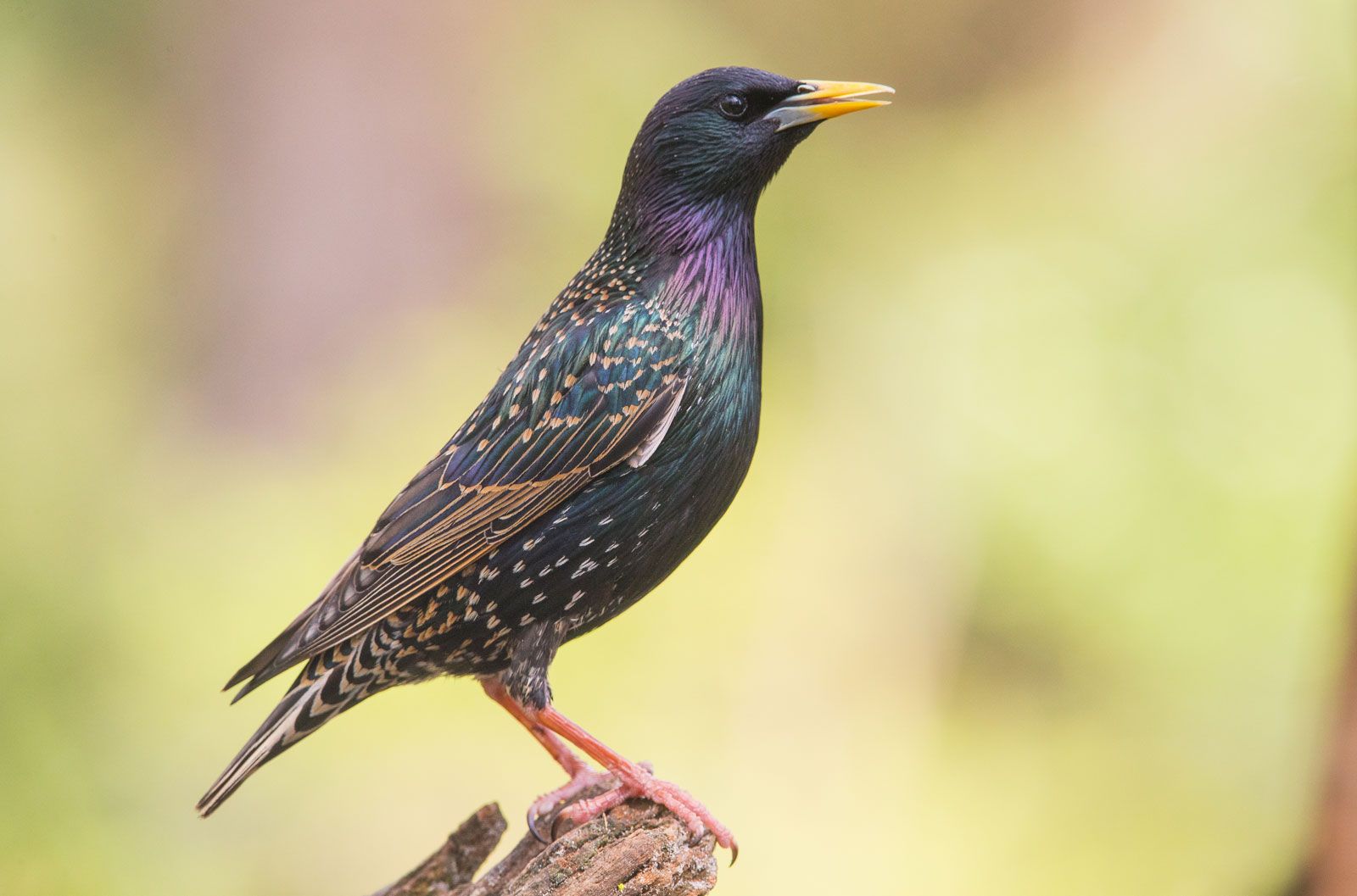
Come identificare Common Starling
Sturnus vulgaris
Visto un uccello? Identificalo all'istante con l'app Birdby
Apri l'appPer identificare correttamente Common Starling (Sturnus vulgaris), controlla ciascuna di queste caratteristiche. Gli uccelli possono essere complicati da riconoscere, perché comportamento, habitat e canto spesso confermano ciò che una sola foto non può.
Dimensioni a colpo d'occhio
- Lunghezza
- 19-23 cm
- Apertura alare
- 31-44 cm
- Peso
- 60-90 g
Caratteristiche fisiche da controllare
- 1
Piumaggio
Colorazione e disegno generale del piumaggio.
Adult breeding plumage is glossy black with iridescent purple and green sheens, heavily speckled with small white spots, especially on the flanks and belly. Non-breeding plumage (autumn/winter) shows more prominent white spotting due to pale feather tips, which wear off by spring. Juveniles are dull grey-brown overall, often with a paler throat and streaking on the underparts.
- 2
Forma del becco
Forma e colore del becco, un segno di campo chiave.
Conical and pointed. In breeding season, the bill is bright yellow with a bluish base in males and a pinkish base in females. In non-breeding season, the bill is dark brown to black.
- 3
Colore degli occhi
Colore dell'iride e segni distintivi sugli occhi.
Dark brown.
- 4
Colore delle zampe
Colore di zampe e piedi.
Reddish-brown to pinkish-brown.
- 5
Caratteristiche distintive
Tratti distintivi che separano questa specie.
Short tail, triangular wings in flight, direct and powerful flight, iridescent plumage, and distinctive speckled appearance (especially in winter).
- 6
Aspetto giovanile
Come i giovani si differenziano dagli adulti.
Uniformly dull grey-brown, lacking iridescence and spotting. The bill is dark brown to black. They gradually acquire adult plumage through their first autumn and winter.
- 7
Cambiamenti stagionali
Variazione del piumaggio tra stagione riproduttiva e non.
The most significant change is the reduction of white spotting from non-breeding (winter) to breeding (spring) plumage. This is due to the wearing away of pale feather tips, revealing the underlying glossy black plumage. The bill color also changes from dark to bright yellow.
- 8
Dimorfismo sessuale
Differenze tra maschi e femmine.
Subtle. Males typically have a bluer base to the bill during breeding season and slightly longer, less prominent throat feathers. Females have a pinker base to the bill. In non-breeding plumage, males tend to have fewer and smaller white spots than females, but this can be variable.
Segni di campo chiave
- Size and Shape. Medium-sized, plump body with a short tail and pointed, triangular wings in flight.
- Plumage (Adult Breeding). Glossy black with iridescent purple and green sheens, appearing 'oily' in good light. Bill is bright yellow.
- Plumage (Adult Non-breeding/Winter). Heavily speckled with small white spots all over the body, especially on flanks and belly. Bill is dark.
- Plumage (Juvenile). Dull, uniform grey-brown with a dark bill, lacking iridescence and spots.
- Flight. Direct, fast, and powerful flight with rapid wingbeats. Often flies in dense, coordinated flocks (murmurations).
- Vocalization. Complex, varied song including whistles, clicks, rattles, and mimicry. Harsh 'churrr' and 'tsit' calls.
- Behavior. Often seen foraging on lawns and open ground, probing with its bill. Highly social outside breeding season.
Esplora Common Starling
Identifica uccelli ovunque
Gratis su iOS, Android e Web. Identificazione per foto e suono, database completo e la tua lista personale.