
Visto un uccello? Identificalo all'istante con l'app Birdby
Apri l'appInformazioni
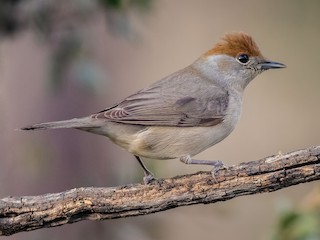
The Eurasian Blackcap, often simply called Blackcap, is a common and widespread passerine bird in the Old World warbler family Sylviidae. It is known for its distinctive cap, which is black in males and reddish-brown in females, and its melodious song. It is a migratory species across much of its range, though populations in milder western and southern Europe are increasingly resident or short-distance migrants.
Dimensioni e longevità
- Lunghezza
- 13-15 cm
- Apertura alare
- 20-23 cm
- Peso
- 14-20 g
- Longevità
- Typically 2-5 years in the wild, up to 10 years recorded.
- Dieta
- Omnivore, primarily insectivorous during breeding season, shifting to fruits and berries in late summer and autumn.
Caratteristiche fisiche
- Piumaggio
- Overall greyish-brown upperparts and paler greyish-white underparts. The most striking feature is the cap.
- Forma del becco
- Slender, pointed, dark grey to blackish beak, adapted for insect foraging and fruit consumption.
- Colore degli occhi
- Dark brown.
- Colore delle zampe
- Dark grey to blackish-grey.
- Caratteristiche distintive
- The distinctive cap color (black in males, reddish-brown in females) is the primary distinguishing feature. Otherwise, it is a rather plain, medium-sized warbler.
- Aspetto giovanile
- Juveniles resemble females, with a reddish-brown cap, but their plumage is generally duller and browner overall. The cap may be less distinctly defined. Young males gradually acquire their black cap during their first autumn/winter.
- Cambiamenti stagionali
- No significant seasonal plumage changes beyond the maturation of juvenile plumage. The cap color remains constant for adults throughout the year.
- Dimorfismo sessuale
- Pronounced sexual dimorphism in cap color: males have a glossy black cap extending from the forehead to the nape, while females have a chestnut or reddish-brown cap. Both sexes have similar body plumage.
Come identificare
- 1
Cap Color
The most reliable field mark: glossy black cap for males, reddish-brown/chestnut cap for females and juveniles. This is visible even at a distance.
- 2
Plumage
Overall plain greyish-brown upperparts and paler greyish-white underparts. Look for the lack of streaking or strong patterns on the body.
- 3
Song
Listen for the distinctive, rich, fluty, and melodious warbling song, often starting hesitantly and then becoming clearer and more powerful. It's a key identification feature, especially when the bird is hidden in foliage.
- 4
Behavior
Watch for its active foraging style, flitting through dense vegetation, gleaning insects. It can be quite shy but will often sing from exposed perches.
Habitat e areale
- Biomi
- Temperate forests, woodlands, parks, gardens, scrubland, hedgerows, and riparian vegetation.
- Areale geografico
- Widespread across most of Europe, western Asia, and northern Africa. Breeding range extends from Ireland and Portugal eastwards to western Siberia and south to the Mediterranean and North Africa. Winters in southern Europe, North Africa, and sub-Saharan Africa.
- Fascia altitudinale
- From sea level up to 2,000 meters, occasionally higher in mountainous regions.
- Ambienti preferiti
- Prefers deciduous and mixed woodlands with a dense understory, thickets, and areas with abundant berry-producing shrubs. Also common in suburban gardens and parks with suitable vegetation.
Comportamento
- Periodo di attività
- Diurnal.
- Abitudini alimentari
- Forages actively in the canopy and undergrowth, gleaning insects, spiders, and larvae from leaves and branches. In late summer and autumn, it switches to a diet rich in fruits and berries, playing an important role in seed dispersal. May also catch insects in flight.
- Comportamento sociale
- Generally solitary or found in pairs during the breeding season. Outside of breeding, they can be seen in small, loose groups, especially during migration or when foraging for berries.
- Tipo di volo
- Undulating, rather weak flight over short distances, often flitting between branches within cover. Migratory flights are more direct and sustained.
- Migrazione
- Most populations are migratory, moving south to wintering grounds in the Mediterranean basin, North Africa, and sub-Saharan Africa. Northern and eastern populations are typically long-distance migrants. Western and southern European populations show increasing residency or short-distance migration, with some individuals even wintering further north in the UK and Ireland, likely due to climate change and supplementary feeding.
- Territorialità
- Males establish and defend breeding territories through song and displays. Both sexes participate in nest defense.
Canto e richiami
- Canto
- The song is a rich, fluty, and melodious warble, often starting with a few hesitant, scratchy notes before developing into a clear, pure, and often accelerating series of phrases. It can be quite varied and beautiful, often compared to that of a Nightingale but typically less powerful and more 'liquid'.
- Richiamo
- Common calls include a sharp, hard 'tack' or 'chack' note, often repeated rapidly when alarmed. Also a soft 'tew' or 'churr' contact call.
- Quando vocalizza
- Males sing frequently from prominent perches during the breeding season (April to July), often from dawn until dusk. Alarm calls are given year-round when disturbed.
Riproduzione
- Stagione riproduttiva
- Typically April to July, with peak activity in May and June.
- Abitudini di nidificazione
- Nests are usually built low down in dense bushes, brambles, or small trees, often well-concealed. The nest is a neat, cup-shaped structure made of grass, leaves, moss, and rootlets, lined with finer materials like hair and plant down.
- Dimensione della covata
- Typically 4-6 eggs.
- Descrizione dell'uovo
- 3-7 (typically 4-6) eggs, smooth and glossy, whitish to pale buff or greenish-white, heavily speckled and blotched with reddish-brown, grey, or purplish markings, often concentrated at the broad end.
- Periodo di incubazione
- 10-12 days, primarily by the female, but the male may assist.
- Periodo di involo
- 10-14 days after hatching. Young leave the nest before they can fly strongly.
- Cure parentali
- Both parents feed the nestlings and fledglings. They may raise two broods in a season.
Dove trovarlo
Deciduous Woodlands
Look in mature deciduous or mixed woodlands with a good understory of shrubs and saplings.
Parks and Gardens
Common in well-vegetated urban and suburban parks and gardens, especially those with dense bushes and fruit-bearing plants.
Hedgerows and Scrubland
Check dense hedgerows, scrubby areas, and woodland edges, particularly where there are berry bushes.
Consigli sul campo
- Listen for the song. The Blackcap's song is often the first indication of its presence, especially when it's hidden in dense foliage. Learn to recognize its distinctive fluty warble.
- Look in dense cover. Blackcaps prefer to forage and nest in dense bushes and undergrowth. Scan these areas carefully, especially at eye level or slightly above.
- Visit during breeding season. During spring and early summer, males are most vocal and visible as they establish territories and attract mates.
- Check berry bushes in autumn. In late summer and autumn, Blackcaps switch to a fruit-heavy diet. Look for them in bushes laden with elderberries, ivy berries, or other soft fruits.
Specie simili
Garden Warbler
Sylvia borin
The Garden Warbler lacks any distinctive cap; its head is uniformly brownish, similar to its back. It is generally plainer and slightly larger, with a less contrasting plumage. Its song is also rich and warbling but typically lacks the clear, fluty notes of the Blackcap and is often more continuous and less structured.
Orphean Warbler
Sylvia hortensis
The Orphean Warbler is larger and has a darker grey head (not a distinct cap) and a prominent white eye-ring. Its underparts are whiter, and its song is more powerful and varied, often mimicking other birds.
Sardinian Warbler
Sylvia melanocephala
The Sardinian Warbler male has a black cap, but it also has a striking red eye-ring and a grey throat and breast, contrasting with white underparts. Females have a greyish-brown cap and a duller eye-ring. It is typically found in more Mediterranean scrub habitats.
Fatti rapidi
- Cap Color:
- Male: Black, Female/Juvenile: Reddish-brown
- Song:
- Rich, fluty, melodious warble
- Diet Shift:
- Insects in spring/summer, fruits/berries in autumn
- Migration:
- Partial to long-distance migrant, increasing residency in west
Curiosità
- Blackcaps are increasingly wintering in the UK and Ireland, a phenomenon linked to climate change and the availability of garden bird feeders, leading to a shift in migratory routes for some populations.
- The Blackcap's song is often considered one of the most beautiful among European warblers, sometimes earning it the nickname 'Northern Nightingale'.
- Studies have shown that Blackcaps can learn and incorporate elements of other birds' songs into their own repertoire.
- They are important seed dispersers for many plant species, especially those with fleshy fruits, contributing to forest regeneration.
Classificazione scientifica
- Regno
- Animalia
- Phylum
- Chordata
- Classe
- Aves
- Ordine
- Passeriformes
- Famiglia
- Sylviidae
- Genere
- Sylvia
- Specie
- Sylvia atricapilla
Esplora Eurasian Blackcap
Identifica uccelli ovunque
Gratis su iOS, Android e Web. Identificazione per foto e suono, database completo e la tua lista personale.