
Spotted a bird? Identify it instantly with the Birdby app
Open the appAbout
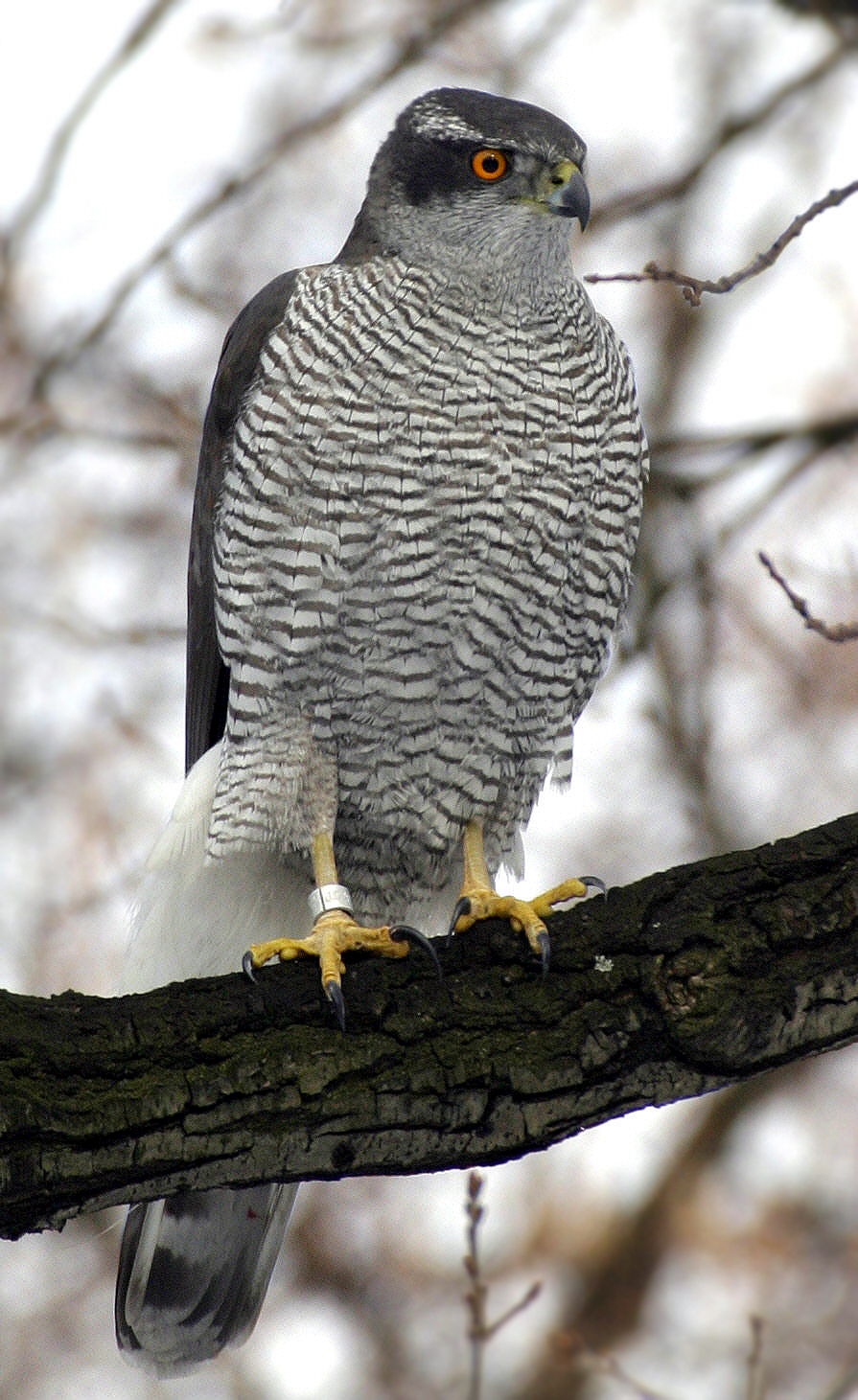
The Northern Goshawk, known as 'Havik' in Dutch, is a powerful and agile raptor, renowned for its fierce hunting prowess in dense woodlands. It is the largest member of the genus Accipiter, characterized by short, broad wings and a long tail, adaptations for maneuvering through forests. Goshawks are apex predators in their ecosystems, preying primarily on medium-sized birds and mammals.
Size & lifespan
- Length
- 46-63 cm (18-25 in)
- Wingspan
- 89-122 cm (35-48 in)
- Weight
- Males: 500-1200 g (1.1-2.6 lbs), Females: 800-2200 g (1.8-4.9 lbs)
- Lifespan
- Typically 10-12 years in the wild, up to 19 years recorded
- Diet
- Carnivore, primarily preying on medium-sized birds (e.g., pigeons, jays, grouse, pheasants) and mammals (e.g., squirrels, rabbits, hares, stoats).
Physical characteristics
- Plumage
- Adults have dark slate-grey to brownish-grey upperparts, finely barred white underparts, and a prominent white supercilium (eyebrow). The tail is long with 3-5 dark bands. Juveniles are brown above with streaked buffy-white underparts.
- Beak shape
- Strong, hooked beak, dark grey to black with a yellow cere.
- Eye color
- Adults have bright orange to deep red eyes. Juveniles have yellow eyes that gradually change with age.
- Leg color
- Yellow to orange-yellow.
- Distinguishing features
- Large size for an Accipiter, broad wings, long tail, prominent white supercilium, and fierce expression. The barring on the underparts is fine and dense in adults.
- Juvenile appearance
- Juveniles are distinctly different from adults. They have brown upperparts with pale feather edgings, giving a scaled appearance. Underparts are buffy-white with heavy, dark brown streaking, particularly on the breast and belly. Their eyes are yellow.
- Seasonal changes
- No significant seasonal plumage changes. Plumage remains consistent year-round, with age-related changes from juvenile to adult plumage occurring over 2-3 years.
- Sexual dimorphism
- Females are significantly larger and heavier than males (up to 50% larger in weight), though plumage is similar. This size difference is a key identification feature in the field.
How to identify
- 1
Size and Build
Look for a large, powerful Accipiter. Females are notably larger than males. Its robust build, broad wings, and long tail are characteristic.
- 2
Plumage (Adult)
Adults have dark grey upperparts, finely barred white underparts, and a striking white 'eyebrow' (supercilium) that extends behind the eye. The eyes are typically orange to red.
- 3
Plumage (Juvenile)
Juveniles are brown above with pale feather edgings and heavily streaked buffy-white underparts. Their eyes are yellow.
- 4
Flight Style
Observe its flight: powerful, rapid wing beats followed by short glides, especially when maneuvering through dense forest. Can be very agile.
- 5
Vocalization
Listen for its characteristic rapid 'kek-kek-kek-kek' call, especially if you are near a potential nest site or if the bird is agitated.
- 6
Habitat
Goshawks are typically found in mature, extensive forests. If you are in such a habitat and see a large, fast-flying raptor, it's a strong indicator.
Habitat & range
- Biomes
- Temperate and boreal forests, woodlands.
- Geographic range
- Widespread across the Northern Hemisphere, including North America, Europe, and Asia. In Europe, it is found from Scandinavia south to the Mediterranean, and east across Russia. In North America, it ranges from Alaska and Canada south through the western mountains to Mexico and across the northern states.
- Elevation range
- Sea level up to 3,000 meters (10,000 ft), depending on geographic location and availability of suitable forest habitat.
- Preferred environments
- Mature, extensive deciduous, coniferous, or mixed forests with a dense canopy and open understory, often near clearings or forest edges for hunting. Requires large, undisturbed areas for breeding.
Behavior
- Activity time
- Diurnal, most active during daylight hours, particularly in the morning and late afternoon.
- Feeding habits
- A powerful and opportunistic hunter. It hunts by perching inconspicuously within the forest canopy, making short, rapid flights to ambush prey. It also hunts by flying low through the forest, using cover to surprise prey. Known for its aggressive pursuit, even into dense vegetation. Prey is typically caught on the ground or in flight.
- Social behavior
- Primarily solitary outside of the breeding season. During breeding, pairs are monogamous and highly territorial, fiercely defending their nest site.
- Flight pattern
- Characterized by powerful, rapid wing beats interspersed with short glides. In open areas, it can soar, but typically flies low and fast through forests. Its short, broad wings and long tail allow for exceptional agility and maneuverability in dense cover.
- Migration pattern
- Generally a resident species throughout much of its range. Northern populations may undertake short-distance, irruptive migrations in response to prey scarcity or harsh winter conditions. Juveniles disperse more widely than adults.
- Territoriality
- Highly territorial, especially during the breeding season. Pairs will aggressively defend their nesting territory against intruders, including other raptors and humans.
Song & calls
- Song
- The Northern Goshawk does not have a complex song. Its vocalizations are primarily calls.
- Call
- The most common call is a rapid, chattering 'kek-kek-kek-kek' or 'gii-gii-gii-gii', often given when agitated or defending the nest. During courtship, a softer 'gii-a' or 'kwee-a' may be heard. Alarm calls are sharper and more insistent.
- When they vocalize
- Most vocal during the breeding season, particularly around the nest site when disturbed or during courtship. Less vocal outside of the breeding period.
Breeding & reproduction
- Breeding season
- Typically March to June, with egg-laying occurring from late March to early May, depending on latitude.
- Nesting habits
- Builds a large stick nest, often in the fork of a tall tree (coniferous or deciduous) in a dense forest stand. Nests are typically 10-20 meters (30-65 ft) high. Pairs often reuse nests or build new ones in close proximity to previous sites.
- Clutch size
- 2-4 eggs
- Egg description
- 2-4 (occasionally 1-5) eggs, dull white to pale bluish-white, sometimes faintly stained brown. They are typically unmarked.
- Incubation period
- Approximately 35-42 days, primarily by the female, while the male provides food.
- Fledging period
- Young fledge (leave the nest) at about 35-42 days old, but remain dependent on parents for several weeks to months after fledging.
- Parental care
- Both parents are involved in raising the young. The female incubates and broods, while the male provides most of the food during incubation and early nestling stages. Both parents hunt and feed the young after they are older.
Where to find
Mature Forests
Look in large, undisturbed tracts of mature deciduous, coniferous, or mixed forests. They prefer areas with a dense canopy.
Forest Edges and Clearings
While they nest deep in forests, they often hunt along forest edges, clearings, or near open areas where prey is abundant.
Mountainous Regions
In some parts of their range, they can be found in forested mountainous terrain.
Field tips
- Patience and Stealth. Goshawks are elusive and wary. Move quietly and slowly through suitable forest habitats. They are often detected by their calls or by observing their powerful flight.
- Look for Signs. Search for large stick nests in tall trees, especially during the breeding season. Look for 'plucking posts' (perches where they pluck feathers from prey) or prey remains below potential roosts.
- Listen for Calls. During the breeding season (spring and early summer), listen for their distinctive 'kek-kek-kek' calls, which can indicate a nearby nest or agitated bird.
- Early Morning/Late Afternoon. These are often the most active hunting times for Goshawks, increasing your chances of observation.
- Binoculars and Scope. Essential for detailed observation, especially for distinguishing plumage features and confirming identification from a distance.
Similar species
Eurasian Sparrowhawk
Accipiter nisus
The Eurasian Sparrowhawk is significantly smaller than the Goshawk. It has a shorter tail and more rounded wings. Adult males have slate-grey upperparts and rufous barring on the underparts, while females are browner above with greyish barring below. The Goshawk's prominent white supercilium is also a key distinguishing feature not present in the Sparrowhawk.
Cooper's Hawk
Accipiter cooperii
In North America, the Cooper's Hawk is smaller than the Goshawk, though size overlap can occur with large female Cooper's and small male Goshawks. Cooper's Hawks have a more rounded head (Goshawks have a flatter crown), a shorter, more rounded tail (Goshawk's tail is longer and more squared or slightly notched), and less prominent supercilium. The Goshawk's flight is more powerful and direct.
Northern Harrier
Circus hudsonius
While also a raptor, the Northern Harrier has a very different flight style (low, buoyant, with wings held in a dihedral) and habitat preference (open grasslands, marshes). It also has a distinctive white rump patch and an owl-like facial disc, features absent in the Goshawk.
Quick facts
- Diet:
- Birds and mammals
- Habitat:
- Mature forests
- Wingspan:
- 89-122 cm
- Conservation Status:
- Least Concern
- Key ID Feature:
- Large size, white supercilium, barred underparts, powerful flight
Fun facts
- The Northern Goshawk is often referred to as the 'phantom of the forest' due to its elusive nature and ability to disappear quickly into dense cover.
- It is a highly skilled aerial predator, capable of incredible agility and speed, even in cluttered forest environments.
- In falconry, the Goshawk is highly prized for its hunting abilities and fierce temperament.
- The species name 'gentilis' means 'noble' or 'gentle', referring to its historical use by nobility in falconry.
- Females are significantly larger than males, a common trait among raptors, which is thought to reduce competition for prey between sexes.
Scientific classification
- Kingdom
- Animalia
- Phylum
- Chordata
- Class
- Aves
- Order
- Accipitriformes
- Family
- Accipitridae
- Genus
- Accipiter
- Species
- Accipiter gentilis
Explore the Northern Goshawk
Identify birds anywhere
Free on iOS, Android, and Web. Photo & sound identification, full species database, and your personal life list.