
How to identify the Northern Goshawk
Accipiter gentilis
Spotted a bird? Identify it instantly with the Birdby app
Open the appTo correctly identify the Northern Goshawk (Accipiter gentilis), check each of these features. Birds can be tricky: habit, habitat, and call often confirm a sighting that a single photo cannot.
Size at a glance
- Length
- 46-63 cm (18-25 in)
- Wingspan
- 89-122 cm (35-48 in)
- Weight
- Males: 500-1200 g (1.1-2.6 lbs), Females: 800-2200 g (1.8-4.9 lbs)
Physical features to check
- 1
Plumage
Overall feather coloration and pattern.
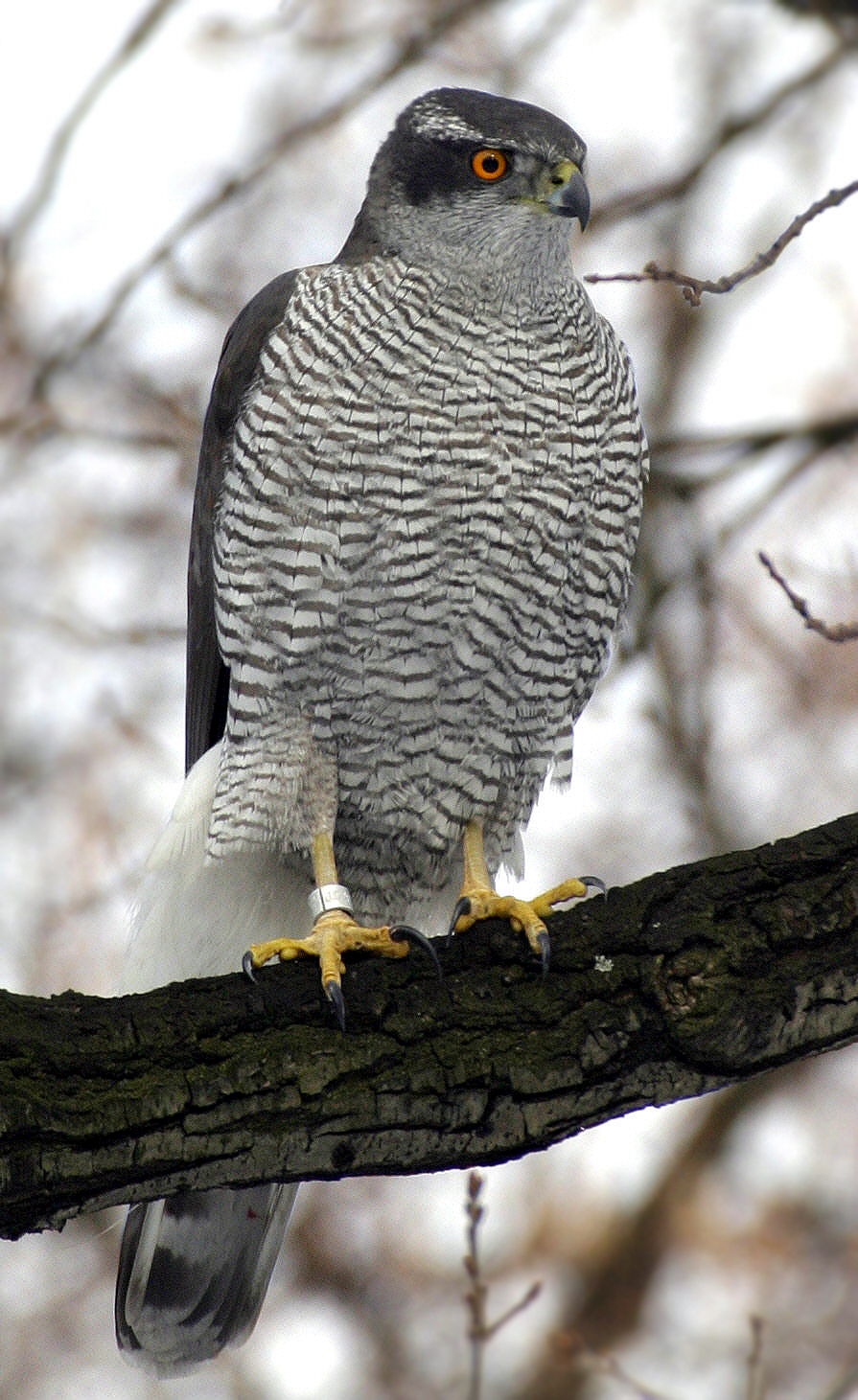
Adults have dark slate-grey to brownish-grey upperparts, finely barred white underparts, and a prominent white supercilium (eyebrow). The tail is long with 3-5 dark bands. Juveniles are brown above with streaked buffy-white underparts.
- 2
Beak shape
Shape and color of the bill: a key field mark.
Strong, hooked beak, dark grey to black with a yellow cere.
- 3
Eye color
Iris color and any distinctive eye markings.
Adults have bright orange to deep red eyes. Juveniles have yellow eyes that gradually change with age.
- 4
Leg color
Leg and foot color.
Yellow to orange-yellow.
- 5
Distinguishing features
Standout features that separate this species.
Large size for an Accipiter, broad wings, long tail, prominent white supercilium, and fierce expression. The barring on the underparts is fine and dense in adults.
- 6
Juvenile appearance
How young birds differ from adults.
Juveniles are distinctly different from adults. They have brown upperparts with pale feather edgings, giving a scaled appearance. Underparts are buffy-white with heavy, dark brown streaking, particularly on the breast and belly. Their eyes are yellow.
- 7
Seasonal changes
Plumage variation between breeding and non-breeding seasons.
No significant seasonal plumage changes. Plumage remains consistent year-round, with age-related changes from juvenile to adult plumage occurring over 2-3 years.
- 8
Sexual dimorphism
How males and females differ.
Females are significantly larger and heavier than males (up to 50% larger in weight), though plumage is similar. This size difference is a key identification feature in the field.
Key field marks
- Size and Build. Look for a large, powerful Accipiter. Females are notably larger than males. Its robust build, broad wings, and long tail are characteristic.
- Plumage (Adult). Adults have dark grey upperparts, finely barred white underparts, and a striking white 'eyebrow' (supercilium) that extends behind the eye. The eyes are typically orange to red.
- Plumage (Juvenile). Juveniles are brown above with pale feather edgings and heavily streaked buffy-white underparts. Their eyes are yellow.
- Flight Style. Observe its flight: powerful, rapid wing beats followed by short glides, especially when maneuvering through dense forest. Can be very agile.
- Vocalization. Listen for its characteristic rapid 'kek-kek-kek-kek' call, especially if you are near a potential nest site or if the bird is agitated.
- Habitat. Goshawks are typically found in mature, extensive forests. If you are in such a habitat and see a large, fast-flying raptor, it's a strong indicator.
Explore the Northern Goshawk
Identify birds anywhere
Free on iOS, Android, and Web. Photo & sound identification, full species database, and your personal life list.