
Spotted a bird? Identify it instantly with the Birdby app
Open the appAbout
The Common Sandpiper is a small, migratory wader found across much of Eurasia. It is characterized by its distinctive 'teetering' or 'bobbing' gait and low, stiff-winged flight over water. It is a widespread and familiar species along freshwater and coastal habitats.
Size & lifespan
- Length
- 18-20 cm
- Wingspan
- 32-35 cm
- Weight
- 30-80 g
- Lifespan
- Up to 10 years in the wild
- Diet
- Insectivore
Physical characteristics
- Plumage
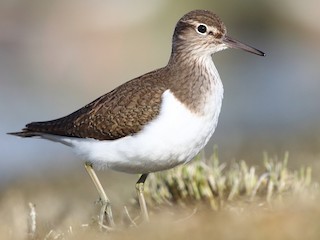
- Adults in breeding plumage have olive-brown upperparts with fine dark streaking, especially on the crown and mantle. The underparts are clean white, with a distinctive white wedge extending up onto the shoulder, separating the brown breast from the wing. A faint, dusky breast band may be present. The rump and tail are dark brown with white outer tail feathers, visible in flight. Non-breeding plumage is similar but slightly duller, with less distinct streaking.
- Beak shape
- Relatively short, slender, and straight bill, dark grey to blackish.
- Eye color
- Dark brown, with a faint white supercilium (eyebrow stripe) above it.
- Leg color
- Dull greenish-grey to yellowish-grey.
- Distinguishing features
- The most distinctive feature is its constant 'teetering' or 'bobbing' motion of the hindquarters when standing or walking. In flight, it shows stiff, shallow wingbeats, often flying low over water, and a prominent white wing-bar (formed by white bases to the primary feathers) and white outer tail feathers.
- Juvenile appearance
- Juveniles resemble adults but have more prominent buff or pale fringes to the feathers of the upperparts, giving them a slightly scaly appearance. The breast band may be more diffuse.
- Seasonal changes
- Plumage changes between breeding and non-breeding are subtle, primarily involving a slight dulling of the upperparts and less distinct streaking in non-breeding birds.
- Sexual dimorphism
- Males and females are monomorphic in plumage and size, making them indistinguishable in the field.
How to identify
- 1
Behavior: Teetering
Look for the constant, rhythmic bobbing of the tail and hindquarters when the bird is standing or walking. This is a key diagnostic feature.
- 2
Flight Pattern
Observe its flight: low over water, with stiff, shallow, rapid wingbeats, often interspersed with short glides and banking from side to side. Look for the white wing-bar.
- 3
Plumage: White Shoulder Wedge
Note the distinctive white patch extending up from the white underparts onto the side of the breast, separating the brown upperparts from the wing. This is visible even when the bird is standing.
- 4
Call
Listen for its characteristic high-pitched, piping 'twee-wee-wee' call, especially when flushed or in flight.
- 5
Tail in Flight
In flight, the dark central tail feathers contrast with the white outer tail feathers, which is a good field mark.
Habitat & range
- Biomes
- Temperate forests, taiga, grasslands, coastal areas, wetlands.
- Geographic range
- Breeds across most of Eurasia, from Western Europe to Japan. Winters in Africa, the Middle East, South Asia, and Australasia.
- Elevation range
- Typically found from sea level up to 2,000 meters, occasionally higher in mountainous regions with suitable water bodies.
- Preferred environments
- Prefers freshwater habitats such as rivers, streams, lakes, ponds, and reservoirs, especially those with stony or gravelly banks. Also found on coastal shores, estuaries, and tidal flats during migration and winter.
Behavior
- Activity time
- Diurnal, though may forage during moonlit nights.
- Feeding habits
- Forages by picking insects and other small invertebrates from the surface of water, mud, or stones. It often runs short distances, stops, bobs, and then pecks. Diet includes aquatic and terrestrial insects (beetles, flies, larvae), small crustaceans, molluscs, and occasionally small fish.
- Social behavior
- Generally solitary or found in small, loose groups, especially during migration and in wintering areas. Breeding pairs defend territories.
- Flight pattern
- Distinctive low, stiff-winged flight with rapid, shallow wingbeats, often interspersed with short glides. It frequently flies just above the water surface, banking from side to side.
- Migration pattern
- A long-distance migratory species. European breeders typically migrate south to Africa, while Asian populations winter in South Asia and Australasia. Migration occurs from July to October (southbound) and March to May (northbound).
- Territoriality
- Highly territorial during the breeding season, with pairs defending a stretch of riverbank or shoreline. They can be aggressive towards intruders.
Song & calls
- Song
- Not a true songster, but its calls can be considered a form of vocal display during breeding. A rapid, high-pitched 'twee-wee-wee' or 'twee-twee-twee' often given in flight.
- Call
- The most characteristic call is a sharp, piping 'twee-wee-wee' or 'tsee-wee-wee', often given in a series of 3-5 notes, especially when flushed or in flight. Also a single 'tew' or 'chip' note.
- When they vocalize
- Most vocal during the breeding season and when disturbed. Calls are frequently heard in flight.
Breeding & reproduction
- Breeding season
- May to July in most of its range.
- Nesting habits
- Nests on the ground, typically in a shallow scrape lined with grass, leaves, or small stones, often concealed under vegetation near water. Both sexes participate in nest site selection and construction.
- Clutch size
- 3-5 eggs, most commonly 4.
- Egg description
- Typically 4 eggs, pyriform (pear-shaped), pale buff to greenish-white with dark brown or reddish-brown spots and blotches, often concentrated at the broader end.
- Incubation period
- 21-22 days, incubated by both parents.
- Fledging period
- Chicks are precocial and leave the nest shortly after hatching. They are able to fly at about 22-28 days old.
- Parental care
- Both parents care for the young, though the female may sometimes leave the brood with the male to attempt a second clutch with another male (polyandry) or to migrate early.
Where to find
Rivers and Streams
Look along the banks of slow-moving to moderately fast-flowing rivers and streams, especially those with gravelly or stony edges.
Lakes and Ponds
Check the shores of freshwater lakes, reservoirs, and larger ponds, particularly where there are exposed mudflats or stony margins.
Coastal Areas
During migration and in winter, they can be found on estuaries, tidal flats, sheltered bays, and rocky shores.
Wetlands
Any wetland habitat with open water and suitable foraging substrate can attract Common Sandpipers.
Field tips
- Look for movement. Their constant 'teetering' motion makes them relatively easy to spot even when camouflaged against the background.
- Listen for calls. Their distinctive 'twee-wee-wee' call is often the first indication of their presence, especially when they are flushed.
- Scan water edges. Focus your binoculars or scope on the water's edge, mudflats, and exposed stones where they typically forage.
- Observe flight. If you see a small wader flying low over water with stiff, shallow wingbeats, it's likely a Common Sandpiper. Look for the white wing-bar.
Similar species
Spotted Sandpiper
Actitis macularius
The Spotted Sandpiper (North American counterpart) has prominent black spots on its underparts during breeding plumage, which the Common Sandpiper lacks. In non-breeding plumage, they are very similar, but Spotted Sandpiper typically has a less distinct white wedge on the shoulder and often a slightly shorter bill. Their calls also differ.
Green Sandpiper
Tringa ochropus
The Green Sandpiper is larger, darker overall, and lacks the white wing-bar of the Common Sandpiper. It has a prominent white rump and dark underwings, contrasting with the white belly. Its flight is more direct and less 'jerky' than the Common Sandpiper. The Green Sandpiper's call is a louder, more ringing 'tloo-eet'.
Wood Sandpiper
Tringa glareola
The Wood Sandpiper is also larger and has a more slender appearance. It has a prominent white supercilium, finely spotted upperparts, and a white rump. Its legs are yellowish-green, similar to Common Sandpiper, but it lacks the distinctive white wing-bar and the 'teetering' behavior is less pronounced. Its call is a rapid 'chiff-iff-iff'.
Quick facts
- Distinctive Behavior:
- Constant 'teetering' or 'bobbing' of the tail.
- Flight Style:
- Low, stiff-winged flight with rapid, shallow wingbeats.
- Key Plumage Mark:
- White wedge extending up onto the shoulder.
- Migration:
- Long-distance migrant, wintering in Africa and Asia.
- Habitat Preference:
- Freshwater rivers, lakes, and coastal areas.
Fun facts
- The Common Sandpiper is one of the most widespread waders in the world, breeding across a vast area of Eurasia.
- Its scientific name 'Actitis' comes from the Greek word 'aktites', meaning 'coast-dweller', referring to its preferred habitat.
- The 'teetering' behavior is thought to help them scan for predators or prey, or perhaps to maintain balance on uneven terrain.
- Some female Common Sandpipers exhibit polyandry, laying multiple clutches for different males in a single breeding season.
- They are known to be quite tame and approachable in some areas, allowing close observation.
Scientific classification
- Kingdom
- Animalia
- Phylum
- Chordata
- Class
- Aves
- Order
- Charadriiformes
- Family
- Scolopacidae
- Genus
- Actitis
- Species
- Actitis hypoleucos
Explore the Common Sandpiper
Identify birds anywhere
Free on iOS, Android, and Web. Photo & sound identification, full species database, and your personal life list.