
How to identify the Common Sandpiper
Actitis hypoleucos
Spotted a bird? Identify it instantly with the Birdby app
Open the appTo correctly identify the Common Sandpiper (Actitis hypoleucos), check each of these features. Birds can be tricky: habit, habitat, and call often confirm a sighting that a single photo cannot.
Size at a glance
- Length
- 18-20 cm
- Wingspan
- 32-35 cm
- Weight
- 30-80 g
Physical features to check
- 1
Plumage
Overall feather coloration and pattern.
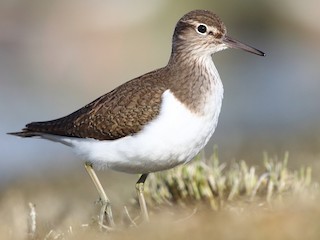
Adults in breeding plumage have olive-brown upperparts with fine dark streaking, especially on the crown and mantle. The underparts are clean white, with a distinctive white wedge extending up onto the shoulder, separating the brown breast from the wing. A faint, dusky breast band may be present. The rump and tail are dark brown with white outer tail feathers, visible in flight. Non-breeding plumage is similar but slightly duller, with less distinct streaking.
- 2
Beak shape
Shape and color of the bill: a key field mark.
Relatively short, slender, and straight bill, dark grey to blackish.
- 3
Eye color
Iris color and any distinctive eye markings.
Dark brown, with a faint white supercilium (eyebrow stripe) above it.
- 4
Leg color
Leg and foot color.
Dull greenish-grey to yellowish-grey.
- 5
Distinguishing features
Standout features that separate this species.
The most distinctive feature is its constant 'teetering' or 'bobbing' motion of the hindquarters when standing or walking. In flight, it shows stiff, shallow wingbeats, often flying low over water, and a prominent white wing-bar (formed by white bases to the primary feathers) and white outer tail feathers.
- 6
Juvenile appearance
How young birds differ from adults.
Juveniles resemble adults but have more prominent buff or pale fringes to the feathers of the upperparts, giving them a slightly scaly appearance. The breast band may be more diffuse.
- 7
Seasonal changes
Plumage variation between breeding and non-breeding seasons.
Plumage changes between breeding and non-breeding are subtle, primarily involving a slight dulling of the upperparts and less distinct streaking in non-breeding birds.
- 8
Sexual dimorphism
How males and females differ.
Males and females are monomorphic in plumage and size, making them indistinguishable in the field.
Key field marks
- Behavior: Teetering. Look for the constant, rhythmic bobbing of the tail and hindquarters when the bird is standing or walking. This is a key diagnostic feature.
- Flight Pattern. Observe its flight: low over water, with stiff, shallow, rapid wingbeats, often interspersed with short glides and banking from side to side. Look for the white wing-bar.
- Plumage: White Shoulder Wedge. Note the distinctive white patch extending up from the white underparts onto the side of the breast, separating the brown upperparts from the wing. This is visible even when the bird is standing.
- Call. Listen for its characteristic high-pitched, piping 'twee-wee-wee' call, especially when flushed or in flight.
- Tail in Flight. In flight, the dark central tail feathers contrast with the white outer tail feathers, which is a good field mark.
Explore the Common Sandpiper
Identify birds anywhere
Free on iOS, Android, and Web. Photo & sound identification, full species database, and your personal life list.