
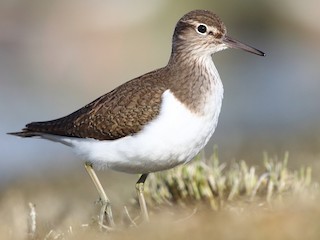
Where does the Common Sandpiper live?
Actitis hypoleucos
Spotted a bird? Identify it instantly with the Birdby app
Open the appThe Common Sandpiper lives in specific habitats and regions. Knowing where, and when, to look improves your chances of a successful sighting.
Biomes
Temperate forests, taiga, grasslands, coastal areas, wetlands.
Geographic range
Breeds across most of Eurasia, from Western Europe to Japan. Winters in Africa, the Middle East, South Asia, and Australasia.
Preferred environments
Prefers freshwater habitats such as rivers, streams, lakes, ponds, and reservoirs, especially those with stony or gravelly banks. Also found on coastal shores, estuaries, and tidal flats during migration and winter.
Elevation range
Typically found from sea level up to 2,000 meters, occasionally higher in mountainous regions with suitable water bodies.
Where to look
Rivers and Streams
Look along the banks of slow-moving to moderately fast-flowing rivers and streams, especially those with gravelly or stony edges.
Lakes and Ponds
Check the shores of freshwater lakes, reservoirs, and larger ponds, particularly where there are exposed mudflats or stony margins.
Coastal Areas
During migration and in winter, they can be found on estuaries, tidal flats, sheltered bays, and rocky shores.
Wetlands
Any wetland habitat with open water and suitable foraging substrate can attract Common Sandpipers.
Field tips
- Look for movement. Their constant 'teetering' motion makes them relatively easy to spot even when camouflaged against the background.
- Listen for calls. Their distinctive 'twee-wee-wee' call is often the first indication of their presence, especially when they are flushed.
- Scan water edges. Focus your binoculars or scope on the water's edge, mudflats, and exposed stones where they typically forage.
- Observe flight. If you see a small wader flying low over water with stiff, shallow wingbeats, it's likely a Common Sandpiper. Look for the white wing-bar.
Migration
A long-distance migratory species. European breeders typically migrate south to Africa, while Asian populations winter in South Asia and Australasia. Migration occurs from July to October (southbound) and March to May (northbound).
Explore the Common Sandpiper
Identify birds anywhere
Free on iOS, Android, and Web. Photo & sound identification, full species database, and your personal life list.