
Spotted a bird? Identify it instantly with the Birdby app
Open the appAbout
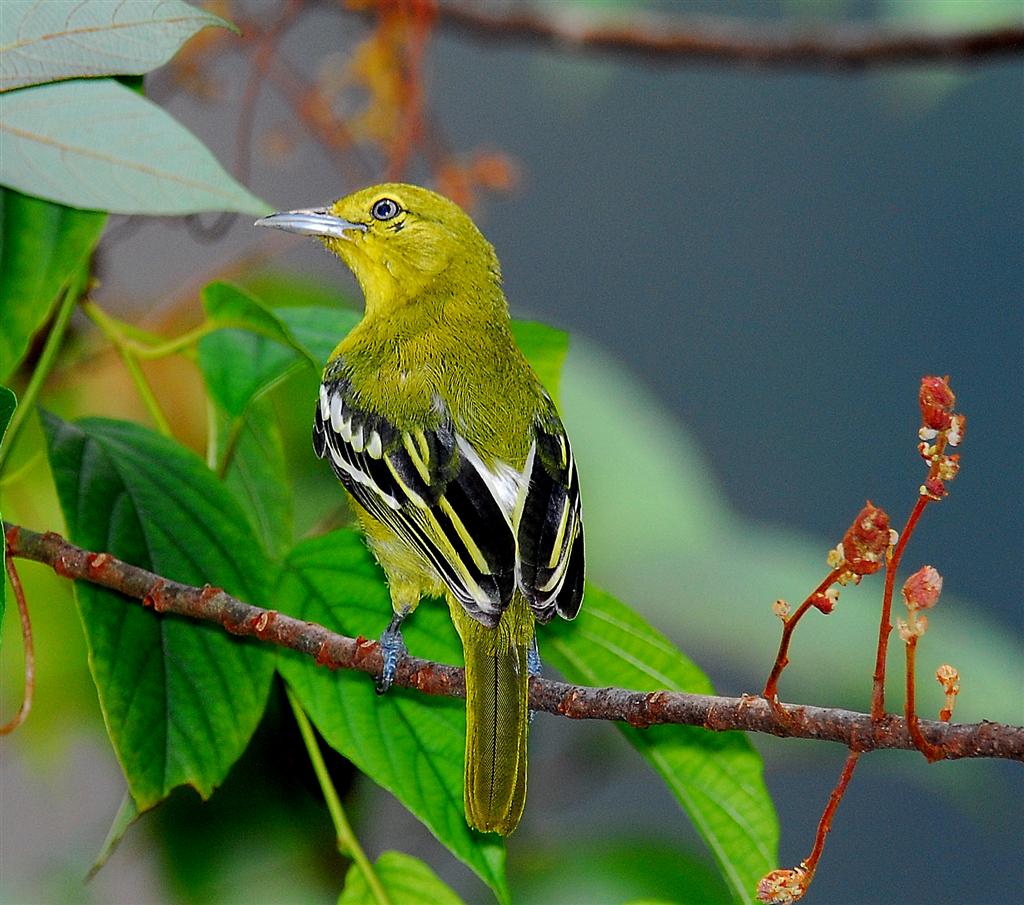
The Common Iora is a small, active passerine bird found across the Indian subcontinent and Southeast Asia. Known for its striking black and yellow plumage (especially in breeding males) and distinctive calls, it is a common sight in gardens, orchards, and open woodlands. It is often observed foraging for insects among foliage.
Size & lifespan
- Length
- 12-16 cm
- Wingspan
- 18-22 cm
- Weight
- 12-17 g
- Lifespan
- 3-5 years in the wild (estimated)
- Diet
- Insectivore
Physical characteristics
- Plumage
- Adult males in breeding plumage are predominantly bright yellow on the underparts, head, and rump, with a black crown, nape, back, and tail. The wings are black with two prominent white wing-bars. Non-breeding males and females are generally duller, with olive-green upperparts, yellow underparts, and blackish wings with white wing-bars. The rump is typically yellowish-green. Juveniles resemble females but are even duller.
- Beak shape
- Slender, pointed, and slightly decurved bill; typically dark grey to black.
- Eye color
- Dark brown with a pale orbital ring.
- Leg color
- Dark grey to blackish.
- Distinguishing features
- Bright yellow and black plumage (breeding male), two prominent white wing-bars, active foraging behavior, and distinctive 'whee-tee' calls.
- Juvenile appearance
- Similar to females but with duller, more greenish-yellow plumage and less distinct wing-bars. The upperparts are often more olive-brown.
- Seasonal changes
- Males undergo a significant plumage change for the breeding season, developing extensive glossy black on the crown, nape, back, and tail. Outside the breeding season, males resemble females, though they may retain some blackish mottling on the crown and back.
- Sexual dimorphism
- Pronounced, especially during the breeding season. Males develop a glossy black cap, back, and tail, contrasting sharply with bright yellow underparts. Females and non-breeding males have olive-green upperparts and yellow underparts, lacking the extensive black.
How to identify
- 1
Plumage (Breeding Male)
Look for the striking combination of glossy black crown, nape, back, and tail contrasting with bright yellow underparts and rump. Two prominent white wing-bars on black wings are key.
- 2
Plumage (Female/Non-breeding Male)
Observe olive-green upperparts, yellowish-green rump, and yellow underparts. Blackish wings with two distinct white wing-bars are still present, though less contrasting than in breeding males.
- 3
Behavior
Watch for its active foraging style, gleaning insects from foliage, often hanging upside down. Its restless movements and frequent vocalizations are characteristic.
- 4
Vocalizations
Listen for the distinctive, clear, and melodious 'whee-tee-too' song and the sharp 'whee-tee' call. The male's 'parachute display' during singing is a strong indicator.
- 5
Size and Shape
It's a small, compact passerine with a relatively short tail and a slender, pointed bill.
Habitat & range
- Biomes
- Tropical and subtropical moist broadleaf forests, dry forests, mangroves, scrublands, plantations, gardens, and urban parks.
- Geographic range
- Indian subcontinent (India, Sri Lanka, Bangladesh, Nepal, Bhutan), Southeast Asia (Myanmar, Thailand, Laos, Cambodia, Vietnam, Malaysia, Singapore, Indonesia, Brunei, Philippines).
- Elevation range
- Sea level up to approximately 1,500 meters (occasionally higher).
- Preferred environments
- Open woodlands, forest edges, secondary growth, scrub, orchards, rubber and coconut plantations, large gardens, and urban green spaces with scattered trees and shrubs.
Behavior
- Activity time
- Diurnal.
- Feeding habits
- Primarily insectivorous, feeding on a variety of insects and their larvae, including caterpillars, beetles, ants, spiders, and grasshoppers. They forage actively among foliage, gleaning insects from leaves and branches, often hanging upside down or performing acrobatic maneuvers. They may also occasionally consume nectar.
- Social behavior
- Typically seen singly or in pairs, especially during the breeding season. Outside of breeding, they may join mixed-species foraging flocks. They are generally quite active and restless.
- Flight pattern
- Undulating flight, often short and direct between trees. They are agile fliers within dense foliage.
- Migration pattern
- Resident throughout its range, with no significant migratory movements. Local movements may occur in response to food availability.
- Territoriality
- Pairs are territorial during the breeding season, defending their nesting area with calls and displays.
Song & calls
- Song
- A distinctive, melodious, and varied song, often described as a series of clear, whistling notes, 'whee-tee-too' or 'sweet-sweet-sweet-ee'. It can be quite elaborate, with rising and falling inflections, and often includes mimicry of other birds. The male performs a characteristic 'parachute display' during singing, fluffing up its rump feathers and slowly descending.
- Call
- Common calls include a sharp, clear 'whee-tee' or 'chew-wit', often repeated. Alarm calls are harsher 'churr' notes.
- When they vocalize
- Most vocal during the breeding season (March to September), but calls can be heard year-round, especially in the mornings and late afternoons.
Breeding & reproduction
- Breeding season
- Primarily March to September, varying geographically with the onset of monsoons.
- Nesting habits
- Nests are small, neat, cup-shaped structures made of fine grass, rootlets, and cobwebs, often decorated with lichen and bark fragments on the exterior for camouflage. They are typically built in the fork of a small tree or shrub, 2-10 meters above the ground. Both parents participate in nest building.
- Clutch size
- 2-4 eggs.
- Egg description
- 2-4 eggs, typically pale greenish-white to pinkish-white, with fine reddish-brown or purplish-brown speckles and blotches, often concentrated at the broader end.
- Incubation period
- Approximately 12-14 days.
- Fledging period
- Chicks fledge around 10-12 days after hatching.
- Parental care
- Both parents share incubation duties and care for the young, feeding them insects.
Where to find
Gardens and Parks
Common in well-vegetated gardens, urban parks, and tree-lined avenues, especially those with flowering shrubs and fruit trees.
Open Woodlands and Forest Edges
Frequently found in deciduous and evergreen open woodlands, secondary forests, and the edges of denser forests.
Plantations and Orchards
Abundant in agricultural areas such as rubber, coconut, and fruit plantations.
Scrublands
Can be found in areas with dense scrub and scattered trees.
Field tips
- Listen for calls. Their distinctive calls and songs are often the first indication of their presence. Learn to recognize the 'whee-tee' call and the melodious song.
- Look in the canopy and mid-story. They forage actively in the foliage of trees and shrubs, often at mid-level or higher. Scan branches and leaves carefully.
- Observe active foraging. Watch for small, active birds gleaning insects, often performing acrobatic moves like hanging upside down.
- Visit during breeding season. Males are most conspicuous during the breeding season due to their brighter plumage and frequent singing, including the 'parachute display'.
Similar species
Marshall's Iora
Aegithina nigrolutea
Marshall's Iora (found in parts of India and Pakistan) is very similar but typically has a more extensive black back in breeding males, extending further down the back, and often a more yellowish rump. The white wing-bars are also often broader and more prominent. Females and non-breeding males are extremely difficult to distinguish in the field without direct comparison or vocalizations.
Green Iora
Aegithina viridissima
The Green Iora (found in Southeast Asia) lacks the prominent black cap and back of the breeding Common Iora male. Both sexes are predominantly green above and yellow below, with less distinct wing-bars. Its calls are also different.
Quick facts
- Family:
- Aegithinidae (Ioras)
- Diet:
- Insects
- Habitat:
- Open woodlands, gardens, scrub
- Conservation Status:
- Least Concern
- Distinguishing Feature:
- Bright yellow and black plumage (breeding male), white wing-bars, distinctive calls
Fun facts
- The Common Iora is known for its elaborate 'parachute display' during courtship, where the male fluffs up its rump feathers and slowly descends while singing.
- Despite their bright colors, their small size and active foraging in dense foliage can make them surprisingly difficult to spot until they call.
- Ioras were once classified with leafbirds and fairy-bluebirds in the family Irenidae, but genetic studies have placed them in their own distinct family, Aegithinidae.
- Their nests are often camouflaged with lichen and bark, making them blend seamlessly with the tree branch.
Scientific classification
- Kingdom
- Animalia
- Phylum
- Chordata
- Class
- Aves
- Order
- Passeriformes
- Family
- Aegithinidae
- Genus
- Aegithina
- Species
- Aegithina tiphia
Explore the Common Iora
Identify birds anywhere
Free on iOS, Android, and Web. Photo & sound identification, full species database, and your personal life list.