
Spotted a bird? Identify it instantly with the Birdby app
Open the appAbout
The Eurasian Skylark is a small passerine bird renowned for its prolonged and complex song, often delivered during an elaborate display flight high above open fields. It is a widespread species across much of Eurasia and parts of North Africa, typically found in open grassland and agricultural areas.
Size & lifespan
- Length
- 16-19 cm
- Wingspan
- 30-38 cm
- Weight
- 25-45 g
- Lifespan
- 2-5 years (up to 10 years recorded)
- Diet
- Omnivore (primarily insects and seeds)
Physical characteristics
- Plumage
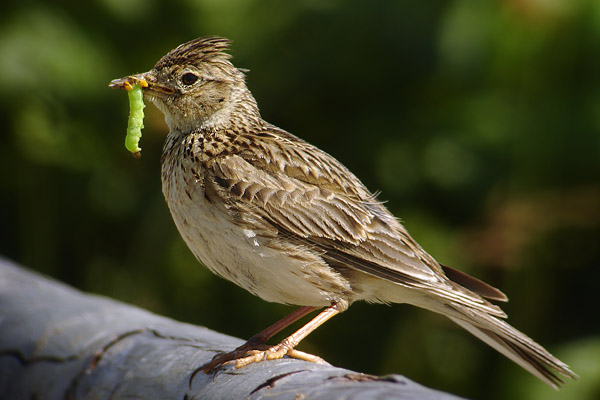
- Upperparts are streaky brown, with darker streaks on a paler brown or buff background. Underparts are whitish, with a streaky breast. The outer tail feathers are white, visible in flight. It possesses a small, erectile crest, which is often raised when alert or singing.
- Beak shape
- Relatively short, conical, and stout, adapted for both insect and seed consumption. Color is typically dark horn on the upper mandible and paler on the lower mandible.
- Eye color
- Dark brown.
- Leg color
- Pale pinkish-brown to yellowish-brown.
- Distinguishing features
- Small erectile crest, white outer tail feathers (especially noticeable in flight), and a long hind claw (hallux claw) which is characteristic of larks and helps them walk on soft ground.
- Juvenile appearance
- Juveniles are similar to adults but have a more spotted or scaly appearance on the upperparts due to pale feather tips, and their crest is less developed.
- Seasonal changes
- No significant seasonal plumage changes. Plumage may appear slightly fresher after the autumn moult and more worn by late spring.
- Sexual dimorphism
- Males and females are largely similar in plumage, though males tend to be slightly larger and have a more prominent crest. Differences are subtle and not reliable for field identification.
How to identify
- 1
Song Flight
The most distinctive identification feature. Listen for the continuous, complex, high-pitched song delivered from high in the sky, often when the bird is barely visible. The bird ascends almost vertically, hovers, and then descends.
- 2
Plumage and Crest
Look for the streaky brown upperparts and pale underparts with a streaky breast. The small, often raised crest is a key feature, though not always visible. White outer tail feathers are diagnostic in flight.
- 3
Habitat
Always found in open, treeless habitats like grasslands, meadows, and agricultural fields. If you see a streaky brown bird singing high above such an area, it's almost certainly a Skylark.
- 4
Behavior on Ground
When on the ground, they walk or run rather than hop. They are often inconspicuous, blending well with their surroundings.
Habitat & range
- Biomes
- Temperate grasslands, agricultural fields, heathlands, coastal dunes, and open moorlands.
- Geographic range
- Widespread across Europe and Asia, from the Atlantic coast to the Pacific, and extending into North Africa. Introduced to Hawaii, Australia, and New Zealand.
- Elevation range
- Sea level up to 2,000 meters, occasionally higher in mountainous regions.
- Preferred environments
- Open, treeless areas with short to medium-height vegetation, often associated with arable land, pastures, and meadows. Avoids dense forests and urban areas.
Behavior
- Activity time
- Diurnal, most active during daylight hours, particularly vocal in the mornings and evenings during the breeding season.
- Feeding habits
- Forages on the ground, walking or running to pick up insects, spiders, and other invertebrates, especially during the breeding season. In winter, its diet shifts more towards seeds, grains, and young plant shoots.
- Social behavior
- During the breeding season, they are territorial and typically solitary or in pairs. Outside the breeding season, they can form large flocks, sometimes numbering hundreds or thousands, especially during migration or in winter feeding grounds.
- Flight pattern
- Characterized by its iconic 'song flight,' where it ascends almost vertically, hovers at a great height (often out of sight), and then descends in a series of glides and tumbles. In general flight, it has a strong, undulating pattern.
- Migration pattern
- Northern and eastern populations are migratory, moving south and west for the winter. Southern and western populations are largely resident or undertake short-distance movements. Migratory flights often occur in large flocks.
- Territoriality
- Males establish and defend breeding territories through their elaborate song flights and occasional ground pursuits of rivals.
Song & calls
- Song
- A continuous, high-pitched, rapid, and complex outpouring of musical trills, whistles, and mimicry, lasting for several minutes (often 2-10 minutes, but can be much longer). Delivered almost exclusively during its characteristic song flight, often at great heights.
- Call
- Common calls include a short, liquid 'prrrit' or 'chirrup' when flushed or in flight, and a softer 'twee-twee' contact call.
- When they vocalize
- Most vocal from early spring through late summer (February to August), primarily during daylight hours, with peak activity in the morning and late afternoon. Can sing on sunny winter days too.
Breeding & reproduction
- Breeding season
- Typically April to August, with two or three broods per season.
- Nesting habits
- Nests are built on the ground, usually in a shallow scrape, well-hidden among dense vegetation (e.g., tall grass, crops). The nest is a cup-shaped structure made of grass, leaves, and roots, often lined with finer materials like hair.
- Clutch size
- 3-5 eggs (occasionally 2-6)
- Egg description
- 3-5 eggs, typically pale greyish-white or greenish-white, heavily speckled and blotched with dark brown, olive, or grey, often concentrated at the broader end. Eggs measure approximately 23 x 17 mm.
- Incubation period
- 11-12 days, primarily by the female.
- Fledging period
- 9-11 days. Young leave the nest before they can fly properly, hiding in vegetation, and are then fed by both parents for another week or two.
- Parental care
- Both parents feed the young, though the female does most of the incubation. Males continue to sing and defend the territory while assisting with feeding.
Where to find
Agricultural Fields
Look in arable fields, especially those with cereal crops or fallow land. They prefer fields with some cover but not too dense.
Grasslands and Meadows
Extensive natural grasslands, hay meadows, and pastures are prime habitats.
Coastal Dunes and Heathlands
Can be found in open, sandy, or heathland environments, particularly near the coast.
Moorlands
Open moorland areas, especially those with shorter vegetation, can host Skylarks.
Field tips
- Listen for the Song. The song is the easiest way to locate a Skylark. Once you hear it, scan the sky directly above the source of the sound. The bird can be very high up.
- Look for Movement. On the ground, they are well camouflaged. Look for subtle movements in the grass or a bird running quickly between cover.
- Early Morning/Late Afternoon. These are often the best times to hear their song, especially during the breeding season.
- Use Binoculars. Essential for spotting the bird high in its song flight and for observing details on the ground.
Similar species
Woodlark
Lullula arborea
The Woodlark is smaller, has a shorter tail, a more prominent supercilium (eyebrow stripe) that meets at the nape, and lacks white outer tail feathers. Its song is also distinct, a fluty, melancholic 'lu-lu-lu' delivered in circles, not high vertical flights.
Corn Bunting
Emberiza calandra
Larger and stockier than the Skylark, with a much thicker bill and no crest. Its song is a monotonous, jangling 'chip-chip-chip-sizzle' often delivered from a prominent perch, not in flight.
Meadow Pipit
Anthus pratensis
Smaller and more slender, with a finer bill and no crest. It has a more upright posture and a distinctive 'pipit' call. Its song flight is less sustained and lower than the Skylark's.
Quick facts
- Iconic Songster:
- Famous for its sustained, complex song delivered high in the sky.
- Ground Nesters:
- Builds well-camouflaged nests directly on the ground.
- Diet Shift:
- Eats insects in summer, seeds and grains in winter.
- Long Hind Claw:
- Possesses a distinctive long hind claw, typical of larks.
- Widespread Distribution:
- Found across vast areas of Europe, Asia, and North Africa.
Fun facts
- The Eurasian Skylark's song can last for over an hour, though typically it's 2-10 minutes. It's one of the longest and most complex bird songs in the world.
- Despite its widespread distribution, Skylark populations have declined in many parts of Europe due to changes in agricultural practices, leading to conservation concerns in some regions.
- The Skylark has inspired numerous poets, writers, and composers, including Percy Bysshe Shelley's 'To a Skylark' and Ralph Vaughan Williams' 'The Lark Ascending'.
- Skylarks can mimic the calls of other birds within their song, adding to its complexity and variety.
- The long hind claw of the Skylark is thought to help it grip the ground and distribute its weight, preventing it from sinking into soft soil.
Scientific classification
- Kingdom
- Animalia
- Phylum
- Chordata
- Class
- Aves
- Order
- Passeriformes
- Family
- Alaudidae
- Genus
- Alauda
- Species
- Alauda arvensis
Explore the Eurasian Skylark
Identify birds anywhere
Free on iOS, Android, and Web. Photo & sound identification, full species database, and your personal life list.