
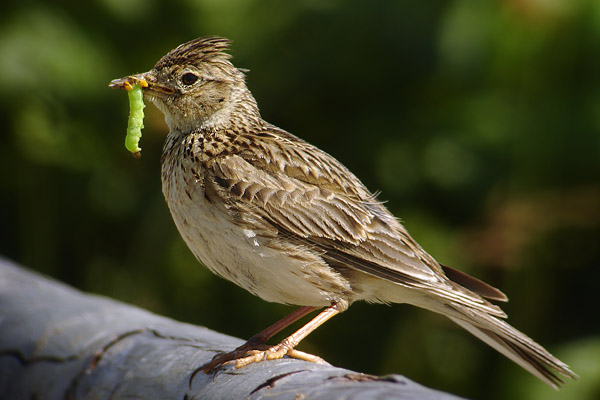
How to identify the Eurasian Skylark
Alauda arvensis
Spotted a bird? Identify it instantly with the Birdby app
Open the appTo correctly identify the Eurasian Skylark (Alauda arvensis), check each of these features. Birds can be tricky: habit, habitat, and call often confirm a sighting that a single photo cannot.
Size at a glance
- Length
- 16-19 cm
- Wingspan
- 30-38 cm
- Weight
- 25-45 g
Physical features to check
- 1
Plumage
Overall feather coloration and pattern.
Upperparts are streaky brown, with darker streaks on a paler brown or buff background. Underparts are whitish, with a streaky breast. The outer tail feathers are white, visible in flight. It possesses a small, erectile crest, which is often raised when alert or singing.
- 2
Beak shape
Shape and color of the bill: a key field mark.
Relatively short, conical, and stout, adapted for both insect and seed consumption. Color is typically dark horn on the upper mandible and paler on the lower mandible.
- 3
Eye color
Iris color and any distinctive eye markings.
Dark brown.
- 4
Leg color
Leg and foot color.
Pale pinkish-brown to yellowish-brown.
- 5
Distinguishing features
Standout features that separate this species.
Small erectile crest, white outer tail feathers (especially noticeable in flight), and a long hind claw (hallux claw) which is characteristic of larks and helps them walk on soft ground.
- 6
Juvenile appearance
How young birds differ from adults.
Juveniles are similar to adults but have a more spotted or scaly appearance on the upperparts due to pale feather tips, and their crest is less developed.
- 7
Seasonal changes
Plumage variation between breeding and non-breeding seasons.
No significant seasonal plumage changes. Plumage may appear slightly fresher after the autumn moult and more worn by late spring.
- 8
Sexual dimorphism
How males and females differ.
Males and females are largely similar in plumage, though males tend to be slightly larger and have a more prominent crest. Differences are subtle and not reliable for field identification.
Key field marks
- Song Flight. The most distinctive identification feature. Listen for the continuous, complex, high-pitched song delivered from high in the sky, often when the bird is barely visible. The bird ascends almost vertically, hovers, and then descends.
- Plumage and Crest. Look for the streaky brown upperparts and pale underparts with a streaky breast. The small, often raised crest is a key feature, though not always visible. White outer tail feathers are diagnostic in flight.
- Habitat. Always found in open, treeless habitats like grasslands, meadows, and agricultural fields. If you see a streaky brown bird singing high above such an area, it's almost certainly a Skylark.
- Behavior on Ground. When on the ground, they walk or run rather than hop. They are often inconspicuous, blending well with their surroundings.
Explore the Eurasian Skylark
Identify birds anywhere
Free on iOS, Android, and Web. Photo & sound identification, full species database, and your personal life list.