
Spotted a bird? Identify it instantly with the Birdby app
Open the appAbout
The Chukar Partridge is a medium-sized game bird renowned for its striking plumage and distinctive calls. It is well-adapted to arid and rocky environments, making it a common resident in mountainous regions across its native range. Known for its strong legs and ability to run swiftly up steep slopes, it is often seen in coveys, particularly outside the breeding season.
Size & lifespan
- Length
- 32-39 cm (12.5-15.5 in)
- Wingspan
- 47-53 cm (18.5-21 in)
- Weight
- 450-800 g (16-28 oz)
- Lifespan
- 3-5 years in the wild, up to 10 years in captivity
- Diet
- Primarily vegetarian, consisting of seeds, grasses, leaves, and berries. Also consumes insects, especially during the breeding season.
Physical characteristics
- Plumage
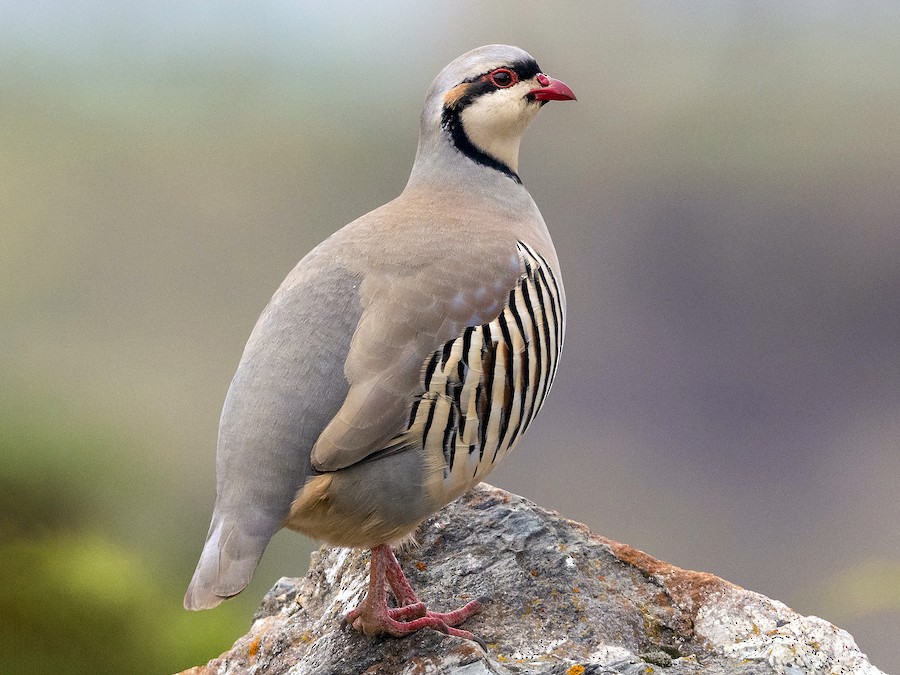
- Adults have a light brown back, a grey breast, and a buff belly. A prominent black band runs from the forehead, through the eye, down the side of the neck, and forms a distinctive necklace bordering the white throat. The flanks are boldly barred with black and chestnut. The outer tail feathers are chestnut. Plumage is generally uniform between breeding and non-breeding seasons.
- Beak shape
- Short, conical, and robust, adapted for pecking and foraging.
- Eye color
- Brown with a red orbital ring.
- Leg color
- Bright coral-red to reddish-orange.
- Distinguishing features
- The most distinctive features are the bold black gorget (necklace) on a white throat and the vertically striped black and chestnut flank barring. The red bill and legs are also very characteristic.
- Juvenile appearance
- Juveniles are duller and lack the distinct black gorget and flank barring of adults. Their plumage is mostly mottled brown and grey, and their bill and legs are duller. They gradually acquire adult plumage over their first year.
- Seasonal changes
- Little to no seasonal change in adult plumage, remaining consistent year-round.
- Sexual dimorphism
- Males and females are very similar in plumage. Males are typically slightly larger and heavier than females and may have a small, blunt spur on the tarsus, which is usually absent or rudimentary in females. This difference is often difficult to discern in the field.
How to identify
- 1
Plumage Pattern
Look for the distinctive black band forming a 'necklace' around a white throat, and the bold black and chestnut barring on the flanks. The back is sandy brown and the breast is grey.
- 2
Legs and Beak
Bright coral-red legs and a red bill are characteristic and stand out against the plumage.
- 3
Vocalization
Listen for its characteristic 'chuck-chuck-chuck-CHUKAR-CHUKAR' call, which is often given from prominent perches and is very distinctive.
- 4
Habitat and Behavior
Chukars prefer steep, rocky, and open terrain. They are often seen running uphill when disturbed and flying downhill in a fast glide. They typically occur in coveys outside the breeding season.
Habitat & range
- Biomes
- Arid to semi-arid mountainous regions, rocky slopes, grasslands, and scrublands.
- Geographic range
- Native to Asia, from Turkey eastward through the Himalayas to Nepal and China. Introduced widely in North America (especially the western United States), New Zealand, and Hawaii, where it has established self-sustaining populations.
- Elevation range
- Typically found at elevations between 200 to 4,000 meters (650 to 13,000 feet), preferring higher altitudes in hotter climates.
- Preferred environments
- Steep, rocky hillsides with sparse vegetation, brushy canyons, and open rangelands. Requires access to water sources.
Behavior
- Activity time
- Diurnal. Most active during early morning and late afternoon, spending midday resting in shade or cover.
- Feeding habits
- Forages on the ground, pecking at seeds, grass shoots, leaves, and berries. Will also consume insects, especially during chick-rearing. Often scratches the ground to uncover food.
- Social behavior
- Highly social outside the breeding season, forming coveys of varying sizes, sometimes up to 50 birds or more. During the breeding season, pairs are monogamous and become territorial.
- Flight pattern
- Flight is strong and rapid, usually in short bursts, often downhill. Takes off with a burst of wingbeats, followed by a long glide. When flushed, they typically fly downhill, gaining speed, and then land on a lower slope to run for cover.
- Migration pattern
- Generally non-migratory. Some populations may undertake short altitudinal movements to lower elevations during harsh winter weather to find food and shelter.
- Territoriality
- Pairs defend a breeding territory during the nesting season. Coveys are not territorial outside of this period.
Song & calls
- Song
- The primary call is a distinctive, rapid, and repetitive 'chuck-chuck-chuck-CHUKAR-CHUKAR' often described as a 'chuckle'. This call is given by both sexes and can be heard over long distances, especially at dawn and dusk.
- Call
- In addition to the 'chukar' call, they emit alarm calls which are sharp 'wik-wik-wik' notes when disturbed. Contact calls within a covey are softer clucks and chirps.
- When they vocalize
- Most vocal during the breeding season and at dawn and dusk throughout the year. Alarm calls are given whenever a predator is spotted.
Breeding & reproduction
- Breeding season
- Typically late March to June, depending on latitude and climate. In some areas, may have two clutches.
- Nesting habits
- Nests are shallow scrapes on the ground, often concealed under a rock, bush, or tussock of grass. Lined with grass, leaves, and a few feathers.
- Clutch size
- Usually 8-15 eggs, but can range from 5 to 20.
- Egg description
- Eggs are cream to buff-colored, sparsely spotted with reddish-brown or purple. Oval to pear-shaped.
- Incubation period
- 22-24 days, primarily by the female.
- Fledging period
- Chicks are precocial and can run and follow their parents shortly after hatching. They develop flight feathers and can make short flights at around 10-12 days old. Independent at about 6-8 weeks.
- Parental care
- Both parents care for the young, though the female does most of the incubation. The male often guards the nest and participates in leading the chicks to food and water. Families remain together as a covey until the following breeding season.
Where to find
Rocky Slopes
Search steep, rocky hillsides and canyon walls, particularly those with sparse vegetation and scrub. They blend in well with the rocks.
Water Sources
Chukars need regular access to water, especially in arid environments. Look near springs, seeps, and waterholes, particularly during dry seasons.
Agricultural Edges
In some introduced ranges, they may be found at the edges of agricultural fields adjacent to suitable rocky habitat, where they can forage for grains.
Field tips
- Listen for Calls. Their loud, repetitive 'chukar' call is often the first indication of their presence. Listen at dawn and dusk, or when hiking in suitable habitat.
- Scan Steep Terrain. Use binoculars to scan rocky slopes, especially near the base of cliffs or along scree fields. They are experts at camouflage.
- Look for Movement. Chukars often run uphill when disturbed. Look for quick movements among rocks or vegetation. If flushed, watch their distinctive downhill flight.
- Visit Water Sources. During hot, dry periods, stake out known water sources in Chukar habitat. They will often come down to drink in the early morning or late afternoon.
Similar species
Rock Partridge
Alectoris graeca
The Rock Partridge (A. graeca) is native to parts of Europe and closely resembles the Chukar. The most reliable distinction in the field is often subtle: Rock Partridges generally have a less extensive black gorget that does not typically extend as far forward on the forehead, and the rufous color on the outer tail feathers is usually less intense. Their calls can also differ slightly. Hybridization can occur where ranges overlap.
Red-legged Partridge
Alectoris rufa
The Red-legged Partridge (A. rufa) is found in southwestern Europe. It has a bolder and more complex black gorget with fine black streaking on the throat. It also has a white supercilium (eyebrow stripe) and a black band running behind the eye, which the Chukar lacks. The flank barring is also typically more intricate and multi-colored than the Chukar's.
Barbary Partridge
Alectoris barbara
The Barbary Partridge (A. barbara) from North Africa and Sardinia has a chestnut crown, a greyish throat with a broad chestnut band below it, and bold chestnut and white spotting on the neck and chest. Its flank barring is also distinct from the Chukar's simpler pattern.
Quick facts
- Distinctive Call:
- Their namesake 'chuck-chuck-chuck-CHUKAR-CHUKAR' call is highly recognizable.
- Adaptable:
- Thrives in harsh, arid, mountainous environments.
- Social Bird:
- Forms coveys outside the breeding season, providing safety in numbers.
- Ground Dweller:
- Primarily terrestrial, preferring to run rather than fly when escaping danger.
- Introduced Species:
- Widely introduced for hunting and has established populations in many non-native areas.
Fun facts
- The name 'Chukar' is onomatopoeic, derived directly from its distinctive call.
- Chukars are incredibly tough birds, able to survive in extreme temperatures and with minimal water for short periods, often relying on dew or succulent plants for moisture.
- In some cultures, Chukars are considered a symbol of love and fidelity due to their strong pair bonds during the breeding season.
- They are well-known among hunters for their challenging nature, as they often flush downhill at high speeds, making for difficult shots.
Scientific classification
- Kingdom
- Animalia
- Phylum
- Chordata
- Class
- Aves
- Order
- Galliformes
- Family
- Phasianidae
- Genus
- Alectoris
- Species
- A. chukar
Explore the Chukar Partridge
Identify birds anywhere
Free on iOS, Android, and Web. Photo & sound identification, full species database, and your personal life list.