
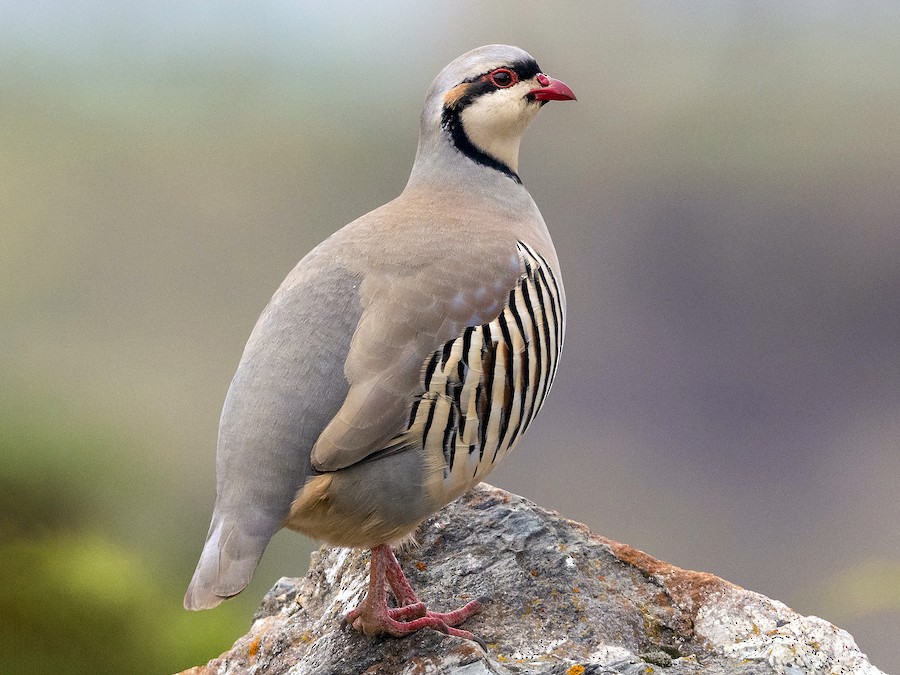
How to identify the Chukar Partridge
Alectoris chukar
Spotted a bird? Identify it instantly with the Birdby app
Open the appTo correctly identify the Chukar Partridge (Alectoris chukar), check each of these features. Birds can be tricky: habit, habitat, and call often confirm a sighting that a single photo cannot.
Size at a glance
- Length
- 32-39 cm (12.5-15.5 in)
- Wingspan
- 47-53 cm (18.5-21 in)
- Weight
- 450-800 g (16-28 oz)
Physical features to check
- 1
Plumage
Overall feather coloration and pattern.
Adults have a light brown back, a grey breast, and a buff belly. A prominent black band runs from the forehead, through the eye, down the side of the neck, and forms a distinctive necklace bordering the white throat. The flanks are boldly barred with black and chestnut. The outer tail feathers are chestnut. Plumage is generally uniform between breeding and non-breeding seasons.
- 2
Beak shape
Shape and color of the bill: a key field mark.
Short, conical, and robust, adapted for pecking and foraging.
- 3
Eye color
Iris color and any distinctive eye markings.
Brown with a red orbital ring.
- 4
Leg color
Leg and foot color.
Bright coral-red to reddish-orange.
- 5
Distinguishing features
Standout features that separate this species.
The most distinctive features are the bold black gorget (necklace) on a white throat and the vertically striped black and chestnut flank barring. The red bill and legs are also very characteristic.
- 6
Juvenile appearance
How young birds differ from adults.
Juveniles are duller and lack the distinct black gorget and flank barring of adults. Their plumage is mostly mottled brown and grey, and their bill and legs are duller. They gradually acquire adult plumage over their first year.
- 7
Seasonal changes
Plumage variation between breeding and non-breeding seasons.
Little to no seasonal change in adult plumage, remaining consistent year-round.
- 8
Sexual dimorphism
How males and females differ.
Males and females are very similar in plumage. Males are typically slightly larger and heavier than females and may have a small, blunt spur on the tarsus, which is usually absent or rudimentary in females. This difference is often difficult to discern in the field.
Key field marks
- Plumage Pattern. Look for the distinctive black band forming a 'necklace' around a white throat, and the bold black and chestnut barring on the flanks. The back is sandy brown and the breast is grey.
- Legs and Beak. Bright coral-red legs and a red bill are characteristic and stand out against the plumage.
- Vocalization. Listen for its characteristic 'chuck-chuck-chuck-CHUKAR-CHUKAR' call, which is often given from prominent perches and is very distinctive.
- Habitat and Behavior. Chukars prefer steep, rocky, and open terrain. They are often seen running uphill when disturbed and flying downhill in a fast glide. They typically occur in coveys outside the breeding season.
Explore the Chukar Partridge
Identify birds anywhere
Free on iOS, Android, and Web. Photo & sound identification, full species database, and your personal life list.