
Spotted a bird? Identify it instantly with the Birdby app
Open the appAbout
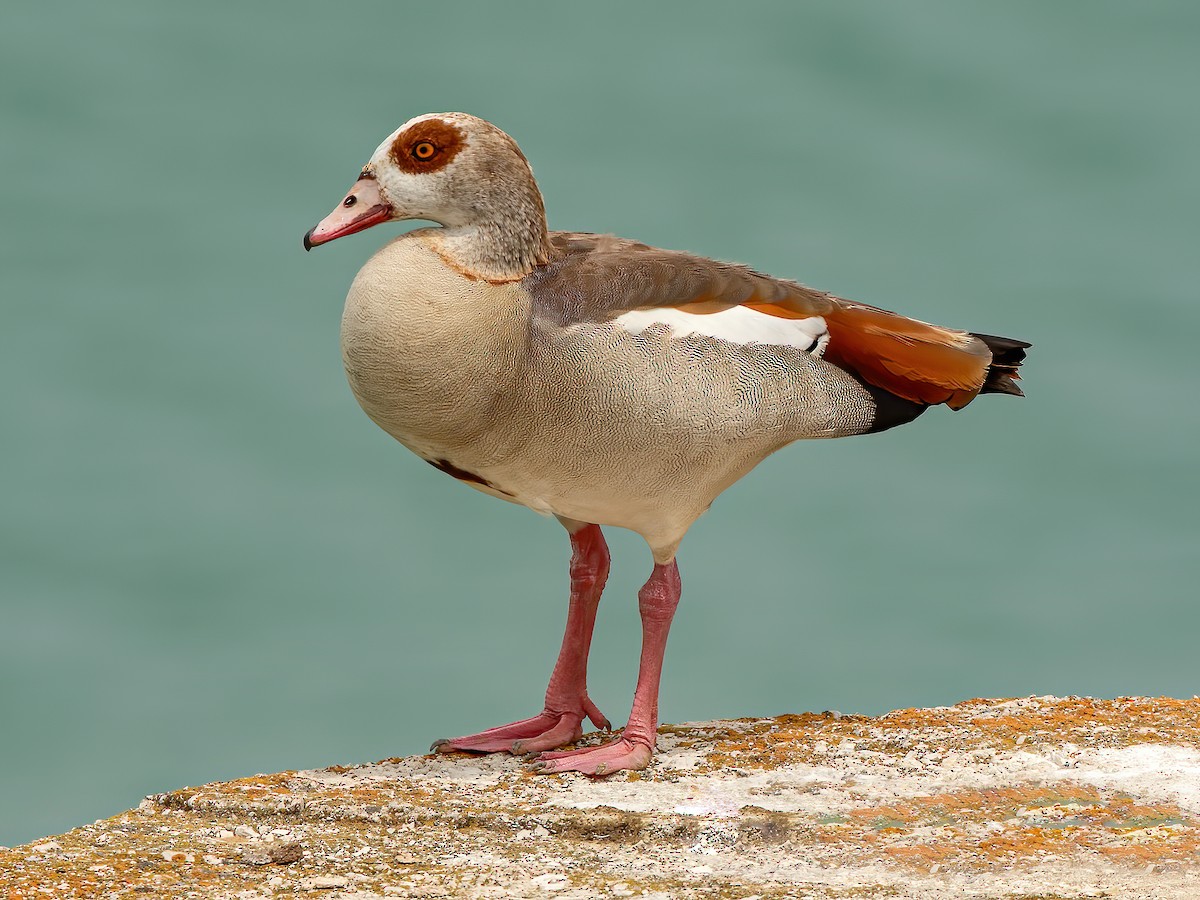
The Egyptian Goose is a distinctive waterfowl species, native to Africa, but widely introduced and established in parts of Europe and elsewhere. It is characterized by its goose-like appearance, striking plumage, and often aggressive territorial behavior. Despite its common name, it is more closely related to shelducks than true geese.
Size & lifespan
- Length
- 63-73 cm (25-29 in)
- Wingspan
- 134-157 cm (53-62 in)
- Weight
- 1.5-2.3 kg (3.3-5.1 lbs)
- Lifespan
- Up to 15 years in the wild, longer in captivity.
- Diet
- Herbivore, primarily grazing on grasses, leaves, seeds, and agricultural crops. Occasionally consumes insects and small aquatic invertebrates.
Physical characteristics
- Plumage
- Overall sandy-brown to grey-brown plumage. Distinctive dark brown patch around the eye, often referred to as a 'chocolate eye-patch'. The breast is paler, often with a chestnut-brown patch in the center. The wings show a prominent white patch (speculum) bordered by black, and iridescent green secondaries, particularly visible in flight. The underwing coverts are white.
- Beak shape
- Pinkish-red bill with a black tip and a black band near the base. Relatively short and stout.
- Eye color
- Yellowish-orange iris, surrounded by the dark brown eye-patch.
- Leg color
- Pinkish-red to orange-red.
- Distinguishing features
- The combination of the dark eye-patch, central breast patch, pinkish legs and bill, and the striking white and green wing patches in flight are highly distinctive. Its upright, goose-like posture is also characteristic.
- Juvenile appearance
- Juveniles are duller overall, lacking the distinct eye-patch and central breast patch. Their plumage is more uniformly grey-brown, and their legs and bill are duller, often greyish-pink, gradually acquiring adult coloration.
- Seasonal changes
- No significant seasonal plumage changes. Plumage remains consistent year-round, though it may appear slightly worn before molting.
- Sexual dimorphism
- Males and females are largely similar in plumage. Males tend to be slightly larger and have a more prominent, harsher call. Females often have a slightly darker eye-patch and a more guttural, honking call.
How to identify
- 1
Eye-patch
Look for the distinctive dark brown, almost chocolate-colored patch around the eye. This is a key field mark.
- 2
Breast Patch
Observe the often prominent, darker chestnut-brown patch in the center of the breast. This can vary in intensity but is usually present in adults.
- 3
Leg and Bill Color
Note the bright pinkish-red legs and the pinkish-red bill with a black tip and base band. This coloration is unique among similar species.
- 4
Wing Pattern in Flight
In flight, the large white wing patches (speculum) bordered by black, and the iridescent green secondaries, are highly visible and diagnostic.
- 5
Overall Plumage
The general sandy-brown to grey-brown body plumage, contrasting with the darker head markings and wing patterns, is characteristic.
- 6
Posture and Gait
They often stand upright with a goose-like posture and walk with a confident, somewhat waddling gait.
- 7
Vocalizations
Listen for the male's wheezy 'honk' or 'hiss' and the female's louder, guttural 'gagg-gagg-gagg' or 'honk-honk-honk'. Their calls are quite distinctive.
Habitat & range
- Biomes
- Wetlands, grasslands, agricultural areas, urban parks, rivers, lakes, reservoirs, and coastal lagoons.
- Geographic range
- Native to sub-Saharan Africa and the Nile Valley. Introduced and established populations exist in Western Europe (especially the UK, Netherlands, Belgium, France, Germany), Florida (USA), and parts of the Middle East.
- Elevation range
- Typically found from sea level up to moderate elevations, generally below 2,000 meters (6,500 feet).
- Preferred environments
- Prefers open water bodies with grassy banks for grazing, often near trees for nesting. Adaptable to human-modified landscapes, including urban and suburban parks with ponds.
Behavior
- Activity time
- Diurnal, active during daylight hours for feeding and other activities.
- Feeding habits
- Primarily a grazer, feeding on short grasses, clover, and other herbaceous vegetation. Also consumes seeds, grains (especially in agricultural areas), and aquatic plants. Occasionally supplements its diet with insects, worms, and small aquatic invertebrates. Feeds by grazing on land or dabbling in shallow water.
- Social behavior
- Highly territorial, especially during the breeding season, often aggressively defending nesting sites and young. Outside the breeding season, they can form small to large flocks, sometimes mixing with other waterfowl species. Pairs typically remain together year-round.
- Flight pattern
- Strong, direct flight with powerful, relatively slow wingbeats. Often flies in V-formations or lines, similar to true geese. The white and green wing patches are very conspicuous in flight.
- Migration pattern
- Generally resident throughout its native African range, though some local movements occur in response to water availability. Introduced populations are largely sedentary, but some dispersal of young birds can occur.
- Territoriality
- Extremely territorial, particularly during nesting. Pairs will aggressively chase away other waterfowl, including much larger species, from their chosen nesting and foraging areas. This can lead to conflicts with native waterfowl in introduced ranges.
Song & calls
- Song
- Not a true songbird. Vocalizations are primarily calls.
- Call
- Males produce a harsh, raspy 'hiss' or a repeated, wheezy 'honk-honk-honk'. Females have a louder, more guttural, and often rapid 'gagg-gagg-gagg' or 'honk-honk-honk' call, particularly when alarmed or in flight. They can be quite noisy, especially when disturbed or during territorial disputes.
- When they vocalize
- Vocalizes year-round, but calls are more frequent and intense during the breeding season and when defending territory or young.
Breeding & reproduction
- Breeding season
- Highly variable depending on geographic location and rainfall. In Africa, often coincides with the end of the rainy season or dry season. In Europe, typically from March to June, but can breed almost year-round in favorable conditions.
- Nesting habits
- Nests are typically placed in elevated, sheltered locations, often in tree hollows, abandoned raptor nests, on cliffs, in dense vegetation, or even on buildings. The nest itself is a shallow scrape lined with down and vegetation. They do not build elaborate nests.
- Clutch size
- 5-12 eggs, typically 6-10.
- Egg description
- Creamy white to pale buff, smooth, and oval-shaped. Average size is about 6.5 x 4.7 cm (2.6 x 1.9 in).
- Incubation period
- 28-30 days, primarily by the female.
- Fledging period
- Young are precocial and leave the nest shortly after hatching. They are able to fly at approximately 70-75 days old, but remain with parents for several weeks after fledging.
- Parental care
- Both parents care for the young, aggressively defending them from predators and other birds. The male guards the territory while the female incubates and broods. Both lead the goslings to feeding areas.
Where to find
Urban and Suburban Parks
Common in parks with ponds, lakes, or slow-moving rivers, especially in areas where they have been introduced and established.
Agricultural Lands
Often found grazing in fields adjacent to water bodies, particularly those growing grains or short grasses.
Wetlands and Reservoirs
Native and introduced populations thrive in various wetland habitats, including large lakes, reservoirs, and slow-moving rivers with vegetated banks.
Coastal Lagoons and Estuaries
Can be found in brackish water environments, especially in their native range.
Field tips
- Look for pairs or small family groups. During the breeding season, they are often seen in pairs with goslings. Outside of breeding, they may form larger flocks.
- Scan grassy banks near water. They are primarily grazers, so look for them feeding on short grass near the water's edge.
- Listen for their calls. Their distinctive calls, especially the female's loud honking, can often alert you to their presence before you see them.
- Observe flight patterns. If you see a goose-like bird flying, look for the striking white and green wing patches, which are unmistakable.
- Check elevated nesting sites. In urban areas, they may nest in unusual places like tree cavities or even on buildings, so keep an eye out for these elevated nests.
Similar species
Ruddy Shelduck
Tadorna ferruginea
The Ruddy Shelduck is a more uniform rusty-orange color, lacking the distinct eye-patch and central breast patch of the Egyptian Goose. Males have a narrow black neck ring during breeding season. Its bill and legs are darker, more greyish-black, compared to the pinkish-red of the Egyptian Goose.
South African Shelduck
Tadorna cana
Found only in southern Africa. Males have a grey head and neck, while females have a white face with a black crown and nape. Both sexes lack the prominent eye-patch and central breast patch of the Egyptian Goose. Their body plumage is a richer chestnut.
Quick facts
- Native Range:
- Sub-Saharan Africa and Nile Valley
- Introduced Range:
- Western Europe, Florida (USA)
- Diet:
- Primarily herbivorous (grasses, seeds)
- Social Structure:
- Monogamous pairs, territorial during breeding
- Distinguishing Mark:
- Dark eye-patch, central breast patch, pinkish legs/bill
- Flight:
- Strong, direct, with prominent white/green wing patches
Fun facts
- Despite its name, the Egyptian Goose is not a true goose but belongs to the shelduck subfamily (Tadorninae), which are intermediate between geese and ducks.
- They were considered sacred in ancient Egypt and were often depicted in hieroglyphs and tomb paintings.
- Their aggressive territorial behavior, especially during breeding, can lead to them dominating water bodies and displacing native waterfowl species in areas where they have been introduced.
- Egyptian Geese are highly adaptable and have successfully colonized a wide range of habitats, including highly urbanized environments.
- They are known for their unusual nesting sites, often choosing elevated locations like tree hollows or even old raptor nests, rather than ground nests typical of many waterfowl.
Scientific classification
- Kingdom
- Animalia
- Phylum
- Chordata
- Class
- Aves
- Order
- Anseriformes
- Family
- Anatidae
- Genus
- Alopochen
- Species
- Alopochen aegyptiaca
Explore the Egyptian Goose
Identify birds anywhere
Free on iOS, Android, and Web. Photo & sound identification, full species database, and your personal life list.