
How to identify the Egyptian Goose
Alopochen aegyptiaca
Spotted a bird? Identify it instantly with the Birdby app
Open the appTo correctly identify the Egyptian Goose (Alopochen aegyptiaca), check each of these features. Birds can be tricky: habit, habitat, and call often confirm a sighting that a single photo cannot.
Size at a glance
- Length
- 63-73 cm (25-29 in)
- Wingspan
- 134-157 cm (53-62 in)
- Weight
- 1.5-2.3 kg (3.3-5.1 lbs)
Physical features to check
- 1
Plumage
Overall feather coloration and pattern.
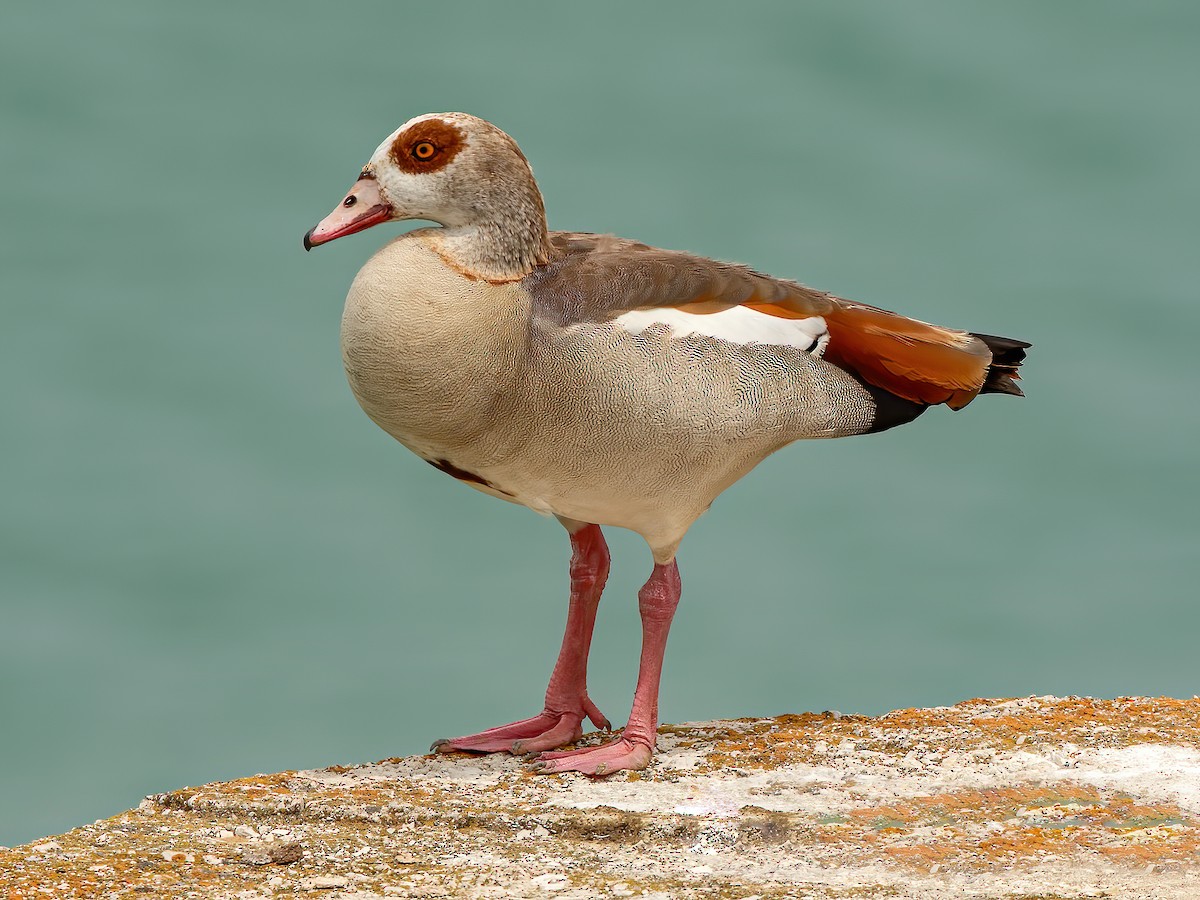
Overall sandy-brown to grey-brown plumage. Distinctive dark brown patch around the eye, often referred to as a 'chocolate eye-patch'. The breast is paler, often with a chestnut-brown patch in the center. The wings show a prominent white patch (speculum) bordered by black, and iridescent green secondaries, particularly visible in flight. The underwing coverts are white.
- 2
Beak shape
Shape and color of the bill: a key field mark.
Pinkish-red bill with a black tip and a black band near the base. Relatively short and stout.
- 3
Eye color
Iris color and any distinctive eye markings.
Yellowish-orange iris, surrounded by the dark brown eye-patch.
- 4
Leg color
Leg and foot color.
Pinkish-red to orange-red.
- 5
Distinguishing features
Standout features that separate this species.
The combination of the dark eye-patch, central breast patch, pinkish legs and bill, and the striking white and green wing patches in flight are highly distinctive. Its upright, goose-like posture is also characteristic.
- 6
Juvenile appearance
How young birds differ from adults.
Juveniles are duller overall, lacking the distinct eye-patch and central breast patch. Their plumage is more uniformly grey-brown, and their legs and bill are duller, often greyish-pink, gradually acquiring adult coloration.
- 7
Seasonal changes
Plumage variation between breeding and non-breeding seasons.
No significant seasonal plumage changes. Plumage remains consistent year-round, though it may appear slightly worn before molting.
- 8
Sexual dimorphism
How males and females differ.
Males and females are largely similar in plumage. Males tend to be slightly larger and have a more prominent, harsher call. Females often have a slightly darker eye-patch and a more guttural, honking call.
Key field marks
- Eye-patch. Look for the distinctive dark brown, almost chocolate-colored patch around the eye. This is a key field mark.
- Breast Patch. Observe the often prominent, darker chestnut-brown patch in the center of the breast. This can vary in intensity but is usually present in adults.
- Leg and Bill Color. Note the bright pinkish-red legs and the pinkish-red bill with a black tip and base band. This coloration is unique among similar species.
- Wing Pattern in Flight. In flight, the large white wing patches (speculum) bordered by black, and the iridescent green secondaries, are highly visible and diagnostic.
- Overall Plumage. The general sandy-brown to grey-brown body plumage, contrasting with the darker head markings and wing patterns, is characteristic.
- Posture and Gait. They often stand upright with a goose-like posture and walk with a confident, somewhat waddling gait.
- Vocalizations. Listen for the male's wheezy 'honk' or 'hiss' and the female's louder, guttural 'gagg-gagg-gagg' or 'honk-honk-honk'. Their calls are quite distinctive.
Explore the Egyptian Goose
Identify birds anywhere
Free on iOS, Android, and Web. Photo & sound identification, full species database, and your personal life list.