
Spotted a bird? Identify it instantly with the Birdby app
Open the appAbout
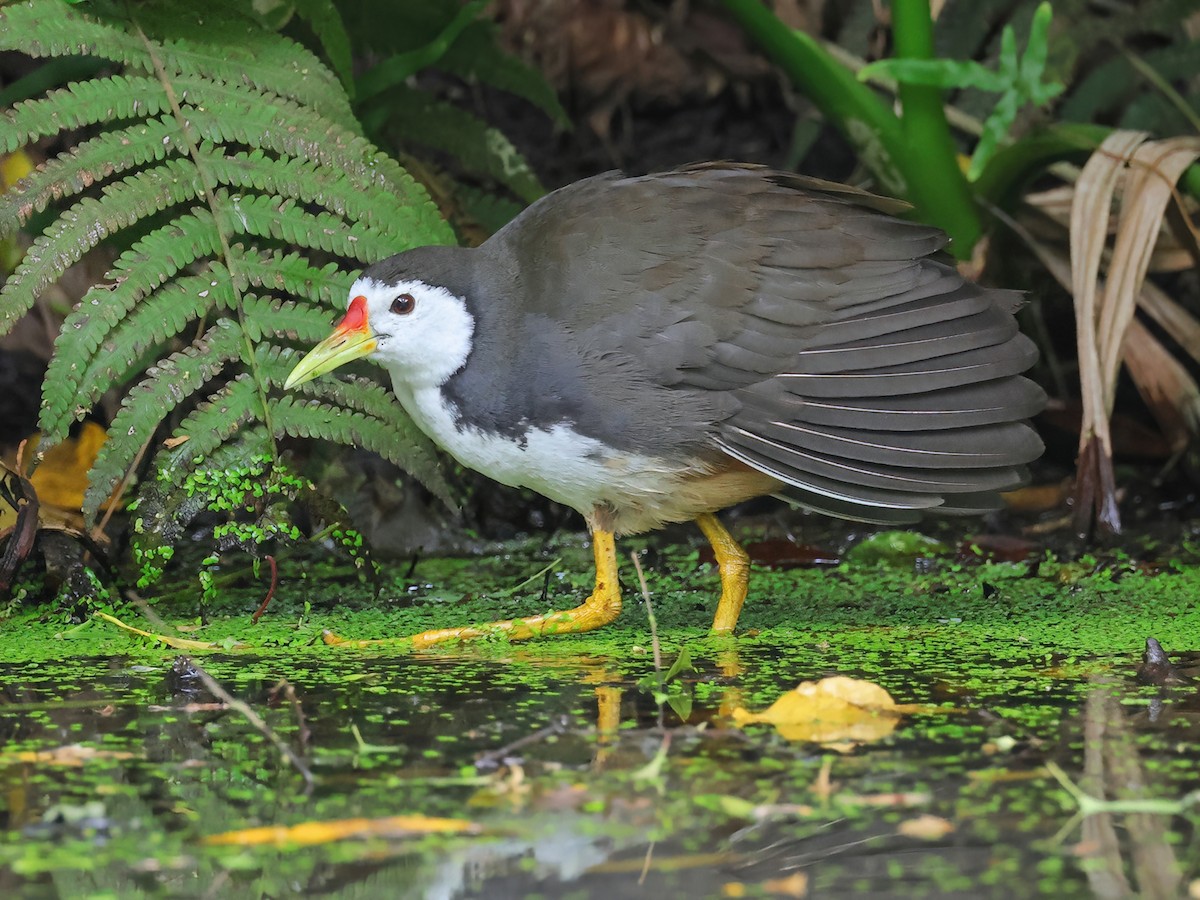
The White-breasted Waterhen is a medium-sized rail, easily recognized by its striking white face, breast, and belly contrasting sharply with its dark upperparts and rufous undertail coverts. It is a common and vocal resident of wetlands and marshes across its expansive Asian range.
Size & lifespan
- Length
- 28-33 cm (11-13 in)
- Wingspan
- 48-52 cm (19-20.5 in)
- Weight
- 150-250 g (5.3-8.8 oz)
- Lifespan
- Reported to be up to 5-8 years in the wild, though precise data is limited.
- Diet
- Omnivorous, feeding on a wide range of invertebrates (insects, worms, mollusks), small fish, amphibians, seeds, shoots, and grains.
Physical characteristics
- Plumage
- Adults have a prominent white patch covering the forehead, face, breast, and upper belly. The crown, nape, back, wings, and tail are slate grey to blackish. The lower flanks, vent, and undertail coverts are a distinctive rufous-chestnut. The primaries are brownish-black. There is no significant seasonal plumage variation.
- Beak shape
- Moderately long, robust, and slightly downcurved. The bill is greenish-yellow at the base, becoming dull yellow to horn-colored towards the tip. A prominent red frontal shield (extending onto the forehead) is characteristic.
- Eye color
- Iris is typically deep red to reddish-brown in adults.
- Leg color
- Long, strong legs and toes are yellow to greenish-yellow. The long toes are adapted for walking on soft ground and floating vegetation.
- Distinguishing features
- The combination of white face and breast, dark upperparts, rufous undertail, and red frontal shield is unique. Often seen flicking its rufous tail upwards.
- Juvenile appearance
- Juveniles are duller and browner overall. The white areas are sullied grey or buffish, and the dark upperparts are more brownish-black. The rufous undertail coverts are present but less vibrant. The bill is duller, lacking the bright red frontal shield, which develops with maturity.
- Seasonal changes
- No significant seasonal changes in plumage are reported for adults. Breeding plumage is essentially the same as non-breeding.
- Sexual dimorphism
- Males and females are generally monomorphic in plumage. Males may be slightly larger on average, but this is not a reliable field identification feature. Juveniles differ significantly.
How to identify
- 1
Plumage
Look for the stark white face, breast, and upper belly, contrasting sharply with slate-grey to blackish upperparts. The rufous-chestnut undertail coverts are a key field mark when the bird bobs its tail.
- 2
Bill and Frontal Shield
Note the greenish-yellow bill and the distinctive bright red frontal shield on the forehead.
- 3
Behavior
Often seen walking slowly and deliberately along water edges or skulking in dense vegetation. Frequently bobs its tail, revealing the rufous undertail coverts. Reluctant to fly.
- 4
Voice
Its loud, grating, repetitive 'krr-waak' or 'kurr-wak' call is highly distinctive and often heard before the bird is seen, especially at dawn, dusk, or at night.
- 5
Legs
Yellow to greenish-yellow long legs and toes are visible when it walks or wades.
Habitat & range
- Biomes
- Tropical and subtropical wetlands, including marshes, swamps, paddy fields, reed beds, mangroves, and dense vegetation near water bodies.
- Geographic range
- Widespread across much of Asia, from the Indian subcontinent, Sri Lanka, and Southeast Asia to southern China, Taiwan, the Philippines, and Indonesia. Resident throughout its range.
- Elevation range
- Primarily found in lowlands, typically up to 1,500 meters (about 4,900 feet), though occasionally higher in some areas.
- Preferred environments
- Prefers areas with dense emergent vegetation (e.g., reeds, sedges, rushes) near calm or slow-moving freshwater or brackish water. Also common in cultivated areas like rice paddies, garden ponds, and ditches.
Behavior
- Activity time
- Primarily crepuscular, most active during dawn and dusk. Also active during the day, especially in undisturbed areas. Vocalizations are often heard throughout the night.
- Feeding habits
- Forages along the edges of water bodies or within dense vegetation. It walks slowly and deliberately, probing in mud or picking items from the water surface and vegetation. It will also wade in shallow water. Occasionally takes food from open ground.
- Social behavior
- Usually solitary or found in pairs, especially during the breeding season. Can be seen in small, loose groups in suitable foraging areas. Generally shy and secretive, though habituated individuals may become quite bold.
- Flight pattern
- Generally reluctant to fly, preferring to skulk in cover. When flushed, it flies with dangling legs for a short distance before dropping back into vegetation. Flight is usually weak and fluttering, though it can fly strongly if migrating or moving between distant water bodies.
- Migration pattern
- Largely resident throughout its range. Some localized movements may occur in response to water levels or food availability. Northern populations (e.g., China) may undertake short-distance migrations to warmer regions during winter.
- Territoriality
- Territorial, especially during the breeding season. Pairs will defend their nesting and foraging areas from other waterhens and potential intruders.
Song & calls
- Song
- The primary song is a loud, grating, and repetitive 'krr-waak' or 'kurr-wak' often given in series, sometimes described as a 'crow-like caw' or 'pump-handle' call. It can be quite prolonged and is a characteristic sound of its wetland habitat.
- Call
- Also produces various other calls, including sharp 'kraak' or 'kek' alarm calls, softer clucks, and a 'churring' sound. Chick calls are soft peeping sounds.
- When they vocalize
- Most vocal during the breeding season, day and night, but particularly at dawn, dusk, and throughout the night, especially during moonlit periods. Its calls are often heard well before the bird itself is seen.
Breeding & reproduction
- Breeding season
- Varies geographically, generally coinciding with the rainy season or periods of abundant water. Typically from May to September in India, but can be year-round in tropical areas with suitable conditions.
- Nesting habits
- Nests are typically built on the ground, often hidden within dense marsh vegetation, reeds, sedges, or tall grasses near water. The nest is a bulky cup made of reeds, grass, and other plant material, often lined with finer grasses.
- Clutch size
- Typically 4-9 eggs, with 6-7 being common. Can sometimes lay up to 10-12 eggs, especially for replacement clutches.
- Egg description
- Eggs are typically 4-9, sub-elliptical or oval, varying in color from creamy-white to buff, often with reddish-brown or purplish-grey spots and blotches, particularly concentrated at the broader end.
- Incubation period
- Approximately 18-20 days. Both parents participate in incubation.
- Fledging period
- Chicks are precocial and nidifugous, meaning they are covered in down and able to leave the nest shortly after hatching (usually within a day or two), though they remain dependent on parents for food and protection for several weeks. Fledging to full independence takes about 6-8 weeks.
- Parental care
- Both parents care for the young, leading them to foraging areas and protecting them. Chicks forage independently but are fed by parents. They develop rapidly.
Where to find
Freshwater Marshes
Look in areas with dense emergent vegetation such as reeds, sedges, and cattails along the edges of ponds, lakes, and slow-moving rivers.
Paddy Fields
Common in active and fallow rice paddies, especially where there are overgrown sections or ditches.
Swamps and Mangroves
Can be found in swampy forests and the fringes of mangrove ecosystems, particularly areas with freshwater influence.
Gardens and Parks
In urban or suburban areas, they may inhabit well-vegetated garden ponds, drainage ditches, and overgrown water features.
Field tips
- Listen for Calls. Their loud vocalizations are often the easiest way to detect their presence. Learn their distinctive 'krr-waak' call.
- Be Patient. They are secretive birds. Find a suitable patch of wetland vegetation and wait quietly. They may eventually emerge from cover.
- Scan Edges. Focus on the interface between water and dense vegetation. They often forage along these edges.
- Use Binoculars. Essential for clear views when they are partially obscured by vegetation.
- Visit at Crepuscular Hours. Dawn and dusk are often the best times for observing them as they are most active then.
Similar species
Watercock
Gallicrex cinerea
The Watercock (especially the male in breeding plumage) is much larger and blacker with a red frontal shield and a fleshy red horn on the head. Females and non-breeding males are browner and streaked, lack the prominent white face/breast, and the rufous undertail is less striking than in the White-breasted Waterhen.
Brown Crake
Amaurornis akool
The Brown Crake is entirely dark brown above and grey below, lacking any white on the face or breast, and does not have the rufous undertail. It is also found in similar dense wetland habitats.
Ruddy-breasted Crake
Zapornia fusca
Smaller than the White-breasted Waterhen. Has rufous underparts but lacks the prominent white face and breast. Its upperparts are olive-brown. The undertail coverts are barred black and white, not solid rufous.
Quick facts
- Distinctive Feature:
- White face and breast with rufous undertail coverts.
- Vocal Habit:
- Loud, repetitive 'krr-waak' call.
- Habitat Preference:
- Dense wetland vegetation near water.
- Movement:
- Mostly resident, localized movements may occur.
- Diet Tendency:
- Omnivorous, feeds on various invertebrates and plant matter.
Fun facts
- Despite being common and widespread, their skulking nature often makes them heard more often than seen.
- The red frontal shield on its forehead is a key visual identifier and distinguishes it from many other rail species.
- They are highly adaptable and can be found in a surprising variety of wetland types, from natural marshes to artificial ponds and rice fields.
- Their long toes help distribute their weight, allowing them to walk on floating vegetation without sinking.
Scientific classification
- Kingdom
- Animalia
- Phylum
- Chordata
- Class
- Aves
- Order
- Gruiformes
- Family
- Rallidae
- Genus
- Amaurornis
- Species
- phoenicurus
Explore the White-breasted Waterhen
Identify birds anywhere
Free on iOS, Android, and Web. Photo & sound identification, full species database, and your personal life list.