
How to identify the White-breasted Waterhen
Amaurornis phoenicurus
Spotted a bird? Identify it instantly with the Birdby app
Open the appTo correctly identify the White-breasted Waterhen (Amaurornis phoenicurus), check each of these features. Birds can be tricky: habit, habitat, and call often confirm a sighting that a single photo cannot.
Size at a glance
- Length
- 28-33 cm (11-13 in)
- Wingspan
- 48-52 cm (19-20.5 in)
- Weight
- 150-250 g (5.3-8.8 oz)
Physical features to check
- 1
Plumage
Overall feather coloration and pattern.
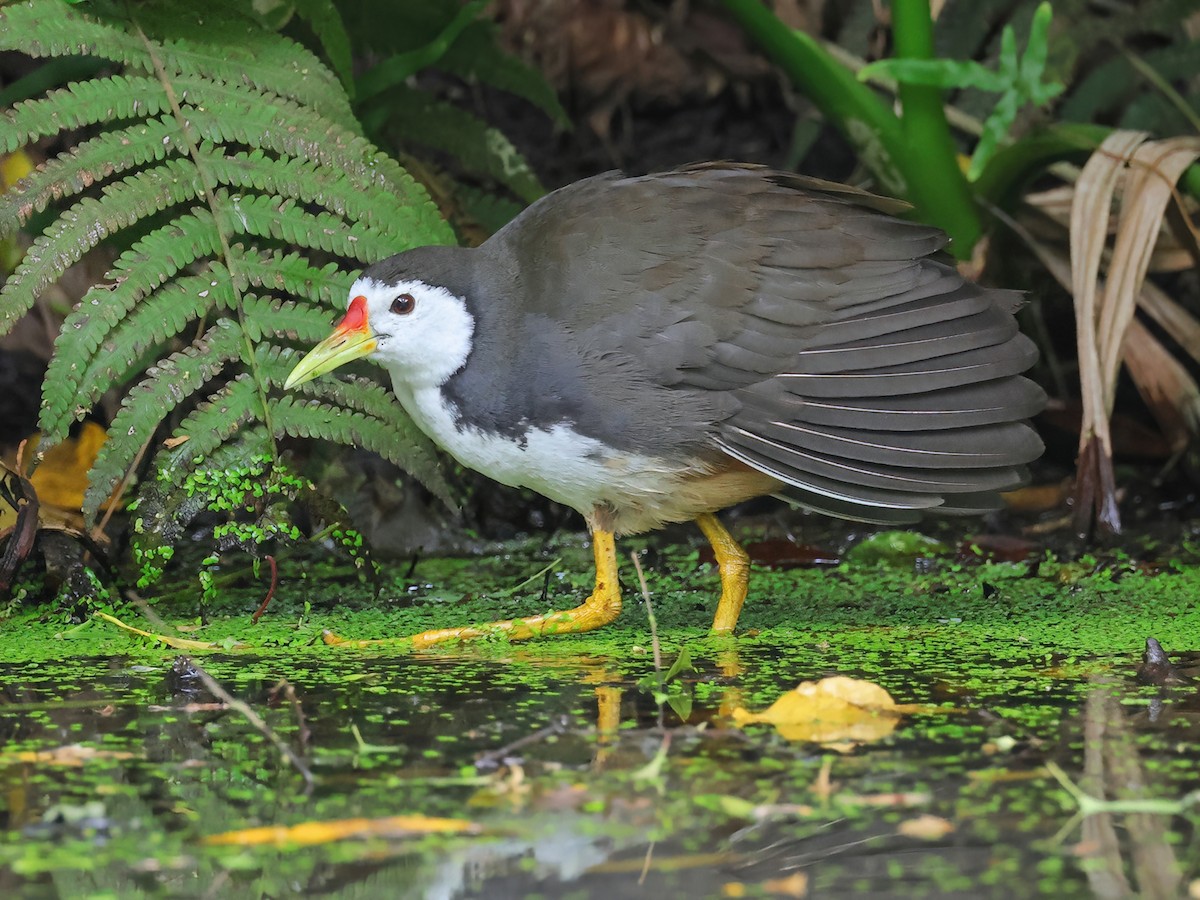
Adults have a prominent white patch covering the forehead, face, breast, and upper belly. The crown, nape, back, wings, and tail are slate grey to blackish. The lower flanks, vent, and undertail coverts are a distinctive rufous-chestnut. The primaries are brownish-black. There is no significant seasonal plumage variation.
- 2
Beak shape
Shape and color of the bill: a key field mark.
Moderately long, robust, and slightly downcurved. The bill is greenish-yellow at the base, becoming dull yellow to horn-colored towards the tip. A prominent red frontal shield (extending onto the forehead) is characteristic.
- 3
Eye color
Iris color and any distinctive eye markings.
Iris is typically deep red to reddish-brown in adults.
- 4
Leg color
Leg and foot color.
Long, strong legs and toes are yellow to greenish-yellow. The long toes are adapted for walking on soft ground and floating vegetation.
- 5
Distinguishing features
Standout features that separate this species.
The combination of white face and breast, dark upperparts, rufous undertail, and red frontal shield is unique. Often seen flicking its rufous tail upwards.
- 6
Juvenile appearance
How young birds differ from adults.
Juveniles are duller and browner overall. The white areas are sullied grey or buffish, and the dark upperparts are more brownish-black. The rufous undertail coverts are present but less vibrant. The bill is duller, lacking the bright red frontal shield, which develops with maturity.
- 7
Seasonal changes
Plumage variation between breeding and non-breeding seasons.
No significant seasonal changes in plumage are reported for adults. Breeding plumage is essentially the same as non-breeding.
- 8
Sexual dimorphism
How males and females differ.
Males and females are generally monomorphic in plumage. Males may be slightly larger on average, but this is not a reliable field identification feature. Juveniles differ significantly.
Key field marks
- Plumage. Look for the stark white face, breast, and upper belly, contrasting sharply with slate-grey to blackish upperparts. The rufous-chestnut undertail coverts are a key field mark when the bird bobs its tail.
- Bill and Frontal Shield. Note the greenish-yellow bill and the distinctive bright red frontal shield on the forehead.
- Behavior. Often seen walking slowly and deliberately along water edges or skulking in dense vegetation. Frequently bobs its tail, revealing the rufous undertail coverts. Reluctant to fly.
- Voice. Its loud, grating, repetitive 'krr-waak' or 'kurr-wak' call is highly distinctive and often heard before the bird is seen, especially at dawn, dusk, or at night.
- Legs. Yellow to greenish-yellow long legs and toes are visible when it walks or wades.
Explore the White-breasted Waterhen
Identify birds anywhere
Free on iOS, Android, and Web. Photo & sound identification, full species database, and your personal life list.