
Spotted a bird? Identify it instantly with the Birdby app
Open the appAbout
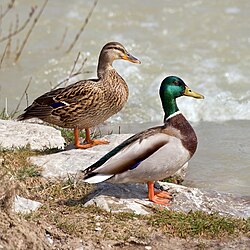
The Mallard is a dabbling duck that is the ancestor of most domestic duck breeds. It is highly adaptable and widely distributed across the Northern Hemisphere, inhabiting a variety of wetland environments. Males are distinctively colored, while females are mottled brown, providing camouflage during nesting.
Size & lifespan
- Length
- 50-65 cm (20-26 in)
- Wingspan
- 81-98 cm (32-39 in)
- Weight
- 720-1580 g (1.6-3.5 lbs)
- Lifespan
- 5-10 years in the wild (up to 20 years in captivity)
- Diet
- Omnivore
Physical characteristics
- Plumage
- Male (drake) in breeding plumage: iridescent green head and neck, white neck ring, chestnut breast, grey flanks, black rear, and a curled black tail feather. Female (hen): mottled brown plumage with a dark eye-stripe and an orange bill with dark markings. Both sexes have a distinctive iridescent blue speculum (wing patch) bordered by white.
- Beak shape
- Spatulate (flat and broad) for dabbling. Male's bill is yellowish-green, female's is orange with a dark saddle or blotches.
- Eye color
- Dark brown.
- Leg color
- Orange to reddish-orange in both sexes.
- Distinguishing features
- The male's green head and white neck ring are unmistakable. The blue speculum on the wing is a key identifier for both sexes in flight or when wings are slightly open. The female's mottled brown plumage with the orange bill and dark markings helps distinguish her from other female dabbling ducks.
- Juvenile appearance
- Juveniles resemble adult females, but are often duller and may have less distinct markings. Young males gradually acquire their adult male plumage over their first year.
- Seasonal changes
- Males undergo an 'eclipse' plumage after breeding, typically from June to September. During this period, they resemble females, losing their vibrant green head and chestnut breast, becoming mottled brown. They retain the yellow bill and blue speculum, which can aid identification. They regain their breeding plumage in late summer/early autumn.
- Sexual dimorphism
- Pronounced. Males are much more brightly colored than females, especially during the breeding season. Females are cryptically colored for camouflage.
How to identify
- 1
Male Plumage
Look for the iridescent green head, white neck ring, chestnut breast, and grey body. The curled black tail feather is also distinctive.
- 2
Female Plumage
Observe the mottled brown body, dark eye-stripe, and the orange bill with dark blotches or a saddle. The blue speculum is crucial.
- 3
Speculum (Wing Patch)
Both sexes display an iridescent blue speculum bordered by white, visible in flight or when the wings are slightly open. This is a key field mark.
- 4
Bill Color
Males have a yellowish-green bill; females have an orange bill with dark markings. This helps differentiate them from other dabbling ducks.
- 5
Vocalization
Listen for the loud, descending 'quack' of the female and the softer, reedy 'kwek-kwek-kwek' of the male.
- 6
Behavior
Observe their dabbling feeding behavior, tipping head-first into shallow water. Their ability to take off vertically from water is also characteristic.
Habitat & range
- Biomes
- Wetlands, including freshwater and brackish marshes, ponds, lakes, rivers, estuaries, and coastal areas. Also found in urban parks and agricultural lands.
- Geographic range
- Holarctic distribution, found across North America, Europe, Asia, and parts of North Africa. Introduced to Australia, New Zealand, and other regions.
- Elevation range
- Sea level to approximately 2,000 meters (6,500 feet), though typically found at lower elevations.
- Preferred environments
- Shallow, calm waters with emergent vegetation for cover and foraging. Highly adaptable to human-modified environments like city parks and golf courses.
Behavior
- Activity time
- Diurnal, but can be active at night, especially during migration or when foraging in areas with human disturbance.
- Feeding habits
- Dabbling duck, feeding by tipping forward to submerge its head and neck, sifting food from the water or mud with its bill. Also grazes on land. Diet includes seeds, aquatic vegetation, insects, larvae, worms, small crustaceans, and sometimes small fish.
- Social behavior
- Highly social, often found in large flocks outside the breeding season. During breeding, pairs become more territorial, though often nest in loose colonies.
- Flight pattern
- Strong, direct flight with rapid wingbeats. Can take off vertically from water. Often flies in V-formations during migration.
- Migration pattern
- Partially migratory. Northern populations migrate south for winter, while southern populations may be resident or undertake shorter movements. Migration occurs in large flocks, typically at night.
- Territoriality
- Males defend a small territory around the female during the breeding season, but not a nesting territory. Females defend the nest site.
Song & calls
- Song
- Males have a soft, reedy 'quack' or 'rab-rab' call, often described as a 'kwek-kwek-kwek'. They also make a low-pitched 'raeb' sound. Females produce the classic loud, descending 'quack-quack-quack-quack-quack' series, which is more varied and frequent than the male's calls.
- Call
- The female's 'quack' is the most recognizable duck call. Both sexes also produce alarm calls, often a series of rapid quacks, and various grunts and whistles during courtship or social interactions.
- When they vocalize
- Vocalize year-round, with increased calling during courtship and breeding season. Females are particularly vocal when leading ducklings or when alarmed.
Breeding & reproduction
- Breeding season
- Varies geographically, typically March to July in temperate regions. Can breed earlier in warmer climates or later if a first clutch fails.
- Nesting habits
- Nests are typically built on the ground, often concealed in dense vegetation near water. The female constructs a shallow depression lined with grass, leaves, and down plucked from her breast.
- Clutch size
- Usually 8-13 eggs, but can range from 1 to 18.
- Egg description
- 8-13 eggs, typically pale greenish-buff to grayish-buff, sometimes tinged blue. Smooth, non-glossy. Average size: 57 x 41 mm.
- Incubation period
- 27-28 days, incubated solely by the female.
- Fledging period
- Ducklings are precocial, leaving the nest within 24 hours of hatching. They are able to fly at 50-60 days old.
- Parental care
- Only the female cares for the ducklings, leading them to food and protecting them from predators. Males typically leave the female after incubation begins.
Where to find
Urban Parks and Ponds
Mallards are highly accustomed to humans and are frequently found in city parks, botanical gardens, and any pond or lake within urban areas.
Wetlands and Marshes
Their natural habitat includes freshwater and brackish marshes, swamps, and shallow wetlands with abundant vegetation.
Rivers and Lakes
Common along slow-moving rivers, large lakes, and reservoirs, especially in areas with vegetated banks.
Coastal Areas
Can be found in estuaries, tidal flats, and sheltered coastal bays, particularly during migration or winter.
Field tips
- Look for them in shallow water. Mallards are dabbling ducks, so they prefer shallow water where they can tip their heads down to feed without fully submerging.
- Listen for their calls. The female's distinctive 'quack' is often the first indication of their presence, even before you see them.
- Observe their behavior. Watch for their characteristic head-dipping while feeding or their strong, direct flight. They are often seen preening or resting on banks.
- Check for the blue speculum. This iridescent blue patch on the wing is a reliable identifier for both sexes, especially when they stretch their wings or are in flight.
- Visit during breeding season for pairs. During spring and early summer, you're more likely to see pairs, with the brightly colored male accompanying the female.
Similar species
American Black Duck
Anas rubripes
Similar in size and shape, but the American Black Duck is uniformly dark sooty-brown with a paler head and a dark bill. It lacks the Mallard's iridescent green head (male) or mottled brown pattern (female) and has a purplish speculum, not blue.
Mottled Duck
Anas fulvigula
Resembles a female Mallard but is generally darker overall, with a more uniform brown body and a brighter orange bill (especially in males) with fewer or no dark markings. The speculum is blue-green, often without distinct white borders.
Mexican Duck
Anas diazi
Very similar to the female Mallard, often considered a subspecies of Mallard. It is generally darker brown, with a less distinct eye-stripe and a more uniformly yellow bill (male) or duller orange bill (female) with less dark mottling. The speculum is blue-green with narrow white borders.
Gadwall
Mareca strepera
Both sexes are generally grey-brown. Males have a black rear and a white speculum (not blue). Females are mottled brown but lack the Mallard's orange bill with dark markings and have a white speculum.
Quick facts
- Ancestor of Domestic Ducks:
- Most domestic duck breeds originated from the Mallard.
- Dabbling Duck:
- Feeds by tipping its head into shallow water, not diving.
- Sexual Dimorphism:
- Males are brightly colored, females are mottled brown.
- Blue Speculum:
- Iridescent blue wing patch bordered by white, present in both sexes.
- Global Distribution:
- Most widespread duck species in the Northern Hemisphere.
Fun facts
- Mallards are highly adaptable and can hybridize with many other duck species, leading to a variety of mixed-breed ducks, especially in urban areas.
- The male Mallard's curled tail feather is a unique feature among dabbling ducks and is a good identifier for drakes.
- Mallard ducklings are precocial, meaning they are born with open eyes, covered in down, and can walk and feed themselves within hours of hatching.
- Despite their commonness, Mallards play an important ecological role as seed dispersers and as a food source for various predators.
- The Mallard's scientific name, 'Anas platyrhynchos', translates roughly to 'flat-billed duck'.
Scientific classification
- Kingdom
- Animalia
- Phylum
- Chordata
- Class
- Aves
- Order
- Anseriformes
- Family
- Anatidae
- Genus
- Anas
- Species
- Anas platyrhynchos
Explore the Mallard
Identify birds anywhere
Free on iOS, Android, and Web. Photo & sound identification, full species database, and your personal life list.