
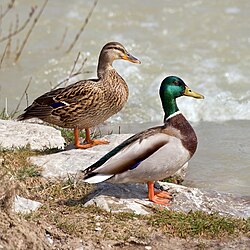
Where does the Mallard live?
Anas platyrhynchos
Spotted a bird? Identify it instantly with the Birdby app
Open the appThe Mallard lives in specific habitats and regions. Knowing where, and when, to look improves your chances of a successful sighting.
Biomes
Wetlands, including freshwater and brackish marshes, ponds, lakes, rivers, estuaries, and coastal areas. Also found in urban parks and agricultural lands.
Geographic range
Holarctic distribution, found across North America, Europe, Asia, and parts of North Africa. Introduced to Australia, New Zealand, and other regions.
Preferred environments
Shallow, calm waters with emergent vegetation for cover and foraging. Highly adaptable to human-modified environments like city parks and golf courses.
Elevation range
Sea level to approximately 2,000 meters (6,500 feet), though typically found at lower elevations.
Where to look
Urban Parks and Ponds
Mallards are highly accustomed to humans and are frequently found in city parks, botanical gardens, and any pond or lake within urban areas.
Wetlands and Marshes
Their natural habitat includes freshwater and brackish marshes, swamps, and shallow wetlands with abundant vegetation.
Rivers and Lakes
Common along slow-moving rivers, large lakes, and reservoirs, especially in areas with vegetated banks.
Coastal Areas
Can be found in estuaries, tidal flats, and sheltered coastal bays, particularly during migration or winter.
Field tips
- Look for them in shallow water. Mallards are dabbling ducks, so they prefer shallow water where they can tip their heads down to feed without fully submerging.
- Listen for their calls. The female's distinctive 'quack' is often the first indication of their presence, even before you see them.
- Observe their behavior. Watch for their characteristic head-dipping while feeding or their strong, direct flight. They are often seen preening or resting on banks.
- Check for the blue speculum. This iridescent blue patch on the wing is a reliable identifier for both sexes, especially when they stretch their wings or are in flight.
- Visit during breeding season for pairs. During spring and early summer, you're more likely to see pairs, with the brightly colored male accompanying the female.
Migration
Partially migratory. Northern populations migrate south for winter, while southern populations may be resident or undertake shorter movements. Migration occurs in large flocks, typically at night.
Explore the Mallard
Identify birds anywhere
Free on iOS, Android, and Web. Photo & sound identification, full species database, and your personal life list.